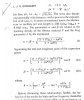
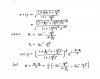
I said that in response to MJKing's question. The key to the Bradbury model is the derivation of the drag parameters of various kinds of fiber materials. Bradbury conducted the proper experiment to validate his model. MJKing may be an engineer, but he demonstrated that he does not understand the fluid dynamics of air moving in a fiber filled tube. He kept saying that the Bradbury model does not work, and sound speed was not reduced in long fiber wool filled tube. But he never showed evidence that he conducted sound speed measurements, nor show proof that Bradbury did not derive the right model to calculate drag parameters.
All these work by Bailey and Bradbury showed that why ONLY the proper dimensioned long fiber wool provides the right kind of acoustic loading. But mathematical knowledge of linear algebra, complex number etc. is not necessary to design good loudspeakers. But trying to make a simple filter model to descirbe the transmission line enclosure like MJKing did just does not work. I suspect that people built loudspeaker enclosures based on MJKing method will never enjoy the deep and tight bass that the Bailey design can provide. But they should get the bass of a vented, large sized enclosure.
BTW, I am currently using a pair of NHT Super One as the front speakers and argumented by a pair of Wharfedale for the low end. Wharfedale called their bi-amp Monitor M-138 model "transmission line" too, but they are not. It was an aperiodic loaded enclosure with twin 7" woofers. The bass does not go as deep, nor as tight as the Bailey TL. But they are better than many commercial subwoofer boxes on the market. I am an audio hobbyist who likes to experiment with DIY equipments, but my engineer nature sometimes gets in the way. (Sorry that I said I was an engineer again.)
Ken, I respect you because of the sound of the Super One that I hear. It is NOT easy to do it right and keep the cost down.