

You are using an out of date browser. It may not display this or other websites correctly.
You should upgrade or use an alternative browser.
You should upgrade or use an alternative browser.
Untapped Potential: Heath's W-5M
- Thread starter dcgillespie
- Start date


trobbins
Super Member
Perhaps the Picoscope related measurement issue is due to the grounding scheme inside the amp, given that a typical scope setup may have the AWG ground, and two probe grounds, connecting to up to three different 0V points within the amp.
When I do measurements with my Picoscope, I connect the input signal probe's ground to the same point as the AWG connections ground at the signal input jack/socket of the amp, but I only connect the output signal probe's tip to the speaker terminal and leave that probe's ground pin disconnected (as I know the speaker ground terminal is typically some physical and electrical distribution distance from the signal input socket. That then avoids a ground loop forming due to probing. I find the Picoscope is fairly insensitive to any external mains earth loop between my main desktop PC and the amp, and have not had a need as yet to use may laptop to power the Picoscope to avoid a mains earth loop (like I do when using my soundcard and REW which is a lot more sensitive to such mains loops). I also try and make any internal amp 0V link to chassis at the signal input socket end of any 0V distribution scheme
When I do measurements with my Picoscope, I connect the input signal probe's ground to the same point as the AWG connections ground at the signal input jack/socket of the amp, but I only connect the output signal probe's tip to the speaker terminal and leave that probe's ground pin disconnected (as I know the speaker ground terminal is typically some physical and electrical distribution distance from the signal input socket. That then avoids a ground loop forming due to probing. I find the Picoscope is fairly insensitive to any external mains earth loop between my main desktop PC and the amp, and have not had a need as yet to use may laptop to power the Picoscope to avoid a mains earth loop (like I do when using my soundcard and REW which is a lot more sensitive to such mains loops). I also try and make any internal amp 0V link to chassis at the signal input socket end of any 0V distribution scheme

Final thought on the Pico ground clip. The com side of the sig gen cable is connected to com of the scope probe connections so I don't think the probe ground needs to be connected with the sig gen providing the ground ref.
That has been my experience.

zenith2134
Lunatic Member
Hey all, I've never heard a W5M, but have heard and used an AA-100 integrated. My question is how close would the 100 get?
I have a line on one which was recapped in 2018 and looks very good. JJ outputs which are the only thing holding me back; coupled with the fact that I've been plenty happy w/ my mosfet amps.
Finding W5Ms and then servicing them correctly is a much costlier endeavor but is it entirely worth it versus the AA-100?
I have a line on one which was recapped in 2018 and looks very good. JJ outputs which are the only thing holding me back; coupled with the fact that I've been plenty happy w/ my mosfet amps.
Finding W5Ms and then servicing them correctly is a much costlier endeavor but is it entirely worth it versus the AA-100?

Can't really say. The W5's as modified/improved by Dave Gillespie are something else. I suspect that with a good separate line stage the W5's would best an AA-100. The AA-100 has excellent output transformers which can be made into a great stand alone power amp.
Last edited:
Hey all, I've never heard a W5M, but have heard and used an AA-100 integrated. My question is how close would the 100 get?
I have a line on one which was recapped in 2018 and looks very good. JJ outputs which are the only thing holding me back; coupled with the fact that I've been plenty happy w/ my mosfet amps.
Finding W5Ms and then servicing them correctly is a much costlier endeavor but is it entirely worth it versus the AA-100?
Not to knock the AA-100, never heard one but I'm sure that properly restored, it's a nice unit. But there's really no comparison with a W-5. The W-5 is a classic Williamson design, one of the last to be manufactured, which has a signature all its own--completely natural and linear, all-triode (if you consider ultralinear as being very close to triode) and mostly Class A operation. Instruments and voices have a "wholeness" and solidity that's hard to beat, IMO. Add the Peerless output transformers and you have a highly distinctive sound--world class, IMO. The AA-100 uses a Dynaco-style pentode/triode front end and operates in Class AB. It's more of a "typical" 1960-ish Scott or Eico type integrated. Musical, but lacking the organic sound of a Williamson.
If restoration work is not in your wheelhouse yet, then a pair of used W-5s in questionable condition (and they are nearly all questionable, IMO) might be a stretch and a restored AA-100 is probably a safer bet. OTOH, if you want something with real magic, and you can find someone to help you source and rebuild a pair of W-5's, then you'll have something really special.
Last edited:
zenith2134
Lunatic Member
Thanks for the info. Tube restos are definitely in my wheelhouse, but I haven't seen many clean W5Ms around. Saw some very high priced ones on ebay in, like you said, questionable shape.
If I pick up the -AA100 I'll make a new thread
If I pick up the -AA100 I'll make a new thread
There is a pretty good restoration thread on AK for the AA-100. There is also a neat Fisher SA-100 clone thread that uses AA-100 output transformers.
this is the resto thread by GordonW
and the SA-100 clone thread by Dave Gillespie
Have fun,
John
this is the resto thread by GordonW
THE end-all FIX for the Heathkit AA-100 integrated amp.
Well, I'm officially done. Some of you are aware of the trouble some folks have encountered, trying to get Heathkit AA-100 integrated amps to sound good. It's a real puzzle, on the face of it. Good stuff in there- Mullard 5AR4/GZ34, 12AX7s and EF86s, Amperex/Mullard 7199s and Westinghouse 7591...
audiokarma.org
and the SA-100 clone thread by Dave Gillespie
Teaser Pics -- Fisher SA-100 clone in progress
With a number of members working on some version of this amp -- either by way of circuit, use of Fisher transformers, or just that it's a 6BQ5/7189 amp, I thought I would mark my progress on my own version of this great amp. I had mentioned the basic features in a thread kpaxfaq started for...
audiokarma.org
Have fun,
John
I would not compare the W5 and the AA100. Not only are they 2 different units, they are intended for different purposes. When introduced, the W5 was Heath's beat tube amplifier. The AA-100 was an integrated amplifier (let down by it's preamp stage). A properly restored W5 is one of the most natural sounding amplifiers you will encounter. It will initially sound unremarkable, then you will hear something- voice, door closing, drum hit and jump from your chair because it sounded shockingly real. Bass is deep, tight and fast, with excellent transient response. A car door slamming sounds just like you would expect without embellishment or overhang. Treble and instrument overtones seem to hang in the air then slowly decay as they do in real life. The AA-100 can be made to sound excellent, however you are still aware that you are listening to an amplifier. Best parts of the AA-100 are the amplifier circuit and output transformers.
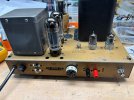
Another pair is alive. This pair with the larger 16458 outputs. On these I have used the @TriodeLuvr output impedance selector scheme. Works fine and allows the use of modern banana jacks. They sound just like the previous two pair I have done for friends, which is great. Clean, clear, great bass, airy highs, etc.

maxhifi
Addicted Member
Question @dcgillespie :
To eliminate the output pulse, you've suggested installing a small relay to interrupt B+. I'm curious, would using a relay to instead short the 16 ohm tap to ground, and therefore interrupt the NFB signal accomplish the same thing?
To eliminate the output pulse, you've suggested installing a small relay to interrupt B+. I'm curious, would using a relay to instead short the 16 ohm tap to ground, and therefore interrupt the NFB signal accomplish the same thing?
Question @dcgillespie :
To eliminate the output pulse, you've suggested installing a small relay to interrupt B+. I'm curious, would using a relay to instead short the 16 ohm tap to ground, and therefore interrupt the NFB signal accomplish the same thing?
Dave will surely provide the correct answer, but it was my impression that the turn-off pulse was potentially damaging to the output tubes. Shorting the secondary wouldn't prevent this, would it?
maxhifi
Addicted Member
Dave will surely provide the correct answer, but it was my impression that the turn-off pulse was potentially damaging to the output tubes. Shorting the secondary wouldn't prevent this, would it?
I think he explained that the pulse was caused by the negative feedback becoming positive as voltages in the amplifier collapse. Shorting the secondary would kill the negative feedback signal, so perhaps the pulse too? Then I'd avoid having to use a relay at high voltage it probably was never designed for.
There doesn’t seem to be a turn off pulse after implementing all of his mods to the W5. I’ve done 3 pair so far.
Edit: The reason for the turn off pulse in the original circuit is explained in post #2 of this thread. It does not occur in the modified circuit.
Edit: The reason for the turn off pulse in the original circuit is explained in post #2 of this thread. It does not occur in the modified circuit.
Last edited:
maxhifi
Addicted Member
There doesn’t seem to be a turn off pulse after implementing all of his mods to the W5. I’ve done 3 pair so far.
I'm not planning to do the full blown set of mods, I'd like to retain the original circuit and cathode bias, but I do want to do something reasonable to protect the transformers.



And used literally countless times over the last 30+ years.
Dave
Dave