SOTA handed Linn their lunch and there is clear evidence of it over and over and over
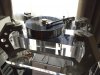
SOTA Star Sapphire turntable Anthony H. Cordesman, May 1986
The competition at the top has been pretty stiff in recent years. The Entec Granite ($6000), Goldmund Studio ($2900), Goldmund Reference ($14,900), Micro Seiki SX-5000 II ($5000),
Oracle Delphi Mk.II ($1250), and VPI HW-19 Mark II ($885) are all superb turntables. Any of them would grace any system to the point where even the most demanding audiophile (though not divinity) could live happily with the result for years.
Nevertheless, if I were going to invest in my last turntable, I would currently invest in the SOTA Star Sapphire with the acrylic Supermat ($1600), and the SOTA Electronic Flywheel ($300) or VPI Powerline Conditioner ($300).
The key to the SOTA's success seems to be the combination of vacuum clamping with the kind of hard plastic surface/metal-filled turntable platter pioneered by Goldmund, and now used in different combinations by both SOTA and VPI. The result is superior to all the competition in its ability to couple the largest number of records to the platter in a manner that produces the best possible combination of detail, transparency, freedom from noise, and natural musicality. The damping of the record seems nearly perfect, without any loss of life and dynamics, or any noticeable addition of coloration—problems that emerge to a slight degree in the regular Star Sapphire, and to a significant degree in the regular SOTA Sapphire without its Supermat and an appropriate clamp.
Further, the SOTA Star Sapphire does a better job of keeping the record flat all over its surface. The VPI, Oracle, and Goldmund never permit you to set up as consistent a cartridge azimuth adjustment with as wide a range of records as does the SOTA Star Sapphire; clampless designs
like the Linn and Pink Triangle don't even come close. With today's stylus designs and straightline tonearms, this superior geometry seems to result in notably more transparent sound.
As for overall sound character, the SOTA Star Sapphire and VPI HW-19 II both have excellent bass, equal to the best high-mass Japanese designs and to the most expensive Goldmunds. The VPI may be slightly better than the SOTA in terms of its resolution of deep bass, but the
SOTA Star Sapphire experiences no loss of low bass, as do the Oracle Delphi and virtually all British suspension turntables.
Further, the various SOTA models remain freer of acoustic breakthrough problems under real-world installation conditions than any other turntables I know of—at any price. This is critical in many listening rooms, particularly where the turntable must be in the same room as full-range speakers.
The VPI, Oracles, and Goldmunds are also quite good in terms of acoustic breakthrough, but never quite as good in difficult rooms. Most British turntables—including the Linn and Pink Triangle—simply don't come close.
Read more at
http://www.stereophile.com/content/...hony-h-cordesman-may-1986#EZUBDVHCqlseFFRW.99
SOTA Star Sapphire turntable
Sound Quality
A Sumiko MDC-800 tonearm and Talisman S cartridge were used for evaluating the Star. The rest of the system included the Dayton Wright MG-l0 Mk.2 speakers, the BEL 2002 amplifier, and the Dayton Wright head-amp and preamp. For this review the Star was compared with the standard SOTA turntable. Since the standard SOTA has not been reviewed in
Stereophile, a few words are in order. I acquired one in the fall of 1982.
The superiority of the SOTA over the Linn and Thorens 'tables I had previously used was apparent after only a short listening session. The SOTA had a cleaner, more detailed midrange, tighter and more extended bass, and far less harshness or glassiness in the high frequencies. Most important, the SOTA had significantly less coloration than the other 'tables. Particularly noticeable was the absence of the upper bass/lower midrange hump which plagues the Linn. The only immediately apparent anomaly was a mild hardness in the upper midrange which occasionally made the music sound overexcited. This problem was eliminated by a change to the new SOTA mat which was introduced last summer.
The SOTA was also a more convenient and practical turntable.
Lack of isolation from vibration was a constant problem with the Thorens and an occasional problem with the Linn. Placement is critical with both 'tables; sound quality could vary significantly depending upon location and sturdiness of support. The SOTA was virtually unaffected by placement. It could be located anywhere in the listening room and on any piece of furniture strong enough to support its 50 lb weight. The additional advantages of automatic speed selection and adjustable pitch soon became appreciated conveniences. Even better, the SOTA required no further adjustment once it was set up.
Overall Quality
We come now to the final evaluation: Is the Star worth its extra cost? On the basis of sound quality alone, I have no doubt that the Star is well worth its asking price when used in a state-of-the-art system.
The improvements over the sound of the standard SOTA are subtle, but they become more and more obvious with extended listening. It is clearly better-sounding than any of the British 'tables I have heard. The Star is a reference-quality turntable; I consider it state-of-the-art, In view of the cost of other premium turntables, the Star's price certainly seems reasonable and must be considered as offering excellent value for the money
Read more at
http://www.stereophile.com/turntables/284sotastar/index.html#K3fsFQah46gpbjX0.99
Sorry Linn owners, just enjoy your fine deck and leave your fallacies as best ever to your self. I don't go running around thinking or saying a SOTA Star is the best....because it isn't it's just another fine table.






 .


