• The move to the new server is done. There are some software and database maintenance updates in process. This has us passing the hat around to help out. We appreciate any donations. Seriously, even a dollar helps. The payment page may be found here - https://www.audiokarma.org/support.html

Why are so many old DAC chips still being used in new gear!

A DAC chip isn't simply a 'computer chip', a pure logic device. It is a mixed signal device, with digital at one 'end', and analogue at the other. The conversion to analogue part is where the 'magic' really happens, and where the careful design and layout is required to isolate digital from analogue. The conversion techniques have changed over the years, from parallel R2R, through single bit PDM/PPM, to single-bit SD to multi-bit SD. The move away from parallel R2R was driven by the difficulty (and hence cost) of maintaining relative bit precision in the network beyond 16 bits.

I was hoping that you would drop in to this thread to share you expertise.
 
Last edited:
A DAC chip isn't simply a 'computer chip', a pure logic device. It is a mixed signal device, with digital at one 'end', and analogue at the other. The conversion to analogue part is where the 'magic' really happens, and where the careful design and layout is required to isolate digital from analogue. The conversion techniques have changed over the years, from parallel R2R, through single bit PDM/PPM, to single-bit SD to multi-bit SD. The move away from parallel R2R was driven by the difficulty (and hence cost) of maintaining relative bit precision in the network beyond 16 bits.
I was primarily referring to older DAC designs which are still in production and actively used today, per the OP’s question.
 
And I'm fairly certain that most of them don't care. I know that I don't and can't think of a good reason to care.
Which is exactly the point. What you should care about is the device’s performance in the specific application, not if the design is “new”. This is why some designers may choose older DAC designs for new products.
 
I do not think cost is the driver since the parts we are talking about for most of the circuit are cheap jely bean parts.
Do a google search on “DAC chip cost”. For my results, on DigiKey alone I could easily see piece costs for audio DACs from $6 to $20. Not exactly jelly beans!
 
I have a few thoughts on this:

Quantization error plays a part in the limitations of a DAC. Basically, the amount of bits that a DAC has determines what voltage it can go to. As an example, lets say you have a 4 bit DAC. That's going to give you the ability to have 0, 1, 2, 4, or 8 binary digits or in effect 0 through 15 as numbers. If you increment through that DAC it will increase voltage at .0625volts per input change. Without going to a higher number of bits, going from 1 to 2 (decimal) will only be going from .0625 to .125 volts, from 2 to 3 will be from .125 to .1875 volts and so on. Such a DAC would never be able to output say .1 volts because it doesn't have the resolution. As said previously, this problem was solved a long time ago.

The second part of the thought is that although you're converting something digital, the component its self still lives in the analog world. That means that internal effects that make the component not perfect will alter the results accordingly. Stray capacitances, inductances, tolerance variations etc.

Besides that unless something has changed (it may well have far as I know) the way that DACs work is a network of internal dividers anyways. See the second page in this Analog Devices PDF. I mean, theoretically you could build your own DAC if you really wanted to by doing this.

https://www.analog.com/media/en/training-seminars/tutorials/MT-014.pdf
 
I was primarily referring to older DAC designs which are still in production and actively used today, per the OP’s question
It doesn't matter how old the design is; all DACs are mixed signal devices. It is inherent in their function.

Some older designs, still in production, have become 'jelly bean parts', available cheaply.
 
Besides that unless something has changed (it may well have far as I know) the way that DACs work is a network of internal dividers anyways.

Audio DACs released in the last 30 years use a different D/A method called delta-sigma modulation. In its pure form it’s technically a 1-bit DAC.
 
Why old DACs still being used? -Well because the pinnacle of design was reached approx. when CDs hit the market. They are still good enough, transparent enough. Heck, even the cheap apple lightning to aux DAC is transparent. It doesn't matter if its -100 or -140 dB. It's a matter of "more inaudible" specs. to sell the pretty expensive boxes some of them are delivered in.
 
There is a lot to be had from some of the old classic chips if implemented well, TDA1540/41, PCM1702/04 ect'.

I had the pleasure if auditioning one from an Australian developer last year and it was great, based around the TDA1541A running in non over sampling mode.
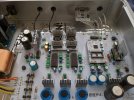
I myself have a modern Chinese implementation of the TDA1540D chips, which I love.
My TDA1540D DAC, I added an i2s receiver board to it as my transport has i2s output.
IMG_20230816_144803_468.jpg
 
Why have phono cartridges improved in Trackability. Similar answers. The are limits to each technology.
 
There is a quote from some famous designer, forget who, which goes something like "If it measures bad but sounds good, its good. If it measures good but sounds bad, you are measuring the wrong thing". I probably butchered that a bit but its something like that. I've heard examples of both, and much as I despise the non-quantifiable nature of all this stuff I have to admit sometimes things just don't sound good for no reason I can explain with test gear.
Daniel von Recklinghausen.
 
Back
Top Bottom