• The move to the new server is done. There are some software and database maintenance updates in process. This has us passing the hat around to help out. We appreciate any donations. Seriously, even a dollar helps. The payment page may be found here - https://www.audiokarma.org/support.html

Zilch's AK Design Collaborative - Econowave Speaker

Z, I've got a couple of Behringer 3400 and have been collecting amps. I sure like using the active crossover over a passive. However, I've noticed that once I get the active set just the way I like it, I don't touch it again. So building a passive to those setting seems like a good idea as well.....but, and here is the question, the 3400 has a steep slope so what would happen if I built a shallower slopped crossove to the setting on the active?

Seems like a LR type slope crossover would cost more to build than keeping the 3400 in line. Cheers.
 
So building a passive to those setting seems like a good idea as well.....but, and here is the question, the 3400 has a steep slope so what would happen if I built a shallower slopped crossove to the setting on the active?
In detail, a custom passive can perform more optimally than a "generic" active, BUT, you're talking a relatively sophisticated design venture.

Use the components JBL uses with them in a specific product, clone the factory crossover and tweak as desired using measurement gear. Not going to happen overnight....
 
C1 = 6.8 uF
L1 = 0.8 mH

I calculate the resonance frequency of that combination at 2.158 kHz.

The acoustic crossover w/LE 14A occurs at 1.450 Hz, slightly lower than the Seleniums, but within the range Wayne suggests is acceptable based upon his use of them in Pi Speakers.

They are more sensitive than the Seleniums, so use the standard low-sensitivity HF compensation filter for them with LE14A, and the attenuation balances at mid rotation of the L-pad.

900ss picked up his pair yesterday after we listened to them and deemed them "Good." They use the Selenium throat adapters from Parts Express and the standard E'Waveguide.

Dayton 6.8 uF is too long to fit on the PC board directly, but either Jantzen or Solen are compatible.

Despite being slightly larger than our standard 0.6 mH L1, the Jantzen 20 Ga. 0.8 mH fits neatly.

Once I have a pair of my own, I may do more, but for now, that's our DE-250 baseline.... :yes:

As to the measurements and B&C being more efficient, what did they measure out to? PE lists Selenium 220 ti at 109 db 2.83v/1m, and the B&C at
108.5 1W/1m. Apparently, two different standards of measurement are used, and at first blush it would appear the Selenium is more efficient, until you notice the differing standards. Is there some way to convert one of these standards to the other, so one can really compare apples to oranges?

Russellc
 
As to the measurements and B&C being more efficient, what did they measure out to? PE lists Selenium 220 ti at 109 db 2.83v/1m, and the B&C at
108.5 1W/1m. Apparently, two different standards of measurement are used, and at first blush it would appear the Selenium is more efficient, until you notice the differing standards. Is there some way to convert one of these standards to the other, so one can really compare apples to oranges?

Russellc

Those two standards of measurement will be equal only if the driver that's being tested at 2.8V is a true 8 Ohms at that frequency. If it's below 8 Ohms it will draw more current at 2.8V and therefore dissipate proportionally more power. The '2.8V' measurement standard is valid in some situations because for the most part loudspeaker systems are driven from voltage amplifiers with low source impedance, but the 2.8V standard is also used by loudspeaker system retailers to make a 4 ohm or 6 ohm system look more efficient on paper when actually it just has higher voltage sensitivity.

Off the top of my head I'd say the efficiency difference between two drivers having the same voltage sensitivity but different impedances is probably our old friend 10log(r1/r2).
 
Last edited:
Not to mention rarely do 2 manufacturers use the same "horn" to test with an that
can really screw the sensativity rating as well. :)
 
Here's some light reading on that subject. Elliott on Active vs Passive
Note that he's not talking about an active XO after the amp, but before, as in bi-amping.

I've only seen Actives feeding an amp. That is one of the benefits. The amp only SEES them frequency range that it will feed to the speakers so the amp is not dealing with Freq ranges that the speaker will not use. The other thing I like about actives is you can select the right amp for a specific range. For a long time, I used a $30.00 Sonic Impact amp to drive my super tweeters. This was in a system that, by most accounts, a much more expensive amp but the tweets only needed very little power and the digital SI was the right fit. Cheers.
 
Not to mention rarely do 2 manufacturers use the same "horn" to test with an that
can really screw the sensativity rating as well. :)

Well, I guess one really never knows how they were measured, but I thought "Standard practice" ( if there is such a thing! :D) was to use a tube like device of a specific length to measure compression drivers, but who knows. It sure would make off the cuff decisions about whether or not there is sufficient difference between the compression driver and the woofer's sensitivity for adequate compensation. Oh well....:scratch2:

russellc
 
C1 = 6.8 uF
L1 = 0.8 mH

I calculate the resonance frequency of that combination at 2.158 kHz.

The acoustic crossover w/LE 14A occurs at 1.450 Hz, slightly lower than the Seleniums, but within the range Wayne suggests is acceptable based upon his use of them in Pi Speakers.

They are more sensitive than the Seleniums, so use the standard low-sensitivity HF compensation filter for them with LE14A, and the attenuation balances at mid rotation of the L-pad.

900ss picked up his pair yesterday after we listened to them and deemed them "Good." They use the Selenium throat adapters from Parts Express and the standard E'Waveguide.

Dayton 6.8 uF is too long to fit on the PC board directly, but either Jantzen or Solen are compatible.

Despite being slightly larger than our standard 0.6 mH L1, the Jantzen 20 Ga. 0.8 mH fits neatly.

Once I have a pair of my own, I may do more, but for now, that's our DE-250 baseline.... :yes:

As to the .80 coil for L1, is there any advantage sonically to using the 18 gauge coil over the 20 gauge coil?

thanks,
Russellc
 
I used 20 Ga. for the development.... :yes:

Hard for me to see how a fraction of an ohm difference in parallel with the tweeter could really hurt. In theory a little resistance in parallel will dampen response... which could be a GOOD thing, no?

So last night I swiped a Tannoy 15" dual concentric driver from a DMT 15 and put it in a 220 liter cabinet with its stock crossover. I went right from listening to a compression driver/horn two-way with JBL 2226 to the dual concentric, which has a 1" compression driver using the 15" cone as wave guide.

I love that point source coherence, which to me was the big BIG difference. I sure wish there were a way to have it all. One of these days someone will mount the mini-wave guide on a dual concentric (DC), and try to get the CD benefits with DC point-source.

If it's me, I'll call it CDDC.
 
Hard for me to see how a fraction of an ohm difference in parallel with the tweeter could really hurt. In theory a little resistance in parallel will dampen response... which could be a GOOD thing, no?

So last night I swiped a Tannoy 15" dual concentric driver from a DMT 15 and put it in a 220 liter cabinet with its stock crossover. I went right from listening to a compression driver/horn two-way with JBL 2226 to the dual concentric, which has a 1" compression driver using the 15" cone as wave guide.

I love that point source coherence, which to me was the big BIG difference. I sure wish there were a way to have it all. One of these days someone will mount the mini-wave guide on a dual concentric (DC), and try to get the CD benefits with DC point-source.

If it's me, I'll call it CDDC.

If you need your response dampened, it "could"...but if you dont....I dont know. It can make a difference, and one could work a little better. That's why they dont just sell one size.:D

I'm more familiar with how this resistance difference, (.43 DCR vs .62 DCR) would affect response in the low pass, but not in the high pass. since testing was done with 20 gauge, I'll order that one.:thmbsp:

Russellc
 
Econowave Point Source DIY....?

Tubino, have you ever had the opportunity to compare the Altec 604 version of point source to the tannoy...or the UREI 813C JBL point source? I wonder if it could be built DIY with an Econowave through the center of the LF driver?:scratch2:
 

Attachments

  • UREI 813.jpg
    UREI 813.jpg
    29.1 KB · Views: 41
I love that point source coherence, which to me was the big BIG difference. I sure wish there were a way to have it all. One of these days someone will mount the mini-wave guide on a dual concentric (DC), and try to get the CD benefits with DC point-source.
The problem is that you need a large-mouth horn/waveguide to play low enough with pattern control. To what extent that DC's use of the woofer cone accomplishes that with CD is certainly ascertainable.

Last time I looked, GPA's redesigned 604 appeared to be on the requisite path, but we really need to see the polars to verify.

There are also some BMS concentrics that look "right," but I gotta wonder how much the large waveguides they use are messing with the midrange dispersion of the woofer cone.... :dunno:
 
Horn play and why I need measuring equip!!!

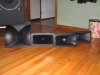
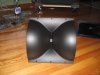
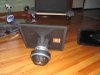
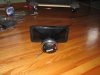
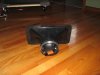
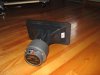
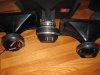
Here are the combinations I've been playing around with:

First pic is a group shot of the combinations, second is JBL 2344A w/ JBL 2425H,
third is a rear shot of the 2344A w/ JBL 2425H, fourth isB&C DE 250 on E'wave, fifth is Selenium 220 ti on E'wave, and finally a shot showing the size differences between the large JBL 2425H, Medium sized B&C DE 250, and the smaller (yet killer) Selenium 220 Ti.

We have a great crossover for the Selenium, which works pretty well with the Altec/H290 combo, a rework of same crossover for B&C DE 250, and I'll be using the JBL 4430 clone crossover for the JBL 2344A and 2425H setup.

The B&C shows great promise, should sound better once the crossover parts arrive and are installed.

I still need to tweek the bass bin to match all of these combos! ( except 2344A, which will be using 4430 crossover. )

Until I can swing the DEQ 2496, I'm thinking of getting True RTA and Behringer mic to get started, its cheap and I'll need the mic anyway. I assume everyone with the DEQ 2496 uses the Behringer mic? If there's another "better" candidate for reasonable bucks, what is it? Seems like I remeber Diappolito or someone making one on a boom out of some Panasonic (?) cartridge mic
back in the day, in Glass Audio or Audio Amatuer?

If anyone with measuring abilities is working with any of these and has RTA
capability, I would certainly love to hear what your doing. Ditto matching it to and tweeking the 4507/2235H combo to play along. I have assembled one of Jack's excellent bi wire boards with the 4430 bass components, but need a few odds and ends that are on the way from PE to try it.

Cheers,

Russellc
 

Attachments

  • IMG_2014.jpg
    IMG_2014.jpg
    43.4 KB · Views: 64
  • IMG_2015.jpg
    IMG_2015.jpg
    42.9 KB · Views: 44
  • IMG_2016.jpg
    IMG_2016.jpg
    49.1 KB · Views: 52
  • IMG_2018.jpg
    IMG_2018.jpg
    50.7 KB · Views: 48
  • IMG_2020.jpg
    IMG_2020.jpg
    43.5 KB · Views: 41
  • IMG_2022.jpg
    IMG_2022.jpg
    45.5 KB · Views: 43
  • IMG_2023.jpg
    IMG_2023.jpg
    51.5 KB · Views: 63
Last edited:
Tubino, have you ever had the opportunity to compare the Altec 604 version of point source to the tannoy...or the UREI 813C JBL point source?

No, I haven't had the chance to compare ... I have (or have had) several Tannoy dual concentrics to compare, from 6" shielded by the TV to DMT 12's to Gold 15s and HPD 15s etc, so I know about the Tannoy sound. Would like very much to hear the GPA 604 remake etc.

The limiting factor on the Tannoys seems to be the 1" compression driver. There are dual concentric drivers out there with 2" HF drivers, but I haven't gotten closer to them than drooling on the spec sheets.

Today I got my B&C DE250s from Wayne W. Thanks, man! I listened to them tonight. :thmbsp:
 
Well, I guess one really never knows how they were measured, but I thought "Standard practice" ( if there is such a thing! :D) was to use a tube like device of a specific length to measure compression drivers, but who knows.

It's called a plane wave tube. I don't remember how we worked out the total length but it was something like 14'. The idea is to keep the signal propagating as a plane wave and to measure it "unmolested" so you're measuring what the horn throat would see. At least that's how we did it at Eminence back in the old days (late 90's)


If there's another "better" candidate for reasonable bucks, what is it? Seems like I remeber Diappolito or someone making one on a boom out of some Panasonic (?) cartridge mic
back in the day, in Glass Audio or Audio Amatuer?

Don't know about "better" but you can also contact Kim Girardin. He was selling callibrated mics that I think were based on the Panasonic capsule. I believe you can get his contact info through the TrueRTA site.

Ray
 
Back
Top Bottom