

You are using an out of date browser. It may not display this or other websites correctly.
You should upgrade or use an alternative browser.
You should upgrade or use an alternative browser.
Zilch's AK Design Collaborative - Econowave Speaker
- Thread starter Zilch
- Start date

I'm doing both.One note on the Ecowave circuit boards, use permenent 3m double sided tape, instead of a cable tie. The coil want's to slip out of the loop, and it isn't going anywhere with the 3m stuff, at least in the next 20 years.
Post some pics of your completed project, so we can make you an "Official" E'Waver, please.... :thmbsp:
Last edited:

Wayne1
Speaker Butcher
So far, I have been able to buy 4) re-foamed woofers for Advents for an average of $25.00 each from the auction site.
They can be used in most sealed cabinets of about 1.4 cu. ft.
I have also re-foamed the pair that came with my NLA that I converted to Ewave. It is not very hard to do, just a bit tedious. Search for information using a 1.5 volt battery to hold the voice coil stable.
The T/S parameters of my round magnet, re-foamed Advent woofer are:
R(e)=4.541 Ohms
F(s)=26.92 Hz
Q(ts)=0.56064
Q(es)=0.5894
Q(ms)=3.598
L(e)= 0.5526
While the original design concept of the Ewave was Economy, I do feel that a pair of Ewave Advents can proudly hold their head up high when compared to speakers that that currently retail for 10 times the price of the parts used in the Ewave.
They can be used in most sealed cabinets of about 1.4 cu. ft.
I have also re-foamed the pair that came with my NLA that I converted to Ewave. It is not very hard to do, just a bit tedious. Search for information using a 1.5 volt battery to hold the voice coil stable.
The T/S parameters of my round magnet, re-foamed Advent woofer are:
R(e)=4.541 Ohms
F(s)=26.92 Hz
Q(ts)=0.56064
Q(es)=0.5894
Q(ms)=3.598
L(e)= 0.5526
While the original design concept of the Ewave was Economy, I do feel that a pair of Ewave Advents can proudly hold their head up high when compared to speakers that that currently retail for 10 times the price of the parts used in the Ewave.

I'm doing both.
Post some pics of your completed project, so we can make you an "Official" E'Waver, please.... :thmbsp:
I sure will, it's been lot's of fun so far. I'm glad you convinced me on the crossover circuit board- it makes it a no brainer as far as connections go, and it looks nice to boot. Still wating on the binding post and gold spade connectors (Madisound). Slow shipping for only 150 miles away.
I need to read the post again via the lack of sufficient damping material, as mine are plum full of fiberglass-not much room for any more-if at all.
The bass on this particuliar set was never booomy by any means.
By the way, my Advent dome tweeters are posted for sale if anyone is interested. They are 1990-91 vintage-replacements sent to me by Advent/Jensen to replace the no longer avialable fried egg units. In great shape, they have a really large magnet assembly for their size.
Last edited:
I just did "medium" fill, as I recall, maybe 60%, R-13 lining the four sides, and a layer over the back to hold it all in place.... :yes:I need to read the post again via the lack of sufficient damping material, as mine are plum full of fiberglass-not much room for any more-if at all.
About the same price as new 2226 JBLs I think.
Something to consider, with options. That's an alnico magnet structure, looks like?
i don't think he uses alnico magnets. the coil is 2", so the magnets aren't as large in diameter as something like the 2226 with its 4" coil.
he provides some additional detail here:
http://www.avsforum.com/avs-vb/showthread.php?p=16040210#post16040210

skywave-rider
Slumming in Akihabara
Thanks, and, ur up early....
skywave-rider
Slumming in Akihabara
Interesting posts there and comparo to the 2226.


Bauhausler
Rational Subjectivist
I just did "medium" fill, as I recall, maybe 60%, R-13 lining the four sides, and a layer over the back to hold it all in place.... :yes:
As documented in the ULA build thread, I had to go to a pretty heavy fill to damp down what I heard as a loose boominess. That pair used round magnet woofers, recently re-foamed. We heard the heaviness here in my 900sf room and at DJNAGLE's house in his living room.
I'd say YMMV and play it by ear for your particular setup.
I've said this before, but I don't think anyone has to apologize for any of the Advent woofers in a 2-way application. They don't handle all the power in the world, as one compromise, but there's little to complain about in terms of cost, ease of implementation and sound.

Paratima
E'Wavin'
According to Dickason in "Loudspeaker Design Cookbook", the optimum stuffing for an acoustic suspension (closed box) system is fiberglass at a density of 2 pounds per cubic foot. I didn't believe this at first, but after going nearly blind reading his pages and pages of measurements, I'm convinced. That would put the large Advents at around 3 pounds per box. :nerd:
If you don't believe me, then YOU read the book! :tongue: This ties in with Bauhausler's findings, btw.
If you don't believe me, then YOU read the book! :tongue: This ties in with Bauhausler's findings, btw.
Hello automojo
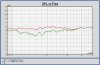
It is so they sum properly through the crossover point. Typically if you keep them in phase you get a notch in the response where they partially cancel each other out. If you reverse them you don't get the notch and when they sum you get a nice flat curve or a bump depending on the crossover type Butterworth vs LR and so on.
Here's sim from a PT Waveguide system I made showing what happens. When you put them in phase you get a notch just like the simulation. It's a mixed 18db and 12db network. The Red is out of phase Green is in phase.
Rob
It is so they sum properly through the crossover point. Typically if you keep them in phase you get a notch in the response where they partially cancel each other out. If you reverse them you don't get the notch and when they sum you get a nice flat curve or a bump depending on the crossover type Butterworth vs LR and so on.
Here's sim from a PT Waveguide system I made showing what happens. When you put them in phase you get a notch just like the simulation. It's a mixed 18db and 12db network. The Red is out of phase Green is in phase.
Rob
Attachments

Russellc
Addicted Member
Hello automojo
It is so they sum properly through the crossover point. Typically if you keep them in phase you get a notch in the response where they partially cancel each other out. If you reverse them you don't get the notch and when they sum you get a nice flat curve or a bump depending on the crossover type Butterworth vs LR and so on.
Here's sim from a PT Waveguide system I made showing what happens. When you put them in phase you get a notch just like the simulation. It's a mixed 18db and 12db network. The Red is out of phase Green is in phase.
Rob
Excellent explaination and nice graph to back it up, clearly shows the difference made by the phasing changes. I'll be glad to get some measuring ability fjnally together, the DE 250 drivers need tweaked, seems like they need a touch more attenuation, I've been running the L-pads at 10 o'clock ( or a little earlier!) as otherwise they seem to go right through your head. Very transparent and clear, just way upfront and in my face type of sound. Helps quite a bit to reverse HF phase from the standard E'wave HF hookup. Lots of potential here. Has anyone else noticed this? I see Wayne's Pi crossover basically uses the same series and shunt resistors as the <95 crossover does, but without the L-pad. Seems like this should be WAY sharp sounding, perhaps his 3rd order crossover isnt as "quiet" on the bass side of things?
I'll give Wayne a shout and ask.
Russellc
Last edited:
skywave-rider
Slumming in Akihabara
Russellc:
I tried the DE250 on Wayne's 4Pi x-over and followed his polarity spec from his schematic. I had to re-check into the polarity of my woofers, then I forgot how I wired them inside the box....because they are like the 2226s in polarity (pos voltage to black terminal gives forward cone motion) I may have reversed the connections internally to make plus on the box yield forward motion. IIRC :scratch2: It's moot however because I checked it on RTA and easily saw what was what.
Soon you will do the same, LOL.
Have not tried DE250s on Econo-x-over yet.
I tried the DE250 on Wayne's 4Pi x-over and followed his polarity spec from his schematic. I had to re-check into the polarity of my woofers, then I forgot how I wired them inside the box....because they are like the 2226s in polarity (pos voltage to black terminal gives forward cone motion) I may have reversed the connections internally to make plus on the box yield forward motion. IIRC :scratch2: It's moot however because I checked it on RTA and easily saw what was what.
Soon you will do the same, LOL.
Have not tried DE250s on Econo-x-over yet.
I have done the same and measured a significant hump in the 2-3k range. I have measured similar results with the Econo-x-over. As an inexperienced operator of RTA equipment I am curious if anyone else has had similar results.
Russellc:
I tried the DE250 on Wayne's 4Pi x-over and followed his polarity spec from his schematic. I had to re-check into the polarity of my woofers, then I forgot how I wired them inside the box....because they are like the 2226s in polarity (pos voltage to black terminal gives forward cone motion) I may have reversed the connections internally to make plus on the box yield forward motion. IIRC :scratch2: It's moot however because I checked it on RTA and easily saw what was what.
Soon you will do the same, LOL.
Have not tried DE250s on Econo-x-over yet.
Bauhausler
Rational Subjectivist
Hello automojo
It is so they sum properly through the crossover point. Typically if you keep them in phase you get a notch in the response where they partially cancel each other out. If you reverse them you don't get the notch and when they sum you get a nice flat curve or a bump depending on the crossover type Butterworth vs LR and so on.
Here's sim from a PT Waveguide system I made showing what happens. When you put them in phase you get a notch just like the simulation. It's a mixed 18db and 12db network. The Red is out of phase Green is in phase.
Rob
Can this be correct? The graph appears to show very significant broad band loss of SPLs from 500 hz to 3K. If I read it correctly the loss is 10db over a large range. Are you sure this is correct?
skywave-rider
Slumming in Akihabara
I have done the same and measured a significant hump in the 2-3k range. I have measured similar results with the Econo-x-over. As an inexperienced operator of RTA equipment I am curious if anyone else has had similar results.
I may have; but I want to re-do them w/ new measuring system.
Waiting for mic preamp right now.
I must have posted Behringer RTA at some point, buried, long ago....
Russellc
Addicted Member
Russellc:
I tried the DE250 on Wayne's 4Pi x-over and followed his polarity spec from his schematic. I had to re-check into the polarity of my woofers, then I forgot how I wired them inside the box....because they are like the 2226s in polarity (pos voltage to black terminal gives forward cone motion) I may have reversed the connections internally to make plus on the box yield forward motion. IIRC :scratch2: It's moot however because I checked it on RTA and easily saw what was what.
Soon you will do the same, LOL.
Have not tried DE250s on Econo-x-over yet.
How was it on Waynes filter? Was it balanced? I guess I need to build Wayne's filter and see.:yes:
Russellc
Russellc
Addicted Member
I may have; but I want to re-do them w/ new measuring system.
Waiting for mic preamp right now.
I must have posted Behringer RTA at some point, buried, long ago....
New mic pre amp eh? I may be in the market, I am getting the Behringer mic to use with true RTA. I know I need a pre, or phantom power or something, can someone tell me what is a good affordable unit for my purposes? ( heck, I'm not even sure of what I need!)
Thank in advance,
Russellc