• The move to the new server is done. There are some software and database maintenance updates in process. This has us passing the hat around to help out. We appreciate any donations. Seriously, even a dollar helps. The payment page may be found here - https://www.audiokarma.org/support.html

Zilch's AK Design Collaborative - Econowave Speaker

I have been listening to my AR2ax WG conversions for a while now switching between ADS l810s. I have noticed the ARs do nat have as much detail in the mid range, almost like there is a hole there.
Schedule a vist to ZilchLab.

We'll know what's up in about a minute.... :thmbsp:
 
Have JBL 4507 (4647), 2226H coming this weekend, but only the parts for the <95db crossover, scavenged from KPM-100 project.
What are the issues with using <95 db X/O versus >95db X/O? For example, tweeter not operating in middle of attenuator range, high frequencies under/over extended?
JBL specs state 'axial sensitivity' of this system as '97 db, 1w, 1m.'
Russellc, around post #150 you used the <95db version in this set up- any probs?

Yes in the begining (when I had 2225H installed) I did have the 3-18-08 crossover, which is the <95 db crossover. It worked, but not as well as the > 95 db one did. I think I remember turning it up a little, but the other one definately worked better, with the L-pad more in the middle zone.

Since I've had 2235H installed, I have used the Low frequency portion of JBL 4430 monitor's crossover, and its zobel as well. Seems to work well. While I definately prefered 2225H with all four ports open, with 2235H I go back and forth between 1 and 2 ports closed. Of course I changed the compensation on the crossover back to the <95 db version for 2235H.

Russellc
 
Thanks Zilch, I am very tempted to try them. Will you venture a guess as to whether or not the electrostatic like traits I crave will be there?

Ray

I think there will be plenty of magic there for you. It will be slightly different than your E'stats however. First, center images will be rock steady and sound stage sweet spot can be as wide or wider (depending on deployment) than the e'stats, and thanks to constant directivity center images hold steady even when way off listening axis, no more head in the vise small sweet spot, and when you stand up the highs dont go away. Also, with E'wave you can acheive dynamics the e'stats can only begin to dream about. Images are fleshed out and full, and big as life. Very transparent!

Like Zilch said, its cheap to try and if you dont like it ( you'll be in a small crowd or by yourself there) you can sell it to someone here. I'm betting it will become a favorite.

Russellc
 
Zilch, if a box enclosure is to use 4 inches port x 4 inches long, can I use 2 - 2inches x 2 inches long ports instead, if space is not available to cut 1 large 4 inch hole.
 
Zilch, if a box enclosure is to use 4 inches port x 4 inches long, can I use 2 - 2inches x 2 inches long ports instead, if space is not available to cut 1 large 4 inch hole.
You want the same cross-sectional area if the vent velocity is to be the same, and the requisite length may also vary. The easiest means to determining equivalency is with a box modeling program such as the free downloadable WinISD.
 
"Sucks" may be the only comment I haven't heard about ewaves. It was a pleasure to sit in the room with Kegger's HPMwaves at AK fest or another room with ewaves and see people come in to listen. Their eyes got reeeally wide when they heard they were listening to DIY speakers. Which frequently do suck in one way or another.

Whether it's to their taste or not - ribbons and electrostats do have a distinctly different sound - there's nothing about the ewave top end to dislike and a great deal that appeals.

Agreed!

Russellc
 
Zilch, question in using WinISd , i was working out a enclosure for a speaker and did some adjustments to the Vb and fb. On the gain graph there is a hump or peak over the 0 db red line at about 1db - 113 hz , does that mean there is some distortion,( what does this mean?)
 
Zilch, question in using WinISd , i was working out a enclosure for a speaker and did some adjustments to the Vb and fb. On the gain graph there is a hump or peak over the 0 db red line at about 1db - 113 hz , does that mean there is some distortion,( what does this mean?)
It means the bass response in that region will be "augmented," a common feature in many "West Coast" designs, though their peak is typically higher and occurs at a lower frequency.

Buy Dickason's Loudspeaker Design Cookbook and read up on this stuff.
 
Agreed!

Russellc

I would agree, as well. However, I did hear a number of reviews at the fest where people were not very enthralled with the ewave sound. Of course, there were more people who did like them.

I do wish there were a pair of econowaves with DE250s and sussed out crossovers on hand to show their real potential.
 
Dipole speakers are a very different result in spaciality but compromise efficiency and low end. A point source is yet another mix of plusses and minuses. I'd say that the EWs fall into a more-or-less efficient enclosure-based system that is very dependent on the qualities of the woofer & enclosure.
The candidate woofer must already have good (by ear) lower midrange response with sufficient power margin at cross-over, and the offset relationship between the woofer and upper range units is critical for best results using the suggested XO. I think that the 6X6 works best baffle mounted with relatively shallower (IE 12" or smaller) woofers regardless of the baffle area due to the closer offset. The baffle-mounted 6X12 needs to work with much deeper woofers to get the offset closer to right. Incorrect offset results in a wrong "sucked-out" midrange or exaggerated sharpness, depending on whether the xover region is being cancelled and/or or the upper end driver is "leading" the woofer. Woofer leading the tweeter can sound dull and "wrong". A certain amount of speaker tilt or listener vertical listening position offset can correct some driver offset error. This is where having the upper end unit independent of the woofer baffle provides for fine-tuning of the best midrange response by shifting it's relative offset to the woofer. This adjustment can be done by ear or by instrumentation. The closest possible axial spacing of the unit mouths gives the broadest optimal vertical listening "window" once the driver offset is determined and fixed.
 
I would agree, as well. However, I did hear a number of reviews at the fest where people were not very enthralled with the ewave sound. Of course, there were more people who did like them.

I do wish there were a pair of econowaves with DE250s and sussed out crossovers on hand to show their real potential.

I personally was heard to say that the bass quality was not up to standard, which I attribute to small rooms. I heard the same boom and overhang in vendors' rooms where they were trying to run full range speakers with significant LF output. The lucky vendors were the ones with mini speakers whose LF was assisted by the room making them sound big and full out of small cabinets.
I'm partial to the ewave top end as an alternative to conventional dome and cone tweeters and I evaluate it on that basis. The basic D220Ti/PH612 setup is not the last word in fidelity but it's a large fraction of the performance for a small fraction of TOTL component cost.
The Econo territory here is well trodden enough that basic repeat questions are being answered for new builders for the nth time and the thread is winding around into its 4th or 5th lap. Econovariations with more stringent goals and higher specification components are of interest to me personally after I finish 2 or possibly 3 more pair builds of the basic ones.
 
No doubt, Ross. I think people had very high expectations going in and maybe didn't come away with their expectations satisfied for what could have been a number of reasons. I suspect the room was one of the more prominent reasons, without any doubt.
 
PT-B99HF-1 on hand now

Thanks to one of teh Dans I have a pair of the JBL PT-B99HF-1 6" X 6" 90 X 90 WGs on hand. I've determined that they will fit on the baffle of an LS3/5A sized speaker like my Fried R's with a B110 midwoofer.
Oh, yes I would too.
I see that JBL specifies a 2400 hz xovr for this unit when used in the AC16 speaker. I can't find a spec sheet for it, though. Has anyone (*cough* Zilch *cough*) done any measurements on this?
I'd like to acknowledge here that I have a WT3 woofer tester and Behringer ECM8000 measurement mic that have not been out of the box to go with my DEQ2496, so I admit I'm lazy.
 
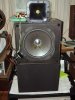
I have provisionally E-W'ed one of the Pioneer CS-R300 "Baby JBLs" and can say that this is a definite improvement over the stock set-up with the little horn-loaded bullet tweeter. It is however not a total slam dunk as was the trial of the AR-6 due to the AR's woofer having a better more transparent and natural midrange response. The Pioneer woofer is not a particularly great midrange unit in spite of the mfgrs apparent trust in it, judging from the original xo point of ca 4.2kc and relatively flat measured freq response.
This does however elevate it from a very well-made and well-finished inoffensive noisy box to something tolerable at worst and very usable, even enjoyable if not a prime example of accuracy.
 

Attachments

  • Pio300_EW.JPG
    Pio300_EW.JPG
    97.1 KB · Views: 45
Last edited:
Yes in the begining (when I had 2225H installed) I did have the 3-18-08 crossover, which is the <95 db crossover. It worked, but not as well as the > 95 db one did. I think I remember turning it up a little, but the other one definately worked better, with the L-pad more in the middle zone.
Cheers, Russell. That'll do, providing I don't run out of HF. Want to be able to hear the pea-anna on the evaluation record.

A week? if I order before 3:00 PM they're here in less than 24 hours by Standard Delivery. If they're in stock, that is.
That's the advantage of living in the US vs Japan. However, I do have the unobtanium TOTL Japanese dream machines pretty well wrapped up.
 
Back
Top Bottom