• The move to the new server is done. There are some software and database maintenance updates in process. This has us passing the hat around to help out. We appreciate any donations. Seriously, even a dollar helps. The payment page may be found here - https://www.audiokarma.org/support.html

Zilch's AK Design Collaborative - Econowave Speaker

Thanks, Dave, appreciated.

I think it's an interesting concept, but the strongest reflections come from the ceiling and floor, and minimizing those, I believe, is a higher priority. Additionally, reflections from the near wall have less to do with an HF section of reasonable horizontal directivity and toe in -- that is, aimed at the listener -- compared to lower frequencies.

This is from my experience and pardon any misuse of vocabulary.

Having said this, it would be interesting to hear a Geddes system in intended setup.

Sure. The idea is that you want to minimize early reflections from the same side of the room as the speaker. In other words, you don't want first reflections from the right speaker from the right wall arriving at your right ear, first. His studies have shown that our hearing is sensitive to this and early reflections, in general. His talk of reducing HOMs also addresses this as he tries to reduces early reflections within the horn itself.

When designing the Summas, the intent was to control dispersion and toe in the speakers significantly enough that the side walls were use to reflect primarily sound from the opposite speaker. So, instead of the right speaker reflecting off the right wall to the right ear, it is aimed towards the left wall so that the direct sound from the left speaker and the reflected sound from the right speaker are both arriving at the left ear first and vice versa. Luckily, when matching up the woofers directivity with the waveguides and selecting the right horn dispersion and crossover point, we aren't giving up anything by listening off axis and we are getting the benefit of minimizing early reflections and the FR havoc they cause (think comb filtering type effects) and creating a sense of space/ambience by embracing the non-objectionable reflections. This way, we are more actively removing the bad portions of room acoustics without making our rooms into an unbearable sounding quasi-anechoic environment that people who resort to passive room damping options inevitably suffer from.
 
Initially, Geddes concealed the on-axis anomaly of his waveguides by not showing the response above the frequency where it occurred, asserting that everything above that frequency was irrelevent. :p:

JBL's Everest (also S2600 and S3100) taught Geddes how to do the wide sweet-spot trick with defined directivity and listening off-axis. He says so himself.

Instead of fixing the anomaly, which he claims would be trivial to do, he now touts it as indicative of the perfection of his design and recommends extreme toe-in (45°) as the only acceptable approach to listening to his products.

In fact, the same approach will also work with any quality constant-directivity speaker pair, such as EconoWave, for example, but the on-axis listening option, if desired, is also retained.

[Edit: Ref. JBL 4430, June, 1983: http://audiokarma.org/forums/showthread.php?p=2162568#post2162568 ]

If you toe-in a 90° horizontal dispersion speaker 45°, in theory, there is no reflection off the near wall. In fact, however, the directivity control is not absolute; the spec merely defines the off-axis angle at which the SPL has diminished -6 dB, by convention, and there is still some output at larger angles, albeit substantially attenuated, contributing to the reflected soundfield.

With an ideal controlled directivity device, the output would drop precipitously outside the design dispersion window, but that might not sound as good. It's well established that some amount of reflected soundfield is desireable for the provision of "ambience," otherwise the sound is "dead." That's a major element in the difference between listening with headphones versus speakers.... :yes:
 
zilch, if i recall, somewhere in the '99 pages of econowave on the wall', you posted a pic of a pro-audio style speaker where an econowave was sitting on top of two woofers. in that design, was the bottom woofer a .5 style helper woofer? if so, could you provide a little detail on that? does the integration of a helper woofer require changes to the mid/hi crossover? does the use of a .5 woofer create a phase problem?

by the way, thanks for all your posts here and on other sites. much appreciated! :thmbsp:
 
Initially, Geddes concealed the on-axis anomaly of his waveguides by not showing the response above the frequency where it occurred, asserting that everything above that frequency was irrelevent. :p:

JBL's Everest (also S2600 and S3100) taught Geddes how to do the wide sweet-spot trick with defined directivity and listening off-axis. He says so himself.

Instead of fixing the anomaly, which he claims would be trivial to do, he now touts it as indicative of the perfection of his design and recommends extreme toe-in (45°) as the only acceptable approach to listening to his designs.

Actually, he has acknowledged it and said it could be improved but since he has and for the record, always has, recommended listening off axis, he has concluded that it wouldn't be worth doing. It's like Wayne's issue with the lower vertical null occuring at the ankles with the Summas. Could that be improved? Of course. Will it make a bit of difference in performance when used in the recommended position? Uh Uh. :no:
In fact, the same approach will also work with any quality constant-directivity speaker pair, such as EconoWave, for example, but the on-axis listening option, if desired, is also retained.

All in the design. If you want to design with on-axis performance as the intent, the PT is the easier bet.
If you toe-in a 90° horizontal dispersion speaker 45°, in theory, there is no reflection off the near wall. In fact, however, the directivity control is not absolute; the spec merely defines the off-axis angle at which the SPL has diminished -6 dB, by convention, and there is still some output at larger angles, albeit substantially attenuated, contributing to the reflected soundfield.

Agreed, which is why I actually prefer a bit tighter coverage patterns for most homes. A 60 to 75 horizontal, 40 degree vertical would be a welcome addition to someones product lineup for me.
 
zilch, if i recall, somewhere in the '99 pages of econowave on the wall', you posted a pic of a pro-audio style speaker where an econowave was sitting on top of two woofers. in that design, was the bottom woofer a .5 style helper woofer?
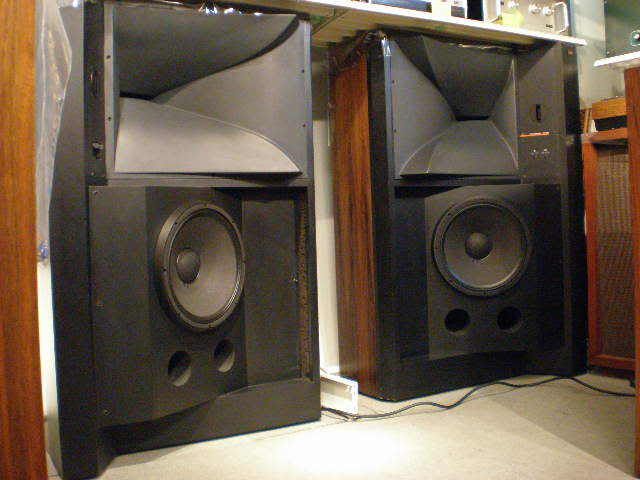
Those are a product in the JBL Pro Array Series, and they are intended for active amplification:

http://www.jblproservice.com/pdf/Array Series/4894A-90.pdf

In any case, yes, I did work with 0.5, ultimately ending up with just a big inductor to accomplish it. Two-pole worked, too.

There are no issues with highpass integration, as whatever you do in the sub-200 Hz range has no impact on the midrange.
 
Agreed, which is why I actually prefer a bit tighter coverage patterns for most homes. A 60 to 75 horizontal, 40 degree vertical would be a welcome addition to someones product lineup for me.
There's a 60° x 40° in the more expensive 1.5" PT Waveguide lineup, both compact rectangular like E'Wave and 12" square. Also, an inexpensive factory 1" throat adapter. I've mostly seen it used for SR applications; it needs almost no compensation.

If you listen to those on-axis in the conventional equilateral triangle, there are effectively no near sidewall reflections, either.

Best I can figure, Geddes's waveguides are 70°, and would work nearly as well, conventionally, if it weren't for their inherent on-axis anomaly. :yes:

It's like Wayne's issue with the lower vertical null occuring at the ankles with the Summas.
At first look, it DOES seem like it might be an issue with his Nathan 10s, however. See page 4, bottom, @ #100 here:

http://www.diyaudio.com/forums/showthread.php?s=&threadid=130494

Frankly, I'd be pleased to learn that the builder has the HF polarity inverted or some similar "error." As you see, I've asked Earl to post how it is supposed to perform there.
 
If you listen on axis, you are probably getting early reflections. JBL (with the Everest) and Geddes both promote off axis positioning with constant directivity. :)

everest.jpg


The null on axis with the Summas is inconsequential if you set up the speakers as intended. Claiming it's a problem is like complaining that your tweeter has some peaky behavior when playing bass.

Are those yours dnewma?

Never seen 'em, interesting speakers. Do they have grills?


Which leads to my next question...

I notice many Klipsch speakers don't have grills over the horn...

So the econo-waveguide is ok with a grill over the horn?
 
Those are a product in the JBL Pro Array Series, and I believe they are intended for active amplification.

In any case, yes, I did work with 0.5, ultimately ending up with just a big inductor to accomplish it. Two-pole worked, too.

There are no issues with highpass integration, as whatever you do in the sub-200 Hz range has no impact on the midrange.

thanks. it's hard to keep all the builds/implementation examples straight.

so to add a .5, it is just as simple as wiring a large inductor in series with the woofer and then wiring that system in parallel with the mid/hi system? if it is that simple, i guess i am wondering why it isn't more common then. does the type of inductor have any effect on sound quality or dynamics in the case of a .5?
 
so to add a .5, it is just as simple as wiring a large inductor in series with the woofer and then wiring that system in parallel with the mid/hi system? if it is that simple, i guess i am wondering why it isn't more common then.
Cost, primarily.

If we look harder at multi-woofer systems, I think we may find there's more attention paid to this than we assume. If they're also both playing midrange, there are phase interference issues which may be difficult to ignore.... :yes:
 
The work today so far...

Drill the port, mount the drivers, and give her a quick listen before bed...

Well, I forgot I needed to tweak the crossover from 16 ohm hi eff woofer to 8 ohm under 95 dB ones, so that's more than I can handle tonight. I did drill the port and hook up the LE14 alone for a quick and dirty listen w/o the E-Waves and the bass is much improved over the Altecs; much closer to the L60Ts I swapped the wires from. How the mids fare could be telling.

Tomorrow should be interesting; might have to lure Kegger over with a few brewskis....:D

attachment.php


attachment.php
 

Attachments

  • 14.jpg
    14.jpg
    176.2 KB · Views: 255
  • 14a.jpg
    14a.jpg
    86.8 KB · Views: 388
Oh I'll definatly want to get by an check that bad boy out! Congrats.

Can the woofer be mounted on the back side of the front baffle as well?
 
Sure, why not.
What would that do? Help out the alignment of the voice coils for coherency issues??
I'll ring you up after I get it sorted out as is, probably after dinner.
 
Question: Does WinISD account for the volume of the driver(s)?

This box wound up being about 4.67 ft3 as I rolled up dimensions to even values (33x22x14) knowing that some volume would get used up by the drivers and the internal bracing, so I made it bigger. But now I'm wondering if I went a bit too far; I didn't expect it to go that big. I guess I can always add a dummy box to the rear to reduce the volume.
 
No it does not account for the drivers, should be just fine, could even do more bracing
if you felt the need to rigid it up some more and eat up some of that extra volume there.
 
Cool!!

A couple stout 2x4s as a modified H-style upright brace might be in order.

I messed with some volumes and the effect of the larger box seems to be on the slight peak before it tails off. The dip from 50-80 hZ seems to be pretty much the same in the -0.50-.60 dB range and I'm pretty sure I won't be noticing .01 dB variances down there.
 
Back
Top Bottom