I have a set of orsonic side force checkers, and I can confirm that the modulation aspect is, by far, the aspect that has the biggest influence on the resulting skating force.
Different stylus profiles give a little bit of variation, but it's very little compared to variance in modulation of music on different records.
Signal strenght is the dominant factor, combined with tracking force.
In that regard those side force checkers have been an eye opener. Stylus profile makes less than 10% difference (where one stylus might require 2,0 AS setting, a different profile might require 1,9 AS setting (maybe 1,8 max)), whereas (example) a 70's pop record might require 25% less antiskating than an 80's DMM pop record (say 1,5 AS setting for the 70's pop record and 2,0AS setting for the 80's DMM pop record).
This also automatically means that setting your antiskate with a modulation track will always result in the wrong antiskating setting, in the sense that it's gonna be way to high. The better your cartridge tracks, the more you're off. Most cartridges will require a modulation of >70µm to give an audible distortion to set antiskating, and by then you're already 50% too high.
My experience (measurements) is that the grooveless section method will give a more accurate estimate of antiskating setting (less deviation to the correct setting) compared to the modulation track method, albeit too low.
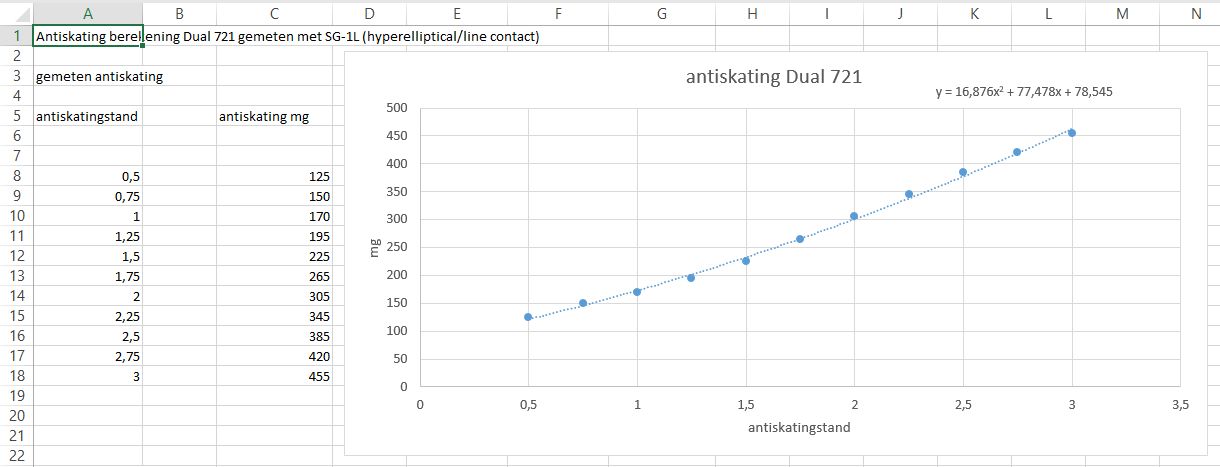
My experience is, that the scale on the dial of a quality tonearm is usually the best setting. The dial on my Dual 721, an on my Pioneer PL-55x (both 70's turntables) were both pretty much spot on with the orsonic side force checkers for 80's DMM records (generally records with the highest level of modulation), and only marginally higher than what a modern pop record requires (post 2000 mix and pressing). However my CEC BD-7000 (magnetic antiskating, same as rega RB200), was way off.
And speed indeed does virtually nothing, I've checked that with my side force checkers. This is why tonearms have no separate 33/45 AS scales.
The only thing speed does, in terms of outer grooves and inner grooves, is that tracks on inner grooves are ususally cut with lower modulated signal and therefore an inner track might require less antiskating. But that's a different thing.
When talking in absolute numbers, an 80's DMM pop music record needs between 14,5% and 15,5% of the VTF as antiskating force (this is something you could measure with a wallyskater), 14,5% for lower VTF (like 1-1,25gr) and 15,5% for higher VTF (2,75gr) and about 15% for the 1,5-2,25gr range. I measured this on my dual 721 (9"tonearm) with the record seeds of love by tears for fears.
A modern pop record (for this I used RAM from Daft Punk, a fairly dynamic record) the required antiskating force was about 13-14,5% of the VTF. 13% for the lower VTF (<1,5gr) and 14,5% for 2,75gr VTF and above. For 1,5-2.25gr range it was roughly 13-13,5%.
This is different (higher) on what Wally engineering for their wallyskater advices, they advise 11% for a 9" tonearm. But maybe they base their findings on classical music and 60's-70s pop music. the 70's pop music I tested needed around 12% (Paul Simon -still crazy)
To give a comparison what a modulated test track does:
50µm already requires 18% antiskating of the VTF, and 70µm requires 20%, so using that method will result in an antiskating setting that is way off.
I hope this helps people to get an idea to what kind of values are needed.
So my advice is, if you have an expensive tonearm with antiskating setting but no values on the setting dial (like Clearaudio, Reed etc), don't set the antiskating with a modulated test track on a test record, but buy a wallyskater (or make one yourself, it's pretty easy (
dutch link)) and use the above percentages, according to what you listen to mostly.



 )
)