• The move to the new server is done. There are some software and database maintenance updates in process. This has us passing the hat around to help out. We appreciate any donations. Seriously, even a dollar helps. The payment page may be found here - https://www.audiokarma.org/support.html

Bi-amping Infinity RS-2

I don’t know anything about those and all of my amplifiers are vintage?what does DSP stand for?
DSP is a digital signal processor. I replaced my simple active crossover with an inexpensive DSP unit, and find that it's far more useful and even had a better active crossover in this case.
 
DSP speaker management units are great, they paper over a lot of sins and deliver time coherence on a platter since delay can be dialed in for each driver separately.

DSP units convert analog signals to digital, process it, then convert it back to analog to feed your amps.

Some folks object to that analog to digital to analog conversion on philosophical grounds, but in reality it does work really well and the sound quality can be excellent. You do need a quality DSP unit though, with good ADCs and DACs in it.

Here's one example: https://dbxpro.com/en-US/products/driverack-venu360
 
I don’t have any 4 ohm amps and I was thinking about selling these RS-II’s until now
Well, you're going to need 2 ohm amps, not 4 ohm


RS-IIs are basically a 2 ohm load from 8 kHz on up. I'm not 100% certain and others may chime in, but I'd say that that low HF impedance is more a function of the EMITs than of the crossover.
 
Well, you're going to need 2 ohm amps, not 4 ohm


RS-IIs are basically a 2 ohm load from 8 kHz on up. I'm not 100% certain and others may chime in, but I'd say that that low HF impedance is more a function of the EMITs than of the crossover.
I’m hoping I won’t need a 2 ohm amplifier after getting them tri amp ready?if my vintage Sansui amps still don’t cut it I’ll get rid of the speakers before my amplifiers.
 
I’m hoping I won’t need a 2 ohm amplifier after getting them tri amp ready?
I honestly don't know the answer to that specific question, and it's not trivial when the well-being of your vintage Sansuis is at stake. Hopefully others will know.
 
I honestly don't know the answer to that specific question, and it's not trivial when the well-being of your vintage Sansuis is at stake. Hopefully others will know.
I guess I’ll find out soon enough but I think using 3 identical Sansui 8 ohm amps will work because one of them can drive the speakers with the original crossovers for an hour or so before they start getting hot.
 
I honestly don't know the answer to that specific question, and it's not trivial when the well-being of your vintage Sansuis is at stake. Hopefully others will know.
Measuring the resistance of each driver the woofers are 4 ohms each the mids all wired together are 2.2 ohms and the tweeters are around 1.6 ohms wired together
 
?if my vintage Sansui amps still don’t cut it I’ll get rid of the speakers before my amplifiers.
What model of Sansui amps are you using? I wouldn't use vintage Sansui amps to run any of the larger vintage Infinitys. I hooked up a pair of Reference 4s to a friends vintage Sansui receiver which he bragged about output 120w easy and the Ref 4s pushed it into clipping way sooner than expected. Ref 4s are not a difficult load to drive.
 
I hooked up my RS-II to a Carver M500 the day I brought them home. The Carver was clearly struggling above 75-80dB but it was not harmed.

Oh, and the speakers sounded like garbage. These need plenty of current to sound their best.
 
What model of Sansui amps are you using? I wouldn't use vintage Sansui amps to run any of the larger vintage Infinitys. I hooked up a pair of Reference 4s to a friends vintage Sansui receiver which he bragged about output 120w easy and the Ref 4s pushed it into clipping way sooner than expected. Ref 4s are not a difficult load to drive.
I’m using 3 Sansui AU-7900’s for this project and they’ve all been gone through and restored exactly the same.Ive been collecting Sansui gear for 30 + years and I have a lot of different models but I don’t have 3 of everything else just the 7900’s.
 
I hooked up my RS-II to a Carver M500 the day I brought them home. The Carver was clearly struggling above 75-80dB but it was not harmed.

Oh, and the speakers sounded like garbage. These need plenty of current to sound their best.
What do use with them now?I can tell they’re very power hungry.
They sound pretty good with my G9000 but I can’t turn them up to much or it starts getting hot so I basically quit using them.
 
They're driven by Classe monoblocks that are rated 400wpc at 4 ohm. They don't have an official 2 ohm rating but they're said to be stable at that impedance.

If I'm listening to EDM at 100dB+ their heatsinks get pretty toasty, but at moderate listening levels they get just a little warm.

If I'm being completely honest, they're definitely up to the task and they sound great, but they don't exactly give the impression that they have unlimited amounts of headroom when pushed hard.
 
They're driven by Classe monoblocks that are rated 400wpc at 4 ohm. They don't have an official 2 ohm rating but they're said to be stable at that impedance.

If I'm listening to EDM at 100dB+ their heatsinks get pretty toasty, but at moderate listening levels they get just a little warm.

If I'm being completely honest, they're definitely up to the task and they sound great, but they don't exactly give the impression that they have unlimited amounts of headroom when pushed hard.
I do have a Yamaha P2250 that needs work that I was thinking might be a good one for the RS ll’s?
 
The Yamaha P2250 is a great amp but specs says 175wpc @ 8 ohm and 250wpc @ 4 ohm so maybe not the best candidate to drive difficult loads.

A "high current" amp is a must to drive low impedance speakers. Rule of thumb says that a high current amp doubles power when impedance is halved, ie 100wpc @ 8 ohm becomes 200wpc @ 4 ohm becomes 400wpc @ 2 ohm and, for a select few, 800wpc @ 1 ohm. Very very few amps double into 1 ohm - some Krell and Accuphase off the top of my head, but there are a few others and of course amps with autoformer outputs like McIntosh.

It makes sense because Ohm's law says that current equals voltage divided by resistance. Voltage remains constant regardless of impedance, so it follows that when speakers' impedance is halved amps have to deliver double the current, and most of them don't have the power supply to do that.

For sure the Yamaha would work fine at moderate listening levels, but it might run into trouble at high SPL. On the bright side, since it's a pro amp it has some kind of overcurrent protection so it's unlikely to sustain any damage; however, a clipping amp can damage speaker drivers.

 
The Yamaha P2250 is a great amp but specs says 175wpc @ 8 ohm and 250wpc @ 4 ohm so maybe not the best candidate to drive difficult loads.

A "high current" amp is a must to drive low impedance speakers. Rule of thumb says that a high current amp doubles power when impedance is halved, ie 100wpc @ 8 ohm becomes 200wpc @ 4 ohm becomes 400wpc @ 2 ohm and, for a select few, 800wpc @ 1 ohm. Very very few amps double into 1 ohm - some Krell and Accuphase off the top of my head, but there are a few others and of course amps with autoformer outputs like McIntosh.

It makes sense because Ohm's law says that current equals voltage divided by resistance. Voltage remains constant regardless of impedance, so it follows that when speakers' impedance is halved amps have to deliver double the current, and most of them don't have the power supply to do that.

For sure the Yamaha would work fine at moderate listening levels, but it might run into trouble at high SPL. On the bright side, since it's a pro amp it has some kind of overcurrent protection so it's unlikely to sustain any damage; however, a clipping amp can damage speaker drivers.
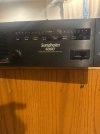
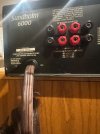
I do have an amp that will drive them but it’s so powerful it needs a dedicated circuit and my listening room doesn’t have one.If you’ve ever heard of Conrad Sundholm the founder of Sunn Amplifiers I have one of his personal amplifiers.IMG_2573.jpegIMG_2576.jpeg
 
I'm not familiar with Sundholm Amps, but if you're playing your system loud enough that the amp needs its own circuit, you're probably already deaf. I'd give it a try on a shared circuit and see what happens. I note the 20A circuit breaker notification. Does it have a standard 15A (2 vertical blades plus one ground pin) or a 20A (one horizontal blade, one vertical blade, plus a ground pin) plug?
 
I'm not familiar with Sundholm Amps, but if you're playing your system loud enough that the amp needs its own circuit, you're probably already deaf. I'd give it a try on a shared circuit and see what happens. I note the 20A circuit breaker notification. Does it have a standard 15A (2 vertical blades plus one ground pin) or a 20A (one horizontal blade, one vertical blade, plus a ground pin) plug?
It’s wired with 20amp outlets and 12 gauge wire and the amp will work at low levels but if I’m doing house cleaning in other rooms or working outside for instance I like to turn it up and that’s when the breaker trips
 
I'm not familiar with Sundholm Amps, but if you're playing your system loud enough that the amp needs its own circuit, you're probably already deaf. I'd give it a try on a shared circuit and see what happens. I note the 20A circuit breaker notification. Does it have a standard 15A (2 vertical blades plus one ground pin) or a 20A (one horizontal blade, one vertical blade, plus a ground pin) plug?
Research Sunn Amplifiers and you’ll learn some interesting history involving a number of famous musicians.
 
I do have an amp that will drive them but it’s so powerful it needs a dedicated circuit and my listening room doesn’t have one.If you’ve ever heard of Conrad Sundholm the founder of Sunn Amplifiers I have one of his personal amplifiers.View attachment 3825492

I must confess I hadn't heard of Sundholm Electronics, and they're local. In any event, the ratings printed on that back panel suggest more than adequate power.

That said, all this amp power talk applies to stock RS-II and kind of lost sight of your intent to multi-amp yours. Planning out that active crossover layout first would probably be a good idea, however pumping 1600 Hz into your EMITs isn't :)
 
I must confess I hadn't heard of Sundholm Electronics, and they're local. In any event, the ratings printed on that back panel suggest more than adequate power.

That said, all this amp power talk applies to stock RS-II and kind of lost sight of your intent to multi-amp yours. Planning out that active crossover layout first would probably be a good idea, however pumping 1600 Hz into your EMITs isn't :)
Back to the bi amping project the tech from sublime acoustics suggests to go with a 3 way setup with 120hz/24db and 3000hz/24db crossover points
 
Back
Top Bottom