• The move to the new server is done. There are some software and database maintenance updates in process. This has us passing the hat around to help out. We appreciate any donations. Seriously, even a dollar helps. The payment page may be found here - https://www.audiokarma.org/support.html

Bottlehead releases an 805A monoblock amp kit

Personally, I wouldn't dream of trying to create a manual for assembling a tube amp that runs at 1000VDC. That alone is quite an achievement, considering the risks and liability involved.
Hey there, Jameson from Bottlehead here. I'll copy and paste a comment Paul Birkeland made on Facebook in reply to a similar question that was asked:

During the assembly process, the power supply is built off a lower voltage tap on the power transformer. The amplifier is fully debugged under these operating parameters, which keep the voltages roughly around those of a 300B amplifier, and the output power is limited to more like 25W. When all is well and working, one connection is moved to nudge up the B+ to achieve the higher power operating level as a last step.
 
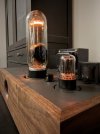
I did also want to show what a kit could look like with some customizations. This is my personal set (please ignore the messy basement background; we just moved and are still settling in). I had some walnut bases made, and I painted the chassis plate a gunmetal grey and all the other topside components a matte black. We also offer some lit meters.

These kits are really ripe for customization, and we tend to focus on how they sound instead of offering a lot of aesthetic options. That keeps our inventory more sane and our costs lower, which keeps the prices in check as well.


A couple notes on pricing while we’re at it. Our margins on these are similar to what our margins are on other products. There are three beefy chokes and transformers we have made bespoke for us, the top chassis plates’ thickness had to be increased to support the weight, and we include all the tubes you need. None of these components are cheap (well, two of the three tubes per monoblock are sub $10), and you have double the bill of materials because there are two of everything per kit.

I also acknowledge and am frustrated by the badge not being included in other kits (although we did price them into the Paradyne). We offer those to our customers at our cost, and we have not yet found a more cost effective way to produce those at a level of quality we expect. We investigated tossing those in as a freebie for all kits, but those costs exceeded what we could absorb.

In any case, we’re feeling very pleased with how the launch has gone. As new owners and new entrants into the audiophile game, we’re learning as we go and are grateful for everybody’s feedback and patience. We’re also thrilled with the partnership we have with the Pauls and happy to say that we have a wealth of knowledge from Dan and Eileen that we can draw on.

IMG_6032.jpeg
IMG_6076.jpeg
 
This might be weird timing in this thread, but, can anyone, maybe one of the Pauls, explain exactly what “parafeed” is?
I feel like every couple years I dip my head inside of amplifier design and discover I never even really knew what I thought I knew before.
5k sounds too much for me right now, but it sounds pretty good for 35w set. Are there listening reports yet?
 
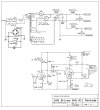
Here is an example of a parallel feed SE amp that I built a couple of years ago from a schematic by Paul B and some advice since his original design was series feed. Notice that the output tube has a choke for a plate load to provide the DC feed to the tube. The output transformer is capacitor coupled to the plate to prevent DC current. This allows the output transformer to be made without a gap in the lamination stack. This isn't anything new as it is discussed in some of the old text books from the 1930's. The RDH4, Radiotron Designer's Handbook V4 and which you can download, discusses this on pages 519 and 645.

6V6 to 6V6 r2j parafeed.jpg
 
A simple internet search can provide the information you seek.
I asked, in THIS thread because it’s very relevant to Bottlehead’s offerings, and specifically this very one and there’s no explanation on Bottlehead’s site. Which is quite something as they are also one of the only companies I’ve ever heard of to offer this topology commercially and declare it openly.
 
I did also want to show what a kit could look like with some customizations. This is my personal set (please ignore the messy basement background; we just moved and are still settling in). I had some walnut bases made, and I painted the chassis plate a gunmetal grey and all the other topside components a matte black. We also offer some lit meters.

These kits are really ripe for customization, and we tend to focus on how they sound instead of offering a lot of aesthetic options. That keeps our inventory more sane and our costs lower, which keeps the prices in check as well.


A couple notes on pricing while we’re at it. Our margins on these are similar to what our margins are on other products. There are three beefy chokes and transformers we have made bespoke for us, the top chassis plates’ thickness had to be increased to support the weight, and we include all the tubes you need. None of these components are cheap (well, two of the three tubes per monoblock are sub $10), and you have double the bill of materials because there are two of everything per kit.

I also acknowledge and am frustrated by the badge not being included in other kits (although we did price them into the Paradyne). We offer those to our customers at our cost, and we have not yet found a more cost effective way to produce those at a level of quality we expect. We investigated tossing those in as a freebie for all kits, but those costs exceeded what we could absorb.

In any case, we’re feeling very pleased with how the launch has gone. As new owners and new entrants into the audiophile game, we’re learning as we go and are grateful for everybody’s feedback and patience. We’re also thrilled with the partnership we have with the Pauls and happy to say that we have a wealth of knowledge from Dan and Eileen that we can draw on.

View attachment 3751610
View attachment 3751609

Have you considered selling amps with a metal chrome plated chassis? I'm not a fan personally of the old furniture look
 
Since it’s a kit, just make the type of chassis you want. I like wood. To me it is more beautiful than any piece of metal but I look old too so it matches.
 
I asked, in THIS thread because it’s very relevant to Bottlehead’s offerings, and specifically this very one and there’s no explanation on Bottlehead’s site. Which is quite something as they are also one of the only companies I’ve ever heard of to offer this topology commercially and declare it openly.
You got the response you did because there is nothing unique about the way Bottlehead uses parafeed, which is one of the basic configurations of output transformer connection, along with series-feed and push pull. So general information about parafeed will be as useful as anything specific to Bottlehead. But basically it adds a coupling cap and removes DC in the OPT primary.
 
Since best results in parallel feed are with output transformers that are without a gap, you can also use a PP transformer for SE parafeed if you have one with the primary you need.
 
One potential problem with that approach is that the blocking choke and output transformer primary are effectively in parallel to signal ground. The transformer may or may not have sufficient inductance under those conditions for the amplifier to produce low bass. Also, core flux increases significantly when the signal frequency moves into the first octave. It's the same effect as DC. Whether the transformer can produce acceptable performance will depend on many factors. Unlike a dedicated SE transformer that carries manufacturer's specifications, the end result can't be known until it's tested in this mode.

Jack
 
I don't have my notes handy, but IIRC the plate choke and output transformer were designed to operate down to 30Hz at 35 watts, using a relatively conservative 13,500 Gauss peak with M6 laminations. In an earlier post (#13) the measured performance confirms the design.
 
Last edited:
I don't have my notes handy, but IIRC the plate choke and output transformer were designed to operate down to 30Hz at 35 watts, using a relatively conservative 13,500 Gauss peak with M6 laminations. In an earlier post (#13) the measured performance confirms the design.
Just to be clear, my earlier comments regarding flux and parallel inductors weren't aimed at your product. I was referring to the post by @nerdorama about the possibility of repurposing a push-pull transformer for parafeed. Are any companies still producing parallel feed transformers as an OTS product? Or was Magnequest the last one?

Jack
 
Back
Top Bottom