

You are using an out of date browser. It may not display this or other websites correctly.
You should upgrade or use an alternative browser.
You should upgrade or use an alternative browser.
Register to hide this ad

halkaloogie
The Jerk
My first guess would be that because you're using an AV receiver you may be using a setting that puts a bass cut to the speakers for use with a subwoofer in a HT setup. I'd try messing with the settings on the HK to see if that's causing the problem. Those Sansui's should have plenty of low end, so I suspect the HK is the problem.

Amp is 50wpc (20-20K) and speakers are sensitive (mid-90s db/w/m) so they shouldn't be. The speakers are old as dirt, might be time to recap the crossovers and deoxit the L-pads.
How will new capacitors improve bass performance?

Yeah, misread the original issue prior to posting; was thinking overall sound issues.How will new capacitors improve bass performance?

John Carr
Active Member
Ok I will spend some time messing with settings. Thank you for the adviceMy first guess would be that because you're using an AV receiver you may be using a setting that puts a bass cut to the speakers for use with a subwoofer in a HT setup. I'd try messing with the settings on the HK to see if that's causing the problem. Those Sansui's should have plenty of low end, so I suspect the HK is the problem.

RTally
Speaker addict
How will new capacitors improve bass performance?
A capacitor in a tweeter's high pass filter, if it has drifted high, will pass some of the LF signal intended for the woofer. The woofer is not as loud because part of its signal is being diverted to the tweeter. The tweeter likely rolls off at the lower frequencies so the low frequency signals it is receiving are not that audible.
Also, the tweeter cap that has drifted high decreases the speaker's impedance for the frequency range where it overlaps the woofers normal range. That is, the woofer's impedance is in parallel with the tweeter's impedance for the lower frequency range of the tweeter. Normally, the tweeter circuit has a high impedance for that frequency range but the bad cap lowers the impedance. The resulting lower impedance is a harder load for the amp and lesser amps may struggle with the lower impedance.
I've seen where some have measured their old crossover caps to have doubled in capacitance value. That could lower the tweeter's crossover frequency by an octave for a first order filter.

swechsler
Frog Whisperer
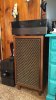
Could be something a little more obvious, too. It looks like the woofers have rubber surrounds. It's not unheard of for rubber (depending on the formulation) to stiffen up as it ages. OP, if you push in gently on the woofer cone, does it move freely? Or is there a lot of resistance?
John Carr
Active Member
It moves easily. I think it’s an amp problem.Could be something a little more obvious, too. It looks like the woofers have rubber surrounds. It's not unheard of for rubber (depending on the formulation) to stiffen up as it ages. OP, if you push in gently on the woofer cone, does it move freely? Or is there a lot of resistance?

fredgarvin
Super Member
Often those have a setting for your front speakers called Large and Small. You want Large.It moves easily. I think it’s an amp problem.

whoaru99
Epic Member
If the HT receiver is new to you I strongly suggest a factory reset then go through the configuration to be sure I's set up properly for your use case.
Another thing to do is momentary connect a small battery, AA, C, D, to the speaker terminals (+) to (+) and (-) to (-). As you make the connection check that the woofer on each speaker moves the same direction (typ. should push out).
Another thing to do is momentary connect a small battery, AA, C, D, to the speaker terminals (+) to (+) and (-) to (-). As you make the connection check that the woofer on each speaker moves the same direction (typ. should push out).

LWB
Well-Known Member
I see you have a small sub-woofer beside the Sansui speaker. If you are connecting the sub to the LFE output of the receiver, the receiver's internal circuitry rolls off the bass in your main L & R speakers, and leaves bass response to the sub. You can avoid this by using the high-level speaker inputs on the sub to connect the L & R and sub in parallel. Don't use the receiver's LFE out. Then you can tune the sub's bass response to match the L & R to your own ear.

maxhifi
Addicted Member
"So little bass" is a very subjective description. It could mean anything from open woofer voice coils, to misplaced expectations.
Keep in mind these speakers are from 50 years ago, and were designed with sensitivity as a priority over bass extension, due to the lack of low bass material in the popular music at the time, and the lower powered amplifiers which were popular then. They probably will be solid down to about 60Hz at best, you definitely won't get solid 30Hz bass from an old Sansui speaker. On the other hand, they will go loud with very little power.
They should give you a natural well balanced sound though, and if you are getting something with no bass at all, something is certainly wrong.
Keep in mind these speakers are from 50 years ago, and were designed with sensitivity as a priority over bass extension, due to the lack of low bass material in the popular music at the time, and the lower powered amplifiers which were popular then. They probably will be solid down to about 60Hz at best, you definitely won't get solid 30Hz bass from an old Sansui speaker. On the other hand, they will go loud with very little power.
They should give you a natural well balanced sound though, and if you are getting something with no bass at all, something is certainly wrong.

kfa888
Addicted Member
First off many of those types of Japanese speakers, despite having large woofers, were not designed well for producing deep bass. Many also had so many mid and tweeter drivers all over them they overwhelmed the bass response. Those also have a huge front port so positioning is going to greatly effect the bass output. Additionally have you tried any other amps on them? I have found many speakers should quite different depending on what is driving them. I would think a vintage Sansui or Pioneer amp might be a good match.
whoaru99
Epic Member
Another thing with HT receivers/AVRs is that you have to turn the volume knob much more than one is accustomed to if your experience is vintage receivers. It's not that the AVR is broken, they just have completely different (much less aggressive) volume control scaling/gain structure.
A capacitor in a tweeter's high pass filter, if it has drifted high, will pass some of the LF signal intended for the woofer. The woofer is not as loud because part of its signal is being diverted to the tweeter. The tweeter likely rolls off at the lower frequencies so the low frequency signals it is receiving are not that audible.
Also, the tweeter cap that has drifted high decreases the speaker's impedance for the frequency range where it overlaps the woofers normal range. That is, the woofer's impedance is in parallel with the tweeter's impedance for the lower frequency range of the tweeter. Normally, the tweeter circuit has a high impedance for that frequency range but the bad cap lowers the impedance. The resulting lower impedance is a harder load for the amp and lesser amps may struggle with the lower impedance.
I've seen where some have measured their old crossover caps to have doubled in capacitance value. That could lower the tweeter's crossover frequency by an octave for a first order filter.
I would assume the OP is talking about lower frequency performance. The SP-200s are 3-way...to the extent that that midrange drivers and tweeters are getting some of the low frequency signal, it would be at the higher end of it. Also, I am under the impression that to the extent the mids or tweeters are carrying lower frequencies than intended due to increased capacitance, those same frequencies are still available to the woofer. If not, what is the mechanism that keeps the woofer from "seeing" them?
RTally
Speaker addict
I would assume the OP is talking about lower frequency performance. The SP-200s are 3-way...to the extent that that midrange drivers and tweeters are getting some of the low frequency signal, it would be at the higher end of it. Also, I am under the impression that to the extent the mids or tweeters are carrying lower frequencies than intended due to increased capacitance, those same frequencies are still available to the woofer. If not, what is the mechanism that keeps the woofer from "seeing" them?
A 3-way would likely result in a more noticeable suppression of the upper bass than a 2-way because the mid crossover network would likely reach well into the usable range of the woofer.
The mechanism is parallel impedances within the now overlapping frequency range of the woofer and mid. As I said previously, part of the signal (power) normally going only to the woofer is now going to the mid driver. I can only explain so much on a forum, but it has to do with the electrical characteristics of the speaker. A good way to test it would be to chart impedance over the FR. There would likely be an impedance dip where the mid now overlaps the woofer. If the FR response of the speaker were tested, there would likely be a dip in the overlapped region.

All these just and fine responses......I love it.
Audiokarma. We'll help the hell out of you.

Audiokarma. We'll help the hell out of you.
A 3-way would likely result in a more noticeable suppression of the upper bass than a 2-way because the mid crossover network would likely reach well into the usable range of the woofer.
The mechanism is parallel impedances within the now overlapping frequency range of the woofer and mid. As I said previously, part of the signal (power) normally going only to the woofer is now going to the mid driver. I can only explain so much on a forum, but it has to do with the electrical characteristics of the speaker. A good way to test it would be to chart impedance over the FR. There would likely be an impedance dip where the mid now overlaps the woofer. If the FR response of the speaker were tested, there would likely be a dip in the overlapped region.
Capacitors are not the likely cause of poor low frequency response. Check polarity, assure AVR settings are appropriate for "large" speakers (or whatever setting assures full frequency range to the mains), and if that's not it, check the woofers with a meter.
Last edited:

gizzyman47
Addicted Member
Don't forget to check the tone controls. Maybe the bass is turned way down?


