• The move to the new server is done. There are some software and database maintenance updates in process. This has us passing the hat around to help out. We appreciate any donations. Seriously, even a dollar helps. The payment page may be found here - https://www.audiokarma.org/support.html

HK Citation 1

Register to hide this ad
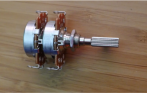
Looks like a dual gang, 500K double tapped pot.
Not easy to find.
I would make an equivalent with a stepped attenuator and discrete resistor if size permits.
And a good stepped attenuator is $$.
 
It sounds fantastic, but the balance/volume (either or) aren’t towing the line. Anyone make or have a plan to build a replacement? This one is close to being awesome. Otherwise it’s in pretty solid shape. I cleaned it up, recapped all the main cans and put a new set of tubes in it. I don’t mind spending some $$$. Just hearing the left channel with the right being lame has me quite motivated from what I have heard so far driving a Luxman M4000. I am fairly experienced with restorations, just haven’t built replacement pots so could use some pointers.
 
This is supposedly a replacement but it’s different from the original. And.. I do like the idea of doing something better.
1689818664646.png
 
Be curious how that works out for you. Mine has the same issue...
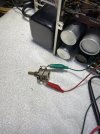
I am going to pull the volume pot later today and do some out of circuit measurements. I found a supposedly new replacement pot that I am asking more questions on as it doesn’t have the exact same connections as the original. Will report back here what I learn. I am also going to replace all the color coded tubular’s with Jantzen 400 volt crosscaps and see if that helps anything. They are all easy to get to and I can just cut the originals out
 
stepped attenuator is a nice option if you get enough steps. Can just make your own taps at that point, just need to know where the originals are. Hopefully its on the schematic or parts list, I wouldn't trust measurements off an original pot.

exactly what ails the original pot? If its got a crackle that cleaning doesn't fix, I'd really be looking hard at those bumblebee caps. DC leakage makes pots noisy, and those capacitors are awful for it.
 
I just brought this Citation 1 back from the dead. Having a problem with the loudness (volume) pot. Anyone successfully rebuild one?
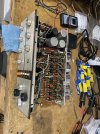
View attachment 2937663
I have not worked on that amp, but my advice is to get rid of those black capacitors with the color bands indicating their capacitance values. They end to leak (small DC currents, not liquids, since they contain none). Sometimes the cases develop cracks in them as well.
 
looking closer at the schematic, this also has local feedback loops around many of the tube sections in the line stage. If those resistors are off, the gain will be off side to side. A bad volume pot tends to have tracking problems, it will shift the balance side to side as you change it. If the feedback resistors are off, it will just be skewed in one direction but it would be fixable with the balance control. Carbon resistors are pretty prone to drift so they would be worth checking at least in circuit and comparing side to side if they read funny because of other parts across them.

the resistors being off will also screw with how the tone controls work. This is way more complex than your average preamp, the bass and treble controls switch in and out different caps and resistors rather than just using pots to do it.
 
looking closer at the schematic, this also has local feedback loops around many of the tube sections in the line stage. If those resistors are off, the gain will be off side to side. A bad volume pot tends to have tracking problems, it will shift the balance side to side as you change it. If the feedback resistors are off, it will just be skewed in one direction but it would be fixable with the balance control. Carbon resistors are pretty prone to drift so they would be worth checking at least in circuit and comparing side to side if they read funny because of other parts across them.

the resistors being off will also screw with how the tone controls work. This is way more complex than your average preamp, the bass and treble controls switch in and out different caps and resistors rather than just using pots to do it.
All the 0.1uf’s have been replaced. It’s either the balance or the volume and would put $100 on the volume
 
This is way more complex than your average preamp, the bass and treble controls switch in and out different caps and resistors rather than just using pots to do it.

I think it might be psychosomatic but I hear a difference when certain 12at7's occupy the tone circuits.
The tone controls are set flat but still seem to be effected by the tubes in them.

Aren't the tone controls out of the circuit when set to flat?
 
There are always some components in the path, even when set to flat, but many of them are switched out. Looks like the bass control bypasses one of the 12at7 entirely if I'm following this right (and I may not be) but it passes signal through other components to make that bypass happen. I'm not 1000% sure if these are drawn when set to flat, though I think they are. Also quite honestly I tend to get lost in multi selector switches. Usually i have to print them out and actually draw out the signal flow.


has a good scan of the schematic down towards the bottom.

loads of high value carbon resistors, many of which I'd bet are no longer on value in those tone controls. R35, R51, R66, R71 and the equivalents in the other channel all provide local feedback at their respective stages. R43, R55, R40, R67 all appear to be part of the bypass path that gets signal around the tone control circuits. Then the various plate and cathode resistors. Its just a complicated piece of machinery with a lot of potential spots for imbalance. Plus of course the old carbon volume and balance pots which may very well be off too. The fixed resistors are just a lot easier to deal with than the pots so I'd want to be 100% sure that they are in fact the problem. Some ohm checks would be in order to confirm.
 
I'm not an expert on the Cit 1, but my choice would be to replace the volume control with a standard pot with no loudness tap. They don't cost much, and this approach would allow you to use the unit while you search for an exact replacement. This is one reason I don't buy used preamps. It's to be expected that controls and switches will be worn out after 50 or 60 years of use.

Jack
 
Back
Top Bottom