• The move to the new server is done. There are some software and database maintenance updates in process. This has us passing the hat around to help out. We appreciate any donations. Seriously, even a dollar helps. The payment page may be found here - https://www.audiokarma.org/support.html

New Project Very Early TD 124

BTW... The Thorens technician picture was sent to Rudolf A. Bruil of the soundfountain.com audio & music bulletin by Joachim Bung, author of the 2008 "Swiss Precision" Thorens history book, who is also using it in his book. It's claimed to be of a 'technician checking and adjusting the precise turning of the green painted platter of the TD-124'. It can sure be regarded as some measure of quality control - but the "nothing more" part appears highly inaccurate.
 
I am personally interested if the new mushrooms lower the noise floor as seen on your OScope.

Yeah me too, it got cold here in south TX, at least for me:bs:moved the Thorens inside away from all my test equipment… too lazy to fire up the shop heater, plus the forecast has it back to normal in a day or so.

My suspicion is that there’s a reduction in very low frequency responses, and/or feedback type vibrations, from these bumpers. The ones I’m using are of a different type material from original and have the metal inserts.

The Thorens Rhapsody ( images below are from theanalogdept.com ) is of interest to me, it’s recessed mounted and employs springs in place of the rubber bumpers. This approach is also mentioned in the TD 124 Service manual.

Plinth design and understanding has developed over the years, mainly because of the combination of new materials coupled with experience/observations of builders.

However many fail to grasp the difference in attenuation & dampening and both need implementation for idler machines, and each has visible (testable) and aural effectiveness; sometimes good results and sometimes bad results musically :confused:

I’ll be using the Rhapsody as inspiration, even though I’d come up with my design prior to seeing the original, however the inside will have lots of mass combined with a sprinkling of dampening material;)

5D967D5D-348F-4EE3-9A11-D1845CE976D1.jpeg 9CDDD850-C264-4E8A-8D3B-324E34E5DB9F.jpeg 9FF24950-31B7-452E-A248-2866B4871712.jpeg
 
^^^ never saw that before. Certainly something to consider although it's still a hollow box and there many folks out there that swear by mass in the plinth for the 124.
 
^^^ never saw that before. Certainly something to consider although it's still a hollow box and there many folks out there that swear by mass in the plinth for the 124.

It’s spring mounted inside the plinth, this design is eluded to in the service manual…..I’m more interested in the presentation, than the technical design :cool:
 
An interesting concept combining a (I assume) a massive top deck to absorb motor vibrations and spring mounts to decouple from floor vibration.

Combination of designs much like the TD-124 combines belt and idler designs.

I like it!
 
I’ll be using the Rhapsody as inspiration, even though I’d come up with my design prior to seeing the original,
I have one of these that came with the TD-124 I've purchased. My initial instinct was to toss it in the bin. However, over the refurb process I've grown used to it. I've always wanted an Artisan Fidelity style plinth for my TD-124, but the more I kept listening, the more I was loosing the motivation to shed the $$$ to get one. I soon reverted to a DIY policy, but with a new set of mushroom grommets (instead of the rock stiff, deformed old ones), I've lost the motivation to do that too. Something about that belt/idler drive and the alloy cast chassis seems to make the peripherals insignificant.
 
When building plinths for myself my approach is to draw 3 possible variations of my design concepts and then make my decision and revisions…

Haven’t come up with all 3 yet so I’m being vague about the plinth design, plus I’m enjoying the table as it is:cool: When the weather changes I’ll get to it….

Switched over to my ESL 1000 it’s a completely original version with Bakelite Ortofon SPU headshell with the ESL logo.
The tonearm was provided to me by @ewplayer3 along with a rare Shure MD3:thumbsup: Has the Bakelite base also but was concerned with the durability of the Bakelite base so @BillWojo designed and machined a new close tolerance base out of aluminum for me:thumbsup:

Really a nice retro look, and the old Shure 44 is sounding terrific:trebon:

7658CFC3-FCB0-414E-AD84-9FCAB6E14D66.jpeg
 
I have one of these that came with the TD-124 I've purchased. My initial instinct was to toss it in the bin. However, over the refurb process I've grown used to it. I've always wanted an Artisan Fidelity style plinth for my TD-124, but the more I kept listening, the more I was loosing the motivation to shed the $$$ to get one. I soon reverted to a DIY policy, but with a new set of mushroom grommets (instead of the rock stiff, deformed old ones), I've lost the motivation to do that too. Something about that belt/idler drive and the alloy cast chassis seems to make the peripherals insignificant.

Tom, that’s a rare one, would love to see photos if possible?

VR
Andy
 
Oh, you got me where it hurts buddy... I've poured nearly a couple grand into this 124 on top of the initial purchasing price including a professional body shop paint job, and yet... it's still mounted in this rotting piece of junk - which now I hear is some rarity. I'm not proud!

The plinth is actually in a poor cosmetic shape, it's dinged with some swelling at the bottom (prolly got soaking wet at some point) and it appears a little slanted to it's length. It does not accommodate my angled 12" armboard very well. There's a see-through triangular gap on the top, exposing the unfinshed internals and it is not a pretty sight.

It doesn't do the turntable any cosmetic justice and I'm kinda shy about it - so no pictures! Sorry. I'm bound to replace it at some point in the future so you could have it if you so desire and it's worth the shipping cost to you. On the bright side... It does the job and I've discovered that it keeps undesired attention from guests and that it repels busy little fingers away from the 124 at home. I'm still far from proud.
 
Oh, you got me where it hurts buddy... I've poured nearly a couple grand into this 124 on top of the initial purchasing price including a professional body shop paint job, and yet... it's still mounted in this rotting piece of junk - which now I hear is some rarity. I'm not proud!

The plinth is actually in a poor cosmetic shape, it's dinged with some swelling at the bottom (prolly got soaking wet at some point) and it appears a little slanted to it's length. It does not accommodate my angled 12" armboard very well. There's a see-through triangular gap on the top, exposing the unfinshed internals and it is not a pretty sight.

It doesn't do the turntable any cosmetic justice and I'm kinda shy about it - so no pictures! Sorry. I'm bound to replace it at some point in the future so you could have it if you so desire and it's worth the shipping cost to you. On the bright side... It does the job and I've discovered that it keeps undesired attention from guests and that it repels busy little fingers away from the 124 at home. I'm still far from proud.

Tom:

Didn’t intend to put you on the spot…..Understand, that’s too bad about the damage. Appreciate the offer but not sure I’d use one even if it was in good condition. The design is intriguing, not just the springs but the fact that it’s recessed, including the arm board, it’s aesthetically pleasing to me.

VR
Andy
 
Yes, I see your point. The TT sunk into the base like this is kinda cool. Mine came without any springs, which were likely lost decades before I've had anything to do with it. At some point I've pulled the springs off a Lenco L75 base (same principal plinth except it never worked) and swapped them in. Lo and behold... Neah, the TD-124 had just collapsed them like a tank. I've never believed in spring based plinth suspension. It always looked so cheesy to me. The Lenco base never 'suspended' anything except maybe when the springs were new back in the early 70's. I suspect this Thorens design, which IMO lacks any remarkable craftsmanship anyway, was ever able to do much better. It's doing fine as a static design with 4 planks of wood and a top where I can let the 124 ride on it's mushroom grommets and level it. The rest is up to the 124 magic, which there's plenty of.
 
I've never believed in spring based plinth suspension.

Agree largely here. Springs will stretch over time, are far more subject to footfalls than other isolation methods and are tough to level. Doesn't matter what the application is. I have a Sota Sapphire that is hung from springs. About once a year I am forced to adjust the arm as the springs stretch over that time and push the arm out of alignment. At some point there will be no more room for adjustment. Ironically I have a Yamaha PF-800 table with the same spring concept and have never had to make an adjustment after the initial setup. Go figure... it's a much lighter table though.
 
The springs in the Lenco base are actually compressed. They can collapse, but can't get stretched. I've seen Dual do this too. I was not referring to the actual turntable chassis/sub-chassis suspension systems. The TD-125 suspension is most of the time remarkable even more than 5 decades later and so is the TD-16X. I was talking about the plinths. I think many of the plinths were not designed with the same care and attention to details as the turntables. They don't just look cheesy - they are.
 
Yeah, springs was a cost effective way to do a little attenuation and dampening. As mentioned before, it was really the aesthetics that caught my attention, and the fact that unique things are always more interesting to me.

Reviewing old threads, came accurately this addition by @Lapslah took some time and effort to do this so I thought it’s appropriate to re-post here not to mention how useful it is for anyone designing their own plinth.

Many thanks for your effort,

Andy

037B5C0D-4232-4B77-B439-45DD60A51C4B.jpeg 1A6A40AB-9E93-4B27-8750-87766DC63AB3.jpeg
 
Alright... run me through the phase of what happens when QC finds the platter is untrue and the hole is not in the middle. What? A 4.5Kg cast iron platter goes in the garbage? They re-drill the hole?

Excellent question! I'll assume you were being facetious about tossing the platter, except in the worst circumstances. So let's follow this line of thinking. What makes more sense - re-drilling the hole and making it too large; filling and re-drilling, making it possibly unstable; or using the existing hole as the center to re-turn the platter on a lathe so that it's true and balanced, as it should have been from the start? To me, the last option is the clear choice, and would result in a platter that could be removed from the spindle without worry - as implied by the three screws that make the process so easy. It seems to me that if the end-user wasn't supposed to separate them, they would have either made them as a single piece, or at least put the screw heads on the underside so you would be forced to remove and insert them together.

Signed,
Brainiac
 
I'll assume you were being facetious about tossing the platter, except in the worst circumstances.
Yeah, I was just kidding about that. I wouldn't expect them to toss it in the bin unless something terrible had happened in the casting process, which would spell disaster for the whole batch. They wouldn't re-drill the hole, nor refill it, and unlike the 'zamak' platters of the later 150/125/16X turntables, there's no imprint signs of ever dynamically balancing those 124 platters, nor are there any lathe grip holes. I doubt the lathe was an option to begin with. This leaves those 3 screws and tapped holes between the platter and spindle assembly. Ever wondered why there's little wiggle play between those two parts just before tightening the screws? Is it even conceivable that Thorens couldn't tap those holes to the tightest tolerance - like the rest of the TT? We know what they were capable of, so that's not accidental. It appears that little wiggle play is their headroom tolerance, built in and designed so that the spindle assembly could be aligned with the platter, no matter what small deformities could show up after the casting of the platter. That was the job (as mentioned by authoritative sources like Joachim Bung) of those technicians, like the one shown in the picture. :)
 
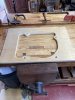
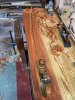
Started work on the plinth this afternoon, cut out the top layer of plywood and started prepping the wood.
Looks like a pretty nice tooled up shop. Way to go! Where did you get the 124 cut template on the top plate from? I need one that I can print too.
 
Back
Top Bottom