

You are using an out of date browser. It may not display this or other websites correctly.
You should upgrade or use an alternative browser.
You should upgrade or use an alternative browser.
Suggestions for co-axial driver?
- Thread starter CalyptorH
- Start date
-
- Tags
- diy project
Register to hide this ad

CalyptorH
New Member
Morel 6"? https://www.madisoundspeakerstore.com/coaxial/morel-integra-624/
SB acoustics 5" https://www.madisoundspeakerstore.c...-sb13pfc25-4-coax-5-paper-cone-coaxial-4-ohm/
Morel 5"? https://www.madisoundspeakerstore.com/coaxial/morel-hybrid-integra-524-5-coaxial-driver/
Seas 6.5" @ a generous $450! Luckily they're out of stock.
On brand reputation the Morels look good with the 6" featuring a more gradual roll-off from ~ 100Hz if not being used with a sub. The 5" might be a batter bet with a sub.
SB acoustics 5" https://www.madisoundspeakerstore.c...-sb13pfc25-4-coax-5-paper-cone-coaxial-4-ohm/
Morel 5"? https://www.madisoundspeakerstore.com/coaxial/morel-hybrid-integra-524-5-coaxial-driver/
Seas 6.5" @ a generous $450! Luckily they're out of stock.
On brand reputation the Morels look good with the 6" featuring a more gradual roll-off from ~ 100Hz if not being used with a sub. The 5" might be a batter bet with a sub.

pliskin
Active Member
Inspired by KEF's Q100 speakers I'd like to put together a DIY bookshelf speaker using a high quality co-axial driver of 6" or less diameter.
Any suggestions appreciated ... ?

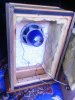
I had this pair of DIY with Layfayette? biaxial drivers. For vintage they really sounded good in the floor speaker.
CalyptorH
New Member
Interesting kit: https://www.madisoundspeakerstore.c...s/seas-loki-mkii-coaxial-kit-parts-only-each/
Seas Loki 7" cone with 1" dome but sensitivity at 82db is a little low for my taste.
Seas Loki 7" cone with 1" dome but sensitivity at 82db is a little low for my taste.

Depends if you want an active or a passive coaxial - do you want a separate tweeter in the middle, or a center mounted separate cone? The KEFs have an actual tweeter in the center, with the associated crossover, and the complications that creates. If that is what you want, cannibalizing a KEF might be the easiest way to go, and it is reversible. There are others out there - Goodmans made one that used induction to drive the tweeter, thus avoiding capacitors in the crossover, but I have never seen one myself, and I think the driver was larger than 6 inches.
Most passive coaxials use a lighter small cone which radiates the higher frequencies which the larger, heavier cone cannot move quickly enough to reproduce - the crossover is mechanical (Good well known examples are the Lowthers, Fostexes and Corals, but there are many others out there including some new production ones). A smaller number of full range passives use either a small central area that is connected to the outer part of the cone through a compliant section (Altec Biaxials do this, but larger than you want), or simply tailor the flare and thickness/stiffness of the cone to have a sort of progressive change in frequencies radiated (the Western Electric 8 inch is a highly sought version of this, but there are quite a few others).
Another option, of course, is simply using a long excursion small driver, perhaps in multiples (The various iterations of the Ted Jordan driver is a well known example).
Most passive coaxials use a lighter small cone which radiates the higher frequencies which the larger, heavier cone cannot move quickly enough to reproduce - the crossover is mechanical (Good well known examples are the Lowthers, Fostexes and Corals, but there are many others out there including some new production ones). A smaller number of full range passives use either a small central area that is connected to the outer part of the cone through a compliant section (Altec Biaxials do this, but larger than you want), or simply tailor the flare and thickness/stiffness of the cone to have a sort of progressive change in frequencies radiated (the Western Electric 8 inch is a highly sought version of this, but there are quite a few others).
Another option, of course, is simply using a long excursion small driver, perhaps in multiples (The various iterations of the Ted Jordan driver is a well known example).

mhardy6647
Lunatic Member
What is the F3 for that alignment?Interesting, thanks. There's a surprising number of Lafayette speakers on ebay with a pair just like yours for $90 but they don't send to Australia.
The Morels use a really small box at .2 cubic feet!
...
Most passive coaxials use a lighter small cone which radiates the higher frequencies which the larger, heavier cone cannot move quickly enough to reproduce - the crossover is mechanical (Good well known examples are the Lowthers, Fostexes and Corals, but there are many others out there including some new production ones). A smaller number of full range passives use either a small central area that is connected to the outer part of the cone through a compliant section (Altec Biaxials do this, but larger than you want), or simply tailor the flare and thickness/stiffness of the cone to have a sort of progressive change in frequencies radiated (the Western Electric 8 inch is a highly sought version of this, but there are quite a few others).
Another option, of course, is simply using a long excursion small driver, perhaps in multiples (The various iterations of the Ted Jordan driver is a well known example).
Speaking of Altec -- and folks who don't live in the US
 -- Altec made and sold a family of cheap and cheerful "coaxials" that were meant for low-end sound reinforcement applications, but which in practice ain't half bad for hifi, either: The Altec 409.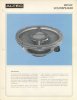
source: http://alteclansingunofficial.nlenet.net/proloudspeakers/duplex/index.html
Speaking of 'biflexes', another vintage option that is held in no mean regard (in some circles) and which should be easy to find even in Australia was a series of 'biflex' drivers made by Fukuin/Pioneer and sold under many house brand names (including Lafayette and also, IIRC, Hamlins). I'll have more to say anon on these -- gotta go now.
Last edited:

This B&C looks interesting; the company is a pro sound outfit and the B&C drivers I heard sounded very good.
https://usspeaker.com/B&C-6fhx51-1.htm
https://usspeaker.com/B&C-6fhx51-1.htm
Last edited:
US Speakers has several small coaxials from high quality makers such as B&C, Beyma and Faital. And the big boys too such as the 15" Radian. The coaxials on this site are of the Altec Duplex type with compression driver tweeters mounted behind the woofer and firing through the woofer pole piece. Serious stuff.
https://usspeaker.com/homepage.htm
https://usspeaker.com/radian 5215BeNeo-1.htm
https://usspeaker.com/homepage.htm
https://usspeaker.com/radian 5215BeNeo-1.htm
Last edited:
mhardy6647
Lunatic Member
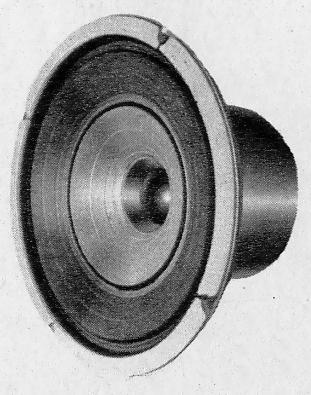
so -- the vintage Pioneer 'biflexes'. These are not bad. They're not uncommon either -- although they're also not particularly inexpensive.
Not state of anybody's art, then or now, but they reproduce music with some feeling and soul (which is what at least some of us desire when it comes to hifi).
 Pioneer LRE biflexes by Mark Hardy, on Flickr
The Lafayette morph of the 8" Pioneer.

source: https://www.americanradiohistory.com/Archive-Catalogs/Lafayette-Catalogs/Lafayette-1968-680.pdf
Pioneer called it the PIM-8 or PIM-20 (English vs. metric)
https://audio-heritage.jp/PIONEER-EXCLUSIVE/unit/pim-20a.html
.JPG)
Of course, dispersion is the price one pays in drivers like these.
Not state of anybody's art, then or now, but they reproduce music with some feeling and soul (which is what at least some of us desire when it comes to hifi).
Pioneer LRE biflexes by Mark Hardy, on FlickrThe Lafayette morph of the 8" Pioneer.
source: https://www.americanradiohistory.com/Archive-Catalogs/Lafayette-Catalogs/Lafayette-1968-680.pdf
Pioneer called it the PIM-8 or PIM-20 (English vs. metric)
https://audio-heritage.jp/PIONEER-EXCLUSIVE/unit/pim-20a.html
Of course, dispersion is the price one pays in drivers like these.

Those Fukuin/Pioneers are nice - I think Mark got some from me years ago, or maybe it was vice versa.
There is something about the sound of full range drivers that makes one dubious of the effect of caps and coils in the crossover. Obviously full range drivers have their own challenges, but lack of fun is not one of them.
There is something about the sound of full range drivers that makes one dubious of the effect of caps and coils in the crossover. Obviously full range drivers have their own challenges, but lack of fun is not one of them.
CalyptorH
New Member
Thanks for all the replies ... fascinating. I've got limited time right now but I'll make a start.
Nat, the KEF surprised me with it's performance. My suspicion is, that upper mid-range is not served well by larger cones and maybe even 6" can be too big, what with beaming and potential cone break up but I don't want to start a debate on that really. The size of the KEF obviously has limitations but for the range it covers the sound is good. I think Danny Richie of GR has made an improved crossover but that's another story. So I'm looking at an active tweeter rather than a whizzer. I admit I've never looked at the mechanism used by Fostex though it's obviously very successful.
mhardy, the F3 is 130Hz
Tom, the 6.5" B&C does look interesting. The response curve is rather dramatic:
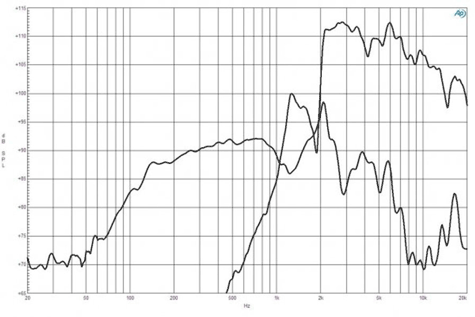
and the "predicted response" is umm, well:
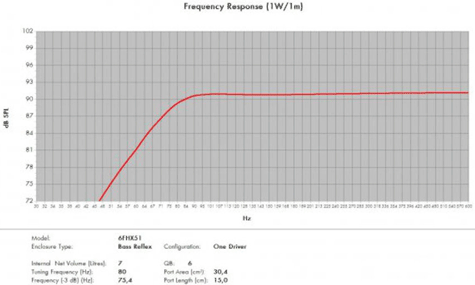
The larger drivers you link to are too big for what I'm doing.
Vintage Mark,
Thanks for now.
Jules
Nat, the KEF surprised me with it's performance. My suspicion is, that upper mid-range is not served well by larger cones and maybe even 6" can be too big, what with beaming and potential cone break up but I don't want to start a debate on that really. The size of the KEF obviously has limitations but for the range it covers the sound is good. I think Danny Richie of GR has made an improved crossover but that's another story. So I'm looking at an active tweeter rather than a whizzer. I admit I've never looked at the mechanism used by Fostex though it's obviously very successful.
mhardy, the F3 is 130Hz
Tom, the 6.5" B&C does look interesting. The response curve is rather dramatic:
and the "predicted response" is umm, well:
The larger drivers you link to are too big for what I'm doing.
Vintage Mark,
Yes, though the examples you give might be too large for what I'm attempting.they reproduce music with some feeling and soul (which is what at least some of us desire when it comes to hifi).
Thanks for now.
Jules

Poultrygeist
Lunatic Member
Eminence Beta 12-CX. The compression tweeter screws into the hole in it's magnet.
edit: Sorry I just remembered you want a smaller driver.

edit: Sorry I just remembered you want a smaller driver.
mhardy6647
Lunatic Member
the little Pioneer PIM-6L are 6 (or 6.5) inch -- and yes that trio in the photo above were from @Nat (I had actually forgotten that; sorry!).
I actually now have four of the 8 inch Pioneer PIM-20/LRE SK98s -- life goes like that sometimes.
More on these drivers from JE Labs' blog (aka @setup1 here at AK):
http://jelabs.blogspot.com/2018/07/lafayette-sk98pioneer-pim8l-redux.html
I actually now have four of the 8 inch Pioneer PIM-20/LRE SK98s -- life goes like that sometimes.
More on these drivers from JE Labs' blog (aka @setup1 here at AK):
http://jelabs.blogspot.com/2018/07/lafayette-sk98pioneer-pim8l-redux.html
Last edited:

Tannoy - I see a fair number of their ceiling speakers in ebay and other places. (search Tannoy CMS). The prices are all over the place. The good ones are the DC models (as in dual concentric) and I've seen 4, 5, 6, and 8 inches. The ICT drivers are not dual concentrics, but I've heard reports that they are pretty good and very robust. There are a lot of other pretty good small coaxials in ceiling speakers from other manufacturers.

setup1
Super Member
the little Pioneer PIM-6L are 6 (or 6.5) inch -- and yes that trio in the photo above were from @Nat (I had actually forgotten that; sorry!).
I actually now have four of the 8 inch Pioneer PIM-20/LRE SK98s -- life goes like that sometimes.
More on these drivers from JE Labs' blog (aka @setup1 here at AK):
http://jelabs.blogspot.com/2018/07/lafayette-sk98pioneer-pim8l-redux.html
I'm listening to a pair right now.
CalyptorH
New Member
Almost too many possibilities.
The reason the KEF Q100s have caught my attention is their ability to reproduce the sound of a piano. I have no idea why they do this but over the years I've tried all manner of bigger and better speakers which for some reason have some element of the piano sound missing. I've wondered if this was due to lack of bass, lack of treble or I don't know what but it's odd that a fairly middling 5" co-axial has some sort of sweet spot for piano.
At this stage I'm wondering if I should just try the obvious full range in Fostek. Well proven and well loved by many it's probably something that has to be given a go.
Mark, the blog you link to mentions "vivid midrange" for the Lafayettes and the same is often said for Fosteks. I really enjoyed the adds and other period information for the Lafayettes. I've got a couple of receivers from that period that I really appreciate so maybe they should be matched with speakers from the same era.
Thanks again everyone.
Jules
The reason the KEF Q100s have caught my attention is their ability to reproduce the sound of a piano. I have no idea why they do this but over the years I've tried all manner of bigger and better speakers which for some reason have some element of the piano sound missing. I've wondered if this was due to lack of bass, lack of treble or I don't know what but it's odd that a fairly middling 5" co-axial has some sort of sweet spot for piano.
At this stage I'm wondering if I should just try the obvious full range in Fostek. Well proven and well loved by many it's probably something that has to be given a go.
Mark, the blog you link to mentions "vivid midrange" for the Lafayettes and the same is often said for Fosteks. I really enjoyed the adds and other period information for the Lafayettes. I've got a couple of receivers from that period that I really appreciate so maybe they should be matched with speakers from the same era.
Thanks again everyone.
Jules
Similar threads


- Replies
- 33
- Views
- 5K
- Replies
- 12
- Views
- 9K
