• Please note that Audiokarma will be offline briefly for updates early on Monday morning, September 28th.

Altec 846B Valencia restoration next steps

D’oh, talk about missing the obvious. Black isn’t my first choice but this looks really good!
Maybe it’s a lost in translation thing but I didn’t find anything like that here. Do you have a link to what kind of cloth this is so I can look for something similar over here?
I'm thinking that this would be most similar to what I used.
 
I'm thinking that this would be most similar to what I used.
Thanks – I think I found something similar and ordered some samples, different colors too.
Couldn’t resist to order some of that cheap mesh fabric (Option C in my last post), too, so we’ll see.

One has to find other aspects to focus on (visual) when the ear is broken…
 
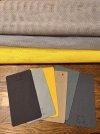
Still no decision regarding the grille cover fabric. New samples are in, but the speaker cloth I found isn’t as transparent as toddalin’s (it has pretty much zero transparency when in front of the woofer) – but they have great colors.

I made two frames quickly just to test the larger fabric pieces I have under real conditions. I did like the see-through look of the mesh fabric, but there are no dark colors other than black. Really wanted the yellow to work, but am unsure.

Testing the larger piece of grey cloth makes me think that this more conservative direction (grey—dark grey) might look better – but yet have to find a cloth with the right color AND transparency.

I really didn’t want to make this that complicated, haha.

IMG_5571.jpeg
088B33D5-03D1-4541-BD0B-07ADEE4979E6.jpeg
IMG_5605.jpeg
 
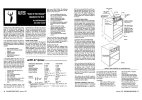
Yesterday I’ve read the article in Sound Practices issue 4 (Vol. 1 #4) on how to improve the sound of the Altec A7 and 806 and 416 drivers. Interesting read! I’m sure I could upload photos/a PDF of the article if anyone is interested and hasn’t read it yet.

In particular it seems to be a good idea to remove the bug filter mesh from the 806, which I would gladly try. Just haven’t figured out yet how to do it without losing charge on the magnet.

The other thing I might try is add more bracing to the cabinets, although the Valencia cabinet seems sturdier than the A7 one.


My right ear is still deaf so I’m looking for things to do other than listening :/

(No updates on the color choices, pretty sure I’ll start with painting the woofer board grey and then might use black mesh fabric)
 
Yesterday I’ve read the article in Sound Practices issue 4 (Vol. 1 #4) on how to improve the sound of the Altec A7 and 806 and 416 drivers. Interesting read! I’m sure I could upload photos/a PDF of the article if anyone is interested and hasn’t read it yet.

In particular it seems to be a good idea to remove the bug filter mesh from the 806, which I would gladly try. Just haven’t figured out yet how to do it without losing charge on the magnet.

The other thing I might try is add more bracing to the cabinets, although the Valencia cabinet seems sturdier than the A7 one.


My right ear is still deaf so I’m looking for things to do other than listening :/

(No updates on the color choices, pretty sure I’ll start with painting the woofer board grey and then might use black mesh fabric)
Nice overview regarding the restoration, went through a similar process with my m19's.

For me removing the bug screen made a big difference, although I initially thought they were pretty clean, after I removed them, I noticed quite some gunk when inspecting up close. I used a long pointy knife and carefully removed them.

I also added dynamat at the back of the horn (nonvisible part when installed in the cabinet). This did not make a significant difference. What made a difference was applying roping caulk at both the upper and lower lip of the horn (similar to this: ). This is a cheap experiment, if you don't like it, you can easily revert back.


What smoothed the sound bit (for my taste), was adding foam around the horn similar to how the M19 originally shipped. I believe the Valencias also shipped with the foam surrounding the horn.

Largest impact for me was going active, similar to what is pointed out in one of the Sound Practices articles.
 
Largest impact for me was going active, similar to what is pointed out in one of the Sound Practices articles.
Thanks for your feedback and for sharing your experiences! I've read many times that going active makes a big difference, but I can't quite understand in concrete terms how. Do you mean bi-amping? And if so then what kind of bi-amping exactly: a dividing network between preamp and power amps with one amp for LF and one for HF? Dividing the full frequency signal just before the speaker in high and low frequency?


For me removing the bug screen made a big difference, although I initially thought they were pretty clean, after I removed them, I noticed quite some gunk when inspecting up close. I used a long pointy knife and carefully removed them.
A similar way is mentioned in the Sound Practices article I've read (see above), not sure if it's the same one you refer to (I've only read until issue 4 but am slowly moving my way through all of the issues – great stuff). I'd much prefer a way that doesn't destroy the bug screen so it can be reversed if ever I wanted to for whatever reason, but if there is no easy one I might take a scalpel and just cut them out like you did.


What smoothed the sound bit (for my taste), was adding foam around the horn similar to how the M19 originally shipped. I believe the Valencias also shipped with the foam surrounding the horn.
Yup, that's definitely on my to-do list – once I've decided on colors etc.


I also added dynamat at the back of the horn (nonvisible part when installed in the cabinet). This did not make a significant difference. What made a difference was applying roping caulk at both the upper and lower lip of the horn
That's interesting – I didn't hear much difference so far from adding a dynamat like thing on one side of the horn (inside) either, but I am half deaf right now and can't judge the sound properly at the moment. The upper and lower lip of the horn are the parts sticking out of the enclosure? I might as well try it, and since there will be a layer of foam around that part, as well, you won't see the roping caulk anyway. Didn't even know something like roping caulk exists – will try to find something similar here.


Thank you!
 
Thanks for your feedback and for sharing your experiences! I've read many times that going active makes a big difference, but I can't quite understand in concrete terms how. Do you mean bi-amping? And if so then what kind of bi-amping exactly: a dividing network between preamp and power amps with one amp for LF and one for HF? Dividing the full frequency signal just before the speaker in high and low frequency?
No, I do not mean BI-Amping. With the active set-up I completely bypass the cross-over. Each speaker is directly connected to one of the power amp channels. For your speakers (being 2-way) you will need a 4-channel power amp, or 2 stereo amps or 4 mono power amps.

Additionally, you will need an electronic cross-over, which sits in front of the power-amps. I’ve been using the MiniDSP SHD over the past 4-years. This unit has many capabilities including a 2-way crossover function and a pretty power full DSP engine that can be Dirac-live enabled (I would recommend to purchase that add-on). If you do not need the streamer function of the SHD you might be go with a cheaper box within the flex series which have been released more recently.

Warning: Although the user interface is pretty straight forward, it will take quite some time to get familiar with the concepts on setting up a cross-over, do room measurements and how to interpret the measurements (using REW Room EQ wizard). There are many great articles on the MiniDSP site and Youtube videos. If you are new to this, it will be a major time sink – however you like doing this as a hobby, it should not be a problem then.

With a unit like this you can time-align the compression driver and woofer, set a better cross-over point and slope (should be in the ~1200Hz range vs 800Hz), filter out quirks and have the speakers play nice/ behave in the room (although keep in mind there are limitations with DSP). Especially the time alignment and impulse response with some flattening of the freq. response here and there made a big difference for me in terms of, transparency, imaging and sound stage perception. With the right settings, IMHO I have now arrived at a point that my M19 disappear (my wife completely disagrees with statement). For the horns, I highly recommend to drive these with a nice tube amp. Can’t explain why, tried several amps and always came back to a Tube amp with KT77/ EL34 tubes. Recommend using a capable solid-state amp for the woofers.

In my earlier post I was actually referring to this article:

Altec Lansing Valencia 846B Rebuild Project And Review (audioresurgence.com)

 
Last edited:
No, I do not mean BI-Amping. With the active set-up I completely bypass the cross-over. Each speaker is directly connected to one of the power amp channels. For your speakers (being 2-way) you will need a 4-channel power amp, or 2 stereo amps or 4 mono power amps.
Didn't you just described bi-amping? You bypass the passive crossover and use an active crossover with two or more amps.
 
No, I do not mean BI-Amping. With the active set-up I completely bypass the cross-over. Each speaker is directly connected to one of the power amp channels. For your speakers (being 2-way) you will need a 4-channel power amp, or 2 stereo amps or 4 mono power amps.

Okay, thanks for your explanation – I think I do have a pretty good idea of what you did now.
I did dip my big toe into the room correction pool when setting up my home cinema audio system and have a basic understanding of DIRAC and using measuring mics etc., but for this setup of mine with the Valencias I want to stay as simple and analogue as possible, although I'm sure it is quite fascinating what qualities you can pull out of your speakers with something like the miniDSP.

I believe there is a passive way to do the kind of bi-amping you have described, too, by having a passive crossover before the 4-channels of power amplification, in whichever form. In principle it's clear to me what it does, but I don't think I have understood the difference between active and passive quite yet (I assume active bi-amping like what you describe needs a power source in one way or another?).

Anyway, I am running the Valencias on one SET stereo amp with about 3W output and it sounds great, but I do consider building either the same amp again and bridge both into mono blocks, or build another tube amp to use with the one I have in some sort of bi-amping configuration that I still need to figure out, it seems…

Eventually I also want to hook up my REL sub with high level input – so far it has done nothing but wonders for every system I added it to.
 
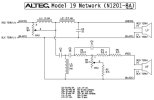
If you could score a pair of M19 (N1201-8A) crossovers down the road, I think that would be a great upgrade for the Valencia.

Alright, I am slowly getting ready to build the N1201-8As in about two months and am looking into which parts exactly to get.
According to the schematic I need 8uF, 16uF, 21uF, 6uF caps, 0.3mH, 0.77mH, 2.7mH inductors and 2, 3, 2x3.9 ohm resistors, plus 8 and 35 ohm variable resistors (and if I understood correctly I could leave the 35 ohm one away for H.F. to be wide open)

Now, two questions I hope someone can help me with:

1) What parts exactly are the variable resistors? Potentiometers? Rheostats? L-pads? Does someone have a link for me so I know what I should be looking for?

2) What kind of inductors should I use? Air core? Iron core? Another specific kind of core?

IMG_5471.JPG

Unfortunately my ear is still not doing great – had a small surgery and still cannot do any critical listening. At least I can listen to a little music at low levels now…
 
Last edited:
While getting ready to build the Model 19 crossover (see post above this), I also finally started shaping the foam that's surrounding the horns. It's trickier than expected, because with the upper formed to fit perfectly in the space above the horn it was pretty much impossible to slide the piece between horn and chassis, or get it in position any other way. Long story short, I will only use a ca. 1 inch thick piece of foam on top, too – should be enough for what it's supposed to do anyway. I do feel, however, that the impossibly tight fit does dampen the horn’s lip in a good way.

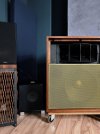
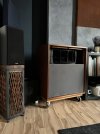
Eventually, I want to cover the foam pieces in color matched cloth and am by now pretty sure I will paint the woofer board in a darker grey and use a black mesh fabric as speaker cover, leaving the horn open (somewhat like what you can see in the photo).

IMG_7572.jpeg
 
Although the MF and HF controls contain two potentiometers in each housing, only one is used per control. 35 ohm for the MF and 8 for the HF as I’m sure you noted.

25w wirewound would work fine. Best to get large like the original if possible. You get finer adjustments. And yes, you can eliminate the HF control as you will set it to max anyway.
 
25w wirewound would work fine. Best to get large like the original if possible. You get finer adjustments. And yes, you can eliminate the HF control as you will set it to max anyway.
That's helpful. So like one of these? https://www.mouser.com/ProductDetail/Ohmite/RHS35RE
Pretty expensive! Do you have any more affordable go-to models?
Please excuse my naivety – I've never built a crossover from scratch, only modified existing ones and for these I've always used the pots/rheostats they came with.
 
Typically, 8 ohm lpads are used for that crossover. You only use one side of the lpad in each case, so it acts as a variable resistor. Pay attention to the connection numbers shown on the schematic when you wire them up.
 
Back
Top Bottom