• The move to the new server is done. There are some software and database maintenance updates in process. This has us passing the hat around to help out. We appreciate any donations. Seriously, even a dollar helps. The payment page may be found here - https://www.audiokarma.org/support.html

Anti-skate setting question

Another thing to know, in reference to the numbers on a typical anti-skate dial on a turntable, is that those numbers mean nothing as to the actual anti-skate force being applied to the stylus/arm. When you set VTF to, say, 2 grams and then set AS to "2", there are not 2 grams of outward force being applied to the arm. Those numbers are correlated just as a convenient reference by the manufacturer to make it easy to set AS.

Doug
And the problem is it varies from one arm to another
 
I was just trying to inform because there may be some users who believe those numbers represent actual force, in grams, applied to the arm. Obviously, the correlation is completely dependent on each manufacturer's theory/interpretation/application.

Doug
 
So I spent most of the day listening to various styles of LPs through headphones and playing around with the anti skate. First I had to swap my JC2 BP preamp out with my P6 (no headphone jack on the JC2). I found that the amount of antiskate needed varied depending on the music being played, but nothing drastic. Wide dynamic swings needed a bit more (Genesis "Invisible Touch" and anything else with lots of drum machine) and mellow stuff (Carol King, Eagles, etc) needed less. Beethoven symphonies needed more than baroque.
I would change the anti skate a little bit at a time while an LP was playing..adding/subtracting a bit until I heard distorion in one channel. I would then swap the phono jacks back and forth between left and right to make sure what I was hearing also moved from left to right... quite a tedious process/experiment.

In the end the best compromise setting was to use the smooth acrylic platter mat and set the anti skate so there was no movement in the center of the disc then ADD just a touch more so that the arm moved outward very slightly/slowly. My previous setting of "a little bit above 1 on the slider" is now at about 1.3 on the scale. The new AT-VM740ML is sounding great with about 15 hours on it now, the bass has started to develop nicely... a few more days like the last two and it will be good to go for a long long time.
 
Thanks @krautmaster, so a slight bit more than what you had said was good previously but from the looks of it, not really that much.....sounds like you had a fun time!
 
Thanks @krautmaster, so a slight bit more than what you had said was good previously but from the looks of it, not really that much.....sounds like you had a fun time!
Yep, the smooth acrylic mat will get you in the ballpark, then you have to play around with it to get the best compromise- like hitting a double instead of a home run !
 
Yep, the smooth acrylic mat will get you in the ballpark, then you have to play around with it to get the best compromise- like hitting a double instead of a home run !
Not with tips like VDH which are sharp which will cut into the blank disc. Blank disc us fine for conical but not for more exotic cuts
Chris
 
Acrylic is actually very brittle and cracks easily. I doubt very much the friction it causes makes it a good stand in for vinyl. However, it's not my needle being worn so to each their own.
 
In addition to my previous post where I described the limitations I encountered of measuring the force applied by an antiskating mechanism in a tonearm, I didn't elaborated on why this is so (or at least, I assume it is so).
To measure that antiskating force from the tonearm with a sideways tilted digital scale sensor and come to reasonably consistent results, the tonearm had to be moving towards the sensor and come to a stop from a movement that was as slow as possible. Resting the tonearm against the scale and fiddeling with the dial gave very irratic results of such magnitude that they were not useable to graph out the antiskating force curve.
I believe this is the result of the difference between kinetic friction coefficient and (maximum) static fricton coefficient in the bearings of the tonearm.
The maximum static friction coefficient is much higher than the kinetic friction coefficient. A curve that displays both (so applying a force to an object to the point that it suddenly starts to move) typically looks like this:
Static-and-Kinetic-friction-force.ppm

Of course you only want to measure antiskating force in the situation of the kinetic friction coefficient. This is also the only situation that occurs when playing a record, because the tonearm is always moving when playing (there's the movement gradually along the groove, and potentially movement of an off center spindle hole). But a digital scale sensor of course is stationairy.

Designing a sensor base that is moving very slowly but consistently and in the arc of the tonearm that is very compact at the same time so that it fits under the stylus.... might be an impossible task.

I don't know if a wallyskater displays this same effect in the same extent or if it's less, because that is a measuring system that comes to a halt. I'm planing to build one and that is the first thing I want to investigate. The manual does describe static friction and to take multiple measurements, but I think this is potentially easier and and more consistent.
However to get precise results from a wallyskater, the scale on the deviation is not linear despite what the manual says. That is a fundamental flaw in it's design or at least in the manual. The path of the tonearm on a string is an arc, so every linear step it takes away further from the vertical 'zero' string, comes with relative more antiskating as the tonearm has to be lifted relatively more on that same linear sideways step.
So that scale of steps and how many percent of the VTF each 1cm (or whatever step) is, has to be recalculated for each step. Doable, but my trigonomitry is a bit rusty :D

There's still so much to research in this particular field as information is so scarce. Probably due to that side force checkers/skate-o-meters have only been sold in the past in very very small quantities and that there is no alternative version for sale today (or in the last ~30 years).
And reseaching all these things, making custom contraptions etc takes a lot of time.
My goal is for example in the end to come up with something like a transition table based on the basis of a signal strenght/dynamics and stylus profile a certain ideal antiskating force can be appointed so that people themselves can measure that antiskating force on their own system (either with a diy improved wallyskater or maybe an improved diy system based on a digital scale)
So that people that are in doubt of the precision of their antiskating dial (or don't have one like on clearaudio and reed tonearms) can dial in a realtive precise AS force just by building a fairly simple wallyskater instead of hunting down a skate-o-meter on ebay for years and spendig hundreds and hundreds of dollars on it.

I don't know what the coefficient difference is but if it is significant then there are bigger problems at issue. At the scale we are dealing with there are very few records pressed perfectly concentric, so the arm will transition between static and sliding friction (and back again) at least twice per rotation. This will undoubtedly take its toll on sonics, not to mention the stylus suspension.

As with the Wallyskater, it's a good idea to make several measurements and average them. Unlike the Wallyskater, almost everyone has a digital VTF scale and can measure the AS force relatively quickly and easily regardless of arm type.
 
Not with tips like VDH which are sharp which will cut into the blank disc. Blank disc us fine for conical but not for more exotic cuts
Chris
My carts work fine on my smooth acrylic platter- not a mark on it from my AT-VM95ML, VM740ML, OC9XML, and two Rega Exact2's... you must have used some cheap acrylic if it left marks/cut into it... take a look at mine-no marks at all:
007.jpgRega 001B.jpg
 
Last edited:
At the scale we are dealing with there are very few records pressed perfectly concentric, so the arm will transition between static and sliding friction (and back again) at least twice per rotation. This will undoubtedly take its toll on sonics, not to mention the stylus suspension.
Yeah I thought about that too. But the timespan that the arm is static is virtually zero.
On the record at least, there is no significant rise in force generated by a potential bearing friction peak. On the orsonic side force checkers nothing like that is visible and they are quite sensitive. For instance you can see the dial needle bounce to the music.

It would be interesting to see if the effect is also highly arm dependant. I mean we're talking about lateral friction, and there are considerable bearing differences (in build, let alone quality) for the lateral bearings.

I'm trying to recreate the effect at this very moment, but I'm not getting the effect in the amounts that I used to get. Now the variation is about 15-20mg tops.
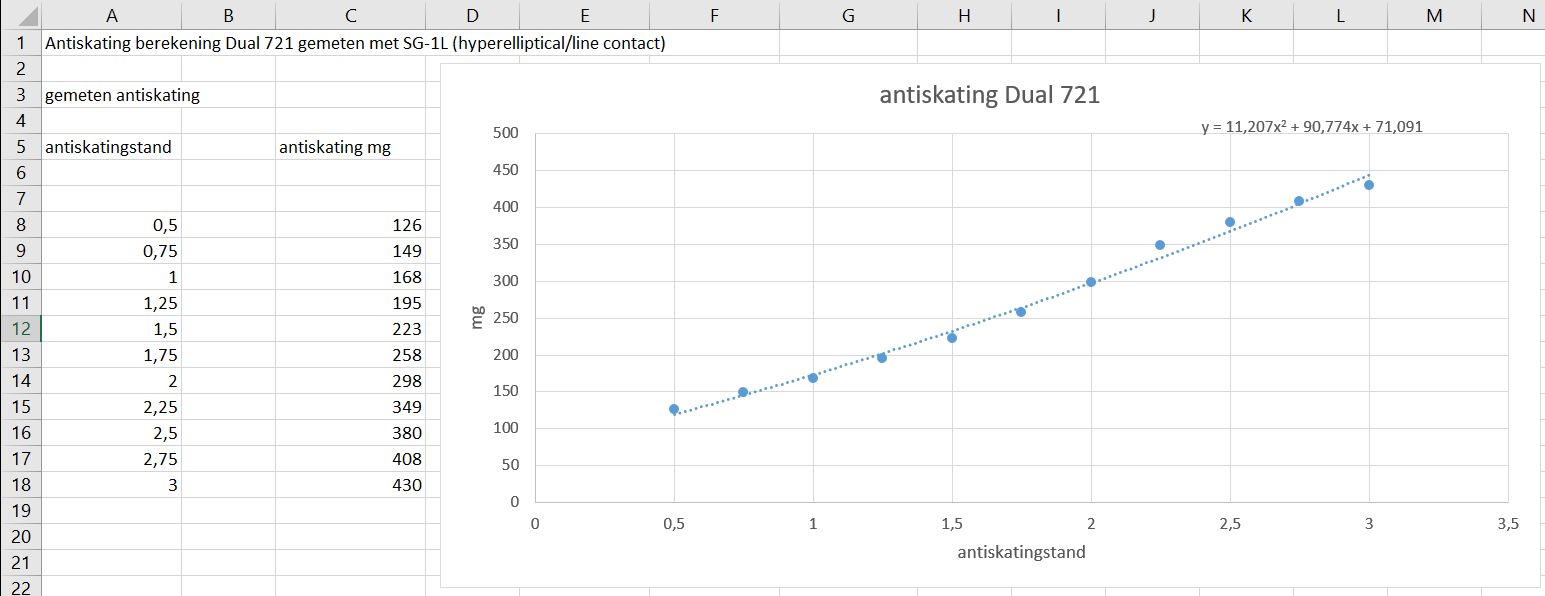
This is what I now get with the arm stationairy against the sensor, increasing the AS on the dial per 0,25 steps. Similar to the previous graphing I posted but here there are some values that deviate a little bit more from the line:
dualantiskatingmetingmg2.jpg


The repeatable accuracy I get, between AS dialing down from 3 to 2 and AS dialing up from 0-2 is about 15-20mg tops. Still quite a bit considering that is about half the value between a 0,25gr AS step. It's just a very finnecky process

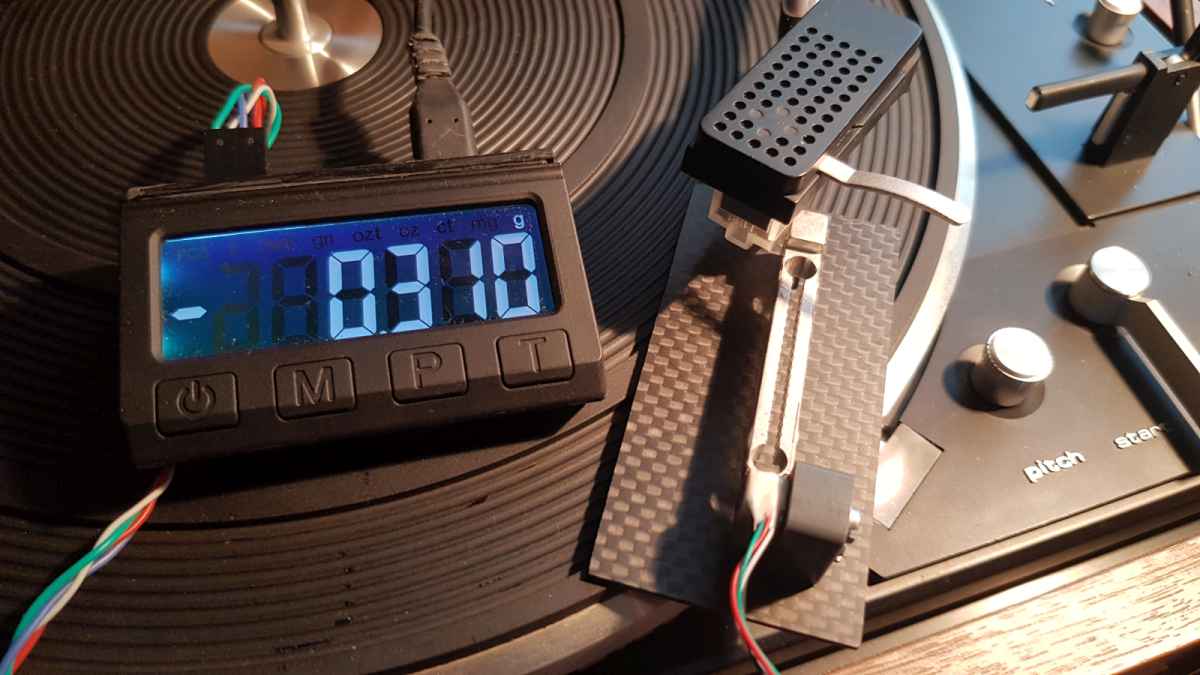
This is my setup. As I said, I have made a horizontal little plateau that can be mounted on the top of the sensor so the arm can rest on that with it's stylus but that gave even more inaccuracy in the past. Here I have the cart (0gr vtf) resting against the side of the sensor (as is at 2.0):
antiskatescale.jpg

Normally I don't have the display on the platter (hence the remote sensor), touching the platter, touching the buttons on the display etc etc give a lasting deviation on the reading.
But maybe I'm working in a far to accurate scope compared to other users; here, I don't try and measure the antiskating force from an arm, but I'm trying to graph the entire antiskating curve of the antiskating system over it's workable range., so I'm not only trying to get 1 plausible value, but an array of values that are also plausible in relation to eachothers.

Regarding a normal stylus gauge on it's side; I think only the aliexpress one that is based on the canrong style meter is suitable for this. Normal gauges don't really stand well on their side, even the canrong style scale isn't 100% flat, and getting it tared exactly to 0,00 on it's side is already quite a challenge, then having to read it upside down from the back of the turntable. try and do that, make a picture of your measured value at 2.0 AS force and place it here and you'll know what I mean, I'd like to see you making a picture with a plausible value. :)
It's doable, but it's a challenge, especially if you get inconsistent values and have to make lots of measurements. :)
 
Last edited:
If a VDH would scratch an acrylic platter what keeps it from chewing up a softer vinyl LP ?

:) VDH (as any stylus, no matter what shape) contact groove with sides, not end of tip. Stylus never hits the bottom of the groove. Except some 78RPM for what truncated stylus are made to avoid it. So end of the tip never touches record and, in result, can not damage it. But, anyway, VDH tip does not scratch acrylic or vinyl, if it does you should look at stylus under microscope, perhaps there are more problems.
 
So I spent most of the day listening to various styles of LPs through headphones and playing around with the anti skate
I have never heard of someone doing this with music records. I suppose bypassing the test LP and going straight for the intended result is fine if you have all day to do so. A test record like the HiFi News would be more effective and efficient IMO. In leu of a test LP, a mono LP with no groove wear would be a better choice for obvious reasons.
 
I have never heard of someone doing this with music records. I suppose bypassing the test LP and going straight for the intended result is fine if you have all day to do so. A test record like the HiFi News would be more effective and efficient IMO. In leu of a test LP, a mono LP with no groove wear would be a better choice for obvious reasons.
I'm retired and don't have to do anything I don't want to (except for what the wife wants !) It was kind of fun experimenting, and in the end getting the anti-skate correct is a bit of voodoo as every record is just a bit different. IMO a test record will only get you in the ballpark, it won't be correct for every record, especially one with a big dynamic range. Of the LPs that I tested, the anti skate was least reliable on ones that had prominent drum machines: the Genesis tune "The Brazillian" off their Invisable Touch album was all over the place, while Baroque/Chamber music was very steady.

Todays experiment will be changing the weights on my Groovetracer counterweight to heavier ones (110 gram up to 130 gram) so as to move the counterweight closer to the pivot point- currently it is right in the center of the stub.
 
and in the end getting the anti-skate correct is a bit of voodoo as every record is just a bit different

I would agree if it would be about VTA. This is why I have indicator. But not anti-skating. Because what should I do with linear tonearm, if every record is different and anti-skating can correct something? No, anti skating setting is the same for all records. If you hear difference it means anti-skating is not correct and it is subjective setting, or you have records with different wear and anti-skating adjustment simply compensate unsymmetrical wear.

Dragon_CT_Eminent_VDH-2.jpg
 
:) VDH (as any stylus, no matter what shape) contact groove with sides, not end of tip. Stylus never hits the bottom of the groove. Except some 78RPM for what truncated stylus are made to avoid it. So end of the tip never touches record and, in result, can not damage it. But, anyway, VDH tip does not scratch acrylic or vinyl, if it does you should look at stylus under microscope, perhaps there are more problems.
VDH does scratch blank vinyl, but yes correct re the tip not touching the groove.
I change and inspect stylus tips every day so I know what a VDH looks like
Chris
 
Back
Top Bottom