• The move to the new server is done. There are some software and database maintenance updates in process. This has us passing the hat around to help out. We appreciate any donations. Seriously, even a dollar helps. The payment page may be found here - https://www.audiokarma.org/support.html

Econowave Help Needed

The next question is how does it sound, hope very good, at least as good as the Selenium
crossed around 1.5K. This driver will help to reduce the cost of the LA Econowave and many
others. We know from MTG that it also works well on the inexpensive PRV/JBL HM17-25.
Also wondering about it on the ELX and the 8x8" JBL WGs.
 
I don't remember if you've mentioned what sort of cabinet you plan to build, but if it is tall
you might want to look into an MLTL. Some things to note is that they place the woofer
about 1/3 down from the top, this leaves room for the horn. Then the port is placed up
from the bottom, something like 5-10" but designers say this can have a strong impact on
higher mode box/port resonance strength. I've only built these by accident as it was the
natural placement of the port in a tower design and I found that the port was significantly
shorter than calculated. I simply adjusted and went with it.
They are really not very different than standard vented but if you have one long dimension
that might cause resonances, might as well try to optimize them
.
This is interesting, and I would just use these guidelines unless someone wants to help with sims:

He claims that doing it his way you sometimes get 15Hz deeper bass. But what does he mean
by this, do we get tuning lower than expected and if so, do we get the same amplitude out
or the lower amplitude with a lower tuning? Low tuned can sound better due to a more
gradual rolloff, but we should try to get what we designed for. You can try it, and adjust for
what sounds best.
 
Initially I was going to do a simple bass reflex box and mount the horn externally to fine tune more easily. Eventually, when all is set up, I wanted to do something with the horn internal like the old altec's (santiago, valencia, etc.). My living room is mid century so I think those would go great with the room. I was looking to do a single driver project until I found the Econowave thread. I was decided on an MLTL to go with a single full range driver but did not look into any MLTL designs for a 2 way, or with a horn. Even the MLTL boxes I saw for 4" Drivers were pretty tall. I would image a 12" driver would be pretty big? some very cool speakers in that linked thread, looked at that when planning the aforementioned single driver build. Didn't see any plans for any drivers over 8" in my research. Tinkered with the idea of making my prototype box out of foam core, would be easy to do a couple of different boxes this way.
 
I don't remember if you've mentioned what sort of cabinet you plan to build, but if it is tall
you might want to look into an MLTL. Some things to note is that they place the woofer
about 1/3 down from the top, this leaves room for the horn. Then the port is placed up
from the bottom, something like 5-10" but designers say this can have a strong impact on
higher mode box/port resonance strength. I've only built these by accident as it was the
natural placement of the port in a tower design and I found that the port was significantly
shorter than calculated. I simply adjusted and went with it.
They are really not very different than standard vented but if you have one long dimension
that might cause resonances, might as well try to optimize them
.
This is interesting, and I would just use these guidelines unless someone wants to help with sims:

He claims that doing it his way you sometimes get 15Hz deeper bass. But what does he mean
by this, do we get tuning lower than expected and if so, do we get the same amplitude out
or the lower amplitude with a lower tuning? Low tuned can sound better due to a more
gradual rolloff, but we should try to get what we designed for. You can try it, and adjust for
what sounds best.
There have been a lot of free tools for years now that let users look at driver and port offsets (Hornresp, AJHorn, Leonard audio, TLSpice, Akabak) as well as MJK's original sheets. Most all are 1-P models, but for the axial standing waves, that's sufficient. Been pretty common for a long time among fullrange people who live with pipes for the extension benefits required. Just get HR and play some--we'd have given an arm 40 years ago for what it does now. Mr. McBean has made it brainless to optimize driver and port offsets and his filling models are as solid as any of them ever get. I still have a machine to run old tools like MJK sheets, but HR is the tool of choice 99% of the time. The interface is modal and a little quirky, but it's powerful. I will cheerfully assist anyone with that stuff as well.
 
Initially I was going to do a simple bass reflex box and mount the horn externally to fine tune more easily. Eventually, when all is set up, I wanted to do something with the horn internal like the old altec's (santiago, valencia, etc.). My living room is mid century so I think those would go great with the room. I was looking to do a single driver project until I found the Econowave thread. I was decided on an MLTL to go with a single full range driver but did not look into any MLTL designs for a 2 way, or with a horn. Even the MLTL boxes I saw for 4" Drivers were pretty tall. I would image a 12" driver would be pretty big? some very cool speakers in that linked thread, looked at that when planning the aforementioned single driver build. Didn't see any plans for any drivers over 8" in my research. Tinkered with the idea of making my prototype box out of foam core, would be easy to do a couple of different boxes this way.
So, the only question for the OP is, do you want some sort of stylin' legs under your Altec clone boxes?

:)

Seriously, if you still have an interest in an MLTL type thingy, say the word and we can kick-out at least these two types. And aiming the center of the pattern at a listening height + jockeying driver offset and cabinet size really does depend on whether or not the thing has legs. Er you have to do it at least twice...

The stuff below the line is less of a direct response to you and more of a tangential ramble in-context.

------------------------

Big, wide-baffle, squatty boxes like the original Altec stuff are great, acoustically.
- Easier to keep center-to-center (CTC) distance small for bigger forward lobe
- Lower baffle step transition freq
- Increased distance from driver to walls allows for thicker lining and avoids early reflections

The tall skinny (MLTL) 1/4-wave pipes are the bugger for 2-ways, particularly if one seeks to outboard the horn. The CTC is just too big if the driver offset position is set to null the lowest harmonic of the pipe. Prioritizing CTC means the acoustics are rougher and will need resistive damping (and at a loss of efficiency). Big long ports just add a third stubborn resonance to interact with the other two.

These resonances matter in the big 2-ways because every single one is in the passband. Stuff ringing 200-400Hz mucks-up low-mids and you can hear it ringing (and once you hear it, you can't unhear it).

It's not just the Helmholtz (and ignore internal modes or hammer them with fiberglass), it's both the fundamental standing wave resonance from the height and the Helmholtz freq that need to be managed together. That's easy in squatty boxes up to maybe <2.5ft tall and it's packing a lunch for heights on-up from that.

Or you stick the horn inside the pipe for short CTC and live with the box mud that radiates out the horn walls. It also "pinches" the volume in the height direction--model that and see what it does and the tighter the cross-section is, the more it matters (esp when you consider adding extra support for heavy compression drivers). That, plus the reflections from walls right next to the drivers make the skinny pipes (seemingly terminally) still in vogue a "less clean" acoustical choice...but it you can't get it "sold" into the living room any other way, then that's what it is. (It's particularly audible in male voices. Things like that are why quick & dirty protos are invaluable).

Round horn fans disagree with prioritizing CTC, but those have issues, too. It's priorities. Wayne's rationale that 90x50 is a good way to go for most people's ceiling heights and listening distances (so the vertical nulls are ceiling and floor) is pretty rock-solid to me, too.

The other thing is that some of those old Altec things just use the fore/aft position of horn (and trim pieces) to form the "port" (common opening). It's a different (old-school) alignment that pretty much no one does anymore (and current drivers don't often fit the approach, either). It'd be great if someone did one in 2024. The thing is, those implicitly get finished by manually applying fabric and resistive materials to dial-in the damping, so the basic alignment is to boom a a tiny bit and then pull it down with resistive materials. They target ports Ap~0.5<Sd<1.0 and that's the sweet radiation resistance improvement (impedance match between port and room air) that only big ports can give. Amounts to "better grip" that that port has on the room air. It's the most efficient unassisted alignment there is, but the sims look ugly because the simple tools don't sim all of the problem. You just creep up on critical damping by applying layers of fabric over the port and the rear of the driver. The usual lining and usually a cross-batt of material on a brace to cover the whole cross section works to both reduce mids out the port and the max group delay as well. In the end, it's an efficient, well-damped, big-sounding cabinet approach--it's just not particularly predictable on a computer. Instead of a typically smaller cab with a smaller duct of some length, it's a big hole--an actual "port" with a length of one baffle thickness. The tradeoff, of course, to hit the same Helmholtz freq is that the box gets big...probably closer to 5ft3 than 3ft3.

 
Thank you for writing that all out Grindstone! So, I think the original plan to prototype a bass reflex box for the woofer is best to begin with. I will move to a 3 ft3 volume per PeteB's work.

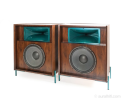
and yes, there will absolutely be some nice legs on the final cabinets. See below for some Altec's that I love.... minus the teal color. As I mentioned in my original post, I intend for this to be an ongoing project as I would like to experiment with other enclosures; bass horns, Onken, TL, MLTL, Etc. But for the first iteration though it's got to be Altec'esque. This is an itch that needs to be scratched!

1723827651138.png
 
found a deal on some Eminence Delta 12a's... how hard would it be to swap this for the GRS 12PT? It won't go as low as the GRS but it's a proven woofer that I believe will sound better. Any reason not to go with the Delta's?
 
You know Rectilinear III Low Boys might offer a good box that fits what you're looking for.
The baffle board screws in, people often need the drivers, they sell easily and the entire system
is often very cheap to buy. I have a pair that I paid $50 for and sold the drivers cheap to AKers
and it still paid for them.
Of course cover the grilles with cloth or make new ones:

They're a bit small for the 15" GRS that I'm planning to use, but as I've mentioned on here several
times there are always the EQ ed B6 alignments. I might just use the box to try it out and go from
there. I really want a high boy but I have these.
 
Last edited:
found a deal on some Eminence Delta 12a's... how hard would it be to swap this for the GRS 12PT? It won't go as low as the GRS but it's a proven woofer that I believe will sound better. Any reason not to go with the Delta's?
@loaded

Tune the driver up in WinISD to see what you'll get for bass when used in a regular Bass-Reflex type cabinet.
- Maybe with a MLTL type cabinet you'll get more lows ( I don't know ).

As far as a crossover >> create the necessary frd + zma files and then import them into the existing XSim file that I created for you ( and then play around with the LowPass's
LC values till you get something usable ).

:)
 
those cabs look nice, would love something like that. But I have never been that lucky! I never find those scores on vintage gear. Just looked online and only one pair on Ebay for $450 in Florida, so tack on another $200 for shipping (if they ship). I have saved searches for some speakers that I like the cabinets, and just added these. We'll see if something comes up soon!
You know Rectilinear III Low Boys might offer a good box that fits what you're looking for.
The baffle board screws in, people often need the drivers, they sell easily and the entire system
is often very cheap to buy. I have a pair that I paid $50 for and sold the drivers cheap to AKers
and it still paid for them.
Of course cover the grilles with cloth or make new ones:

They're a bit small for the 15" GRS that I'm planning to use, but as I've mentioned on here several
times there are always the EQ ed B6 alignments. I might just use the box to try it out and go from
there. I really want a high boy but I have these.
 
@loaded

Tune the driver up in WinISD to see what you'll get for bass when used in a regular Bass-Reflex type cabinet.
- Maybe with a MLTL type cabinet you'll get more lows ( I don't know ).

As far as a crossover >> create the necessary frd + zma files and then import them into the existing XSim file that I created for you ( and then play around with the LowPass's
LC values till you get something usable ).

:)
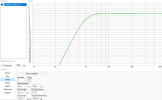
Hey EarlK! yes, I did work on the Delta in WinISD and got the box down to 51.32 in a 3 ft3 box with a slot vent. I will nail down the dimensions of the 3 ft3 cabinet and mount the horn on top externally. One question, I have looked at a single and double port also. I have always gone with Slot ports or sealed in the past as I prefer a more tight and musical LF. However, for this project I wanted the speaker to go as low as possible without sacrificing, too much, tight LF. I've never AB'd a slot vent with a port vent, but I have noticed the difference with a sealed and ported sub. I much prefer sealed. Is there actually any audible difference with a Slot vent to a Round port? And one step further, how does a double round port box differ from a single port?
winISD Delta 12a - Slot Vent.png
 
Is there actually any audible difference with a Slot vent to a Round port? And one step further, how does a double round port box differ from a single port?

Sorry, I don't have any experience with comparing the sounds//effects of different types of box-porting.

:)
 
If you really prefer sealed sound, tune that down to 28-32 Hz and you'll get a sagging response very similar to sealed.
As the tuning frequency goes to zero Hz the response becomes the same as sealed.
You can apply a lot of EQ at the tuning frequency to get back as much as you want. Simulate sealed and see what
response you get to compare. Most of these drivers are not designed for sealed but you can try it of course.

Two ports are used simply to reduce the port velocity, you could simply go with a bigger port. Port compression is a
real issue if you are going to push them. That said, I believe that a pair of ports of the same total area will tend to
promote laminar flow due to the greater wall area.
I don't know of anyone who's compared the sound of slot loaded vs. round port, but my dad was a fluid flow expert
and he pointed out to me that slotted probably would help reduce port turbulence. It is laminar flow that you want,
turbulent flow is bad.
Air is a fluid from flow perspective.

I've mentioned an old AES paper from JBL that discusses and shows measurements of thermal and port compression
due to turbulence.
 
Last edited:
those cabs look nice, would love something like that. But I have never been that lucky! I never find those scores on vintage gear. Just looked online and only one pair on Ebay for $450 in Florida, so tack on another $200 for shipping (if they ship). I have saved searches for some speakers that I like the cabinets, and just added these. We'll see if something comes up soon!

I usually don't find these deals, essentially the person said get these out of my house, PLEASE take them!
Keep looking for the right deal if you want to save some effort.
 
I usually don't find these deals, essentially the person said get these out of my house, PLEASE take them!
Keep looking for the right deal if you want to save some effort.
well, I guess one time I did have a neighbor drop off some Heresy II's for free that he inherited from a father. So, I guess I have to say, I usually am not lucky!
 
If you really prefer sealed sound, tune that down to 28-32 Hz and you'll get a sagging response very similar to sealed.
As the tuning frequency goes to zero Hz the response becomes the same as sealed.
You can apply a lot of EQ at the tuning frequency to get back as much as you want. Simulate sealed and see what
response you get to compare. Most of these drivers are not designed for sealed but you can try it of course.

Two ports are used simply to reduce the port velocity, you could simply go with a bigger port. Port compression is a
real issue if you are going to push them. That said, I believe that a pair of ports of the same total area will tend to
promote laminar flow due to the greater wall area.
I don't know of anyone who's compared the sound of slot loaded vs. round port, but my dad was a fluid flow expert
and he pointed out to me that slotted might help reduce port turbulence. I believe it is laminar flow that you want,
turbulent flow is bad.
Air is a fluid from flow perspective.

I've mentioned an old AES paper from JBL that discusses and shows measurements of thermal and port compression.
Missed this post yesterday! I will definitely try tuning the cabinet in windISD to simulate a sealed cab. I won't be pushing these cab's very much as I will only be listening at moderate levels. If I were to push them for a party or something (unlikely) I wouldn't be too concerned about the overall sound quality. I have the article bookmarked... getting lots of reading in!
 
Ok, with some help from my better half, I have deceided to go with the GRS 12" woofers... order is in! So this will truly be an ECONOwave project.

I will start getting the parts together from EarlK's XO design on post #59. I'll be going with a 2.8 ft3 enclosure, tuned to 36Hz and the horn will be mounted externally on top (3.5" between voicecoils). I will update as I go but there will be some time between posts as time can be difficult to come by. Thank you again all!
 
With the drivers in hand, I am now ordering the XO components. Will be getting the wood next month when I should have some time to get the box built up.

I am ordering the cheaper caps/resistors as the values might need to change after it's all built up. Will upgrade once it's dialed in. I am wondering about the L Pad Attenuator. Given this will not need to be upgraded later, which should I buy now? There is the PE option for $14, seems cheap and plasticky? There is also an Eminence option at 2x the price. Is there any real world difference between the. I don't mind spending more on this part as it would be used on the final build also. Other options not at PE that would be better for use?

I will try to get some raw measurements of the woofer before mounting into the cabinet. I don't have a microphone so I will be using my iPad and an RTA app. Not ideal, I know, but hopefully I can see a similar curve to the manufacturers curve. I'll record outside to avoid reflections (very early in the morning).

On the box build, it is going to be 17x28x13.5 (2.85 ft3), slot port tuned, to 35Hz. Cross bracing and fiberglass will be included. Horn will be mounted externally on top of the box to allow easy adjustment to dial in offset (3.5" per Earlk's directions). I plan to rear mount the woofer. With the rear mounted woofer, I will need to move the horn behind the woofer to get the 3.5" distance between voice coils. Is it okay for the HF voice coil to be behind the Woofer voice coil? maybe I should mount the woofer on the baffle front?

Goal is to have the initial build done by December. Once I have the the the woofer and horn mounted, I will look at getting a microphone to do some real measurement. This wont be until early next year though.

I am going to try my hardest to remember to take photos and document the process. I'll post for friendly criticism :).

any steps missing or advice on the steps shown?
 
There is the PE option for $14, seems cheap and plasticky? There is also an Eminence option at 2x the price. Is there any real world difference between the. I don't mind spending more on this part as it would be used on the final build also. Other options not at PE that would be better for use?

Sorry, I can't help you with an answer regarding relative qualities of the various available Lpads.

FWIW, I'm not aware of any slew of complaints aimed at the P.E. offering ( that says something good about consumer satisfaction ).

:)
 
Back
Top Bottom