

You are using an out of date browser. It may not display this or other websites correctly.
You should upgrade or use an alternative browser.
You should upgrade or use an alternative browser.
Register to hide this ad


I've have never found that going with manufacturer spec. leads my designs astray on new woofer. Even I measured old EVM 15L's next to new Kappa PRO 15a's (not the same as Kappa 15a, so, careful). They always met their spec. Even the good recones do if they use OEM parts. As long as they were not abused by MegaWATTS!

gberchin
Active Member
I asked because the pair of Crites (Eminence) CW1526 that I obtained recently measure significantly different from the specs that I found online. It's possible that Crites changed the specs and I just wasn't aware of it. It's also possible that the numbers I found were just plain wrong. Regardless, it is best to measure if you can.They always met their spec.
I can still use the woofers that I have, because I was going to Linkwitz-Transform them anyway, but it would have been nice if their measurements matched the info that I had. Next time, though, I'll go with the Kappa-15a or -15c, because their specs are closer to what I want (assuming that they meet spec).
I should point out that the two CW1526 measure remarkably close to each other, which indicates very good quality control.
Last edited:

Numbers from a text file eons old.
Not correct?
CW1526c (Crites Woofer, Cast)
K-33-E/B (Klipsch Square Magnet)
K-33-E (Klipsch Round Magnet)
Fs = 26.3Hz
Fs = 27.0Hz
Fs = 34.46Hz
Re = 3.36 ohms
Re = 3.5 ohms
Re = 3.39 ohms
Vas = 506.3 Liters
Vas = 343 liters
Vas = 301.7 liters
BL = 12.49
BL = 9.8 T*m
BL = 11.93 Tm
Qms = 9.93
Qms = 8.5
Qms = 7.39
Qes = 0.27
Qes = 0.68
Qes = 0.41
Qts = 0.26
Qts = 0.633
Qts = 0.388
Mms = 75.5 g
Mms = 106 g
Mms = 79.47 g
Xmax = 7.15 mm
Xmax = 6.67 mm
Xmax = 8.2 mm
Cms = 0.486 mm/N
Cms = 0.305 mm/N
Cms = 0.268 mm/N
?
Sd = 890 cm² (13.5" diameter)
Sd = 889.6 sq.cm
Not correct?
CW1526c (Crites Woofer, Cast)
K-33-E/B (Klipsch Square Magnet)
K-33-E (Klipsch Round Magnet)
Fs = 26.3Hz
Fs = 27.0Hz
Fs = 34.46Hz
Re = 3.36 ohms
Re = 3.5 ohms
Re = 3.39 ohms
Vas = 506.3 Liters
Vas = 343 liters
Vas = 301.7 liters
BL = 12.49
BL = 9.8 T*m
BL = 11.93 Tm
Qms = 9.93
Qms = 8.5
Qms = 7.39
Qes = 0.27
Qes = 0.68
Qes = 0.41
Qts = 0.26
Qts = 0.633
Qts = 0.388
Mms = 75.5 g
Mms = 106 g
Mms = 79.47 g
Xmax = 7.15 mm
Xmax = 6.67 mm
Xmax = 8.2 mm
Cms = 0.486 mm/N
Cms = 0.305 mm/N
Cms = 0.268 mm/N
?
Sd = 890 cm² (13.5" diameter)
Sd = 889.6 sq.cm

I have done both, measured and unmeasured in all my designs of decades. The box and the ROOM have much greater impact than the 10% "unpublished tolerance" that likely exists. Unlike other electrical components that don't move Air for for a living.Regardless, it is best to measure if you can.
I can still use the woofers that I have, because I was going to Linkwitz-Transform them anyway, but it would have been nice if their measurements matched the info that I had. Next time, though, I'll go with the Kappa-15a or -15c, because their specs are closer to what I want (assuming that they meet spec).
I should point out that the two CW1526 measure remarkably close to each other, which indicates very good quality control.
gberchin
Active Member
I don't dispute that. But the difference between the published specs and the measured specs in this case approximately doubles the box volume required for Qtc = 0.7071.The box and the ROOM have much greater impact than the 10% "unpublished tolerance" that likely exists.
Well, then. It's cheap insurance to measure and get all the numbers right. Simulation is still more important to curve the low end.I don't dispute that. But the difference between the published specs and the measured specs in this case approximately doubles the box volume required for Qtc = 0.7071.

Can you expand on your project details?I don't dispute that. But the difference between the published specs and the measured specs in this case approximately doubles the box volume required for Qtc = 0.7071.
gberchin
Active Member
It's just a simple sealed-box. The red curve shows the response using the manufacturer's T/S parameters, with box volume sized for Qtc=0.7071. The blue curve shows the response in the same box using my measured values. The green curve shows either one after applying a 3rd-order Linkwitz Transform with f3 at 32 Hz.Can you expand on your project details?
Attachments
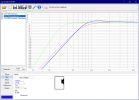
I figured you were building a sealed box from the Qtc parameter. In my experience, some T/S parameters can deviate by quite a bit and not impact the final response too much. Those few dB simulated differences probably will not be heard in the actual listening room.
However, the Linkwitz Transform will really make the system shine.
I have some NHT1259 woofers (somewhat famous back in the day) which are designed for a sealed enclosure but have not done anything with them yet.
However, the Linkwitz Transform will really make the system shine.
I have some NHT1259 woofers (somewhat famous back in the day) which are designed for a sealed enclosure but have not done anything with them yet.
gberchin
Active Member
I remember those! They were the darlings of the subwoofer crowd many years ago.I have some NHT1259 woofers
Like any "systems" approach, which includes the ROOM (box in the box), a Linkwitz Transform is the "icing on the cake" for a sealed enclosure design. Use REW at you MLP after to get the final result, which is the thing we get to enjoy, after all. Aside from the DYI Journey of learning, of course.However, the Linkwitz Transform will really make the system shine.
Oh, and one more thing. Please post your Curves when you are done. There are a few of us that are truly interested.
gberchin
Active Member
It's a matter of preference, but I think of the box EQ and the room EQ separately. Since I use DSP for it all, the end result should be the same.Like any "systems" approach, which includes the ROOM (box in the box), a Linkwitz Transform is the "icing on the cake" for a sealed enclosure design.
BTW, the Linkwitz Transform can also be (cautiously) applied to vented boxes. I have an unpublished paper describing how, if anyone's interested.
Sure, but it will be a long time coming. The build is proceeding very slowly. If I try to go too fast I start cutting corners, which always leads to disappointment.Please post your Curves when you are done. There are a few of us that are truly interested.
gberchin
Active Member
Similar, but not the same. Whereas PEQ changes the Q of the system response, LT can change both Q and critical frequency. And it has the potential to do so much more.The Linkwitz Transform (fancy name for EQ/PEQ) is similar to EQ/PEQ ...
It can do that, but it doesn't have to. The math is very flexible.... to a vented box for a 6th order alignment.

Gigantic
A big, big love
I would like to see that.BTW, the Linkwitz Transform can also be (cautiously) applied to vented boxes. I have an unpublished paper describing how, if anyone's interested.
Similar threads

- Replies
- 9
- Views
- 2K


- Replies
- 29
- Views
- 2K


