• The move to the new server is done. There are some software and database maintenance updates in process. This has us passing the hat around to help out. We appreciate any donations. Seriously, even a dollar helps. The payment page may be found here - https://www.audiokarma.org/support.html

manual rek-o-kut

BTW Among the other things already listed, custom idlers are available, but an inexpensive but a very effective way to reduce noise is to put something like a Delrin ball in place of the steel ball or Delrin pad on top/under the steel ball. When using a plastic ball it will need replacing at some point but some of mine have lasted years….If you’re interested in top performance the motor will probably also need disassembly/inspection and cleaning.
 
And... what is the little dip stick for? Just to have the oil flow in? Or does it measure?
IMG_5301[1].JPG
 
Cap is an arc suppressor, not a bad idea to sub it.

Definitely not a dipstick but not sure what its for exactly. Might just be a wire to help the oil flow down into the well. Mine didn't have that.

In case you do need to tear down the motor, this is what I did with mine.

 
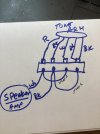
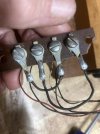
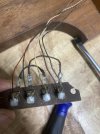
So... For stereo - I assume that I need to remove "strap 2" in the hand drawn diagram, but can leave "strap 1" (or do I need to remove both straps?)IMG_5311.JPGIMG_5307.JPGIMG_5306.JPG
 
I believe you need to remove both straps. It appears that the arm ground is tied into the left channel ground, so you only need right and left signal and ground. But, though I assume the grounds are next to the signal, it might not be - not sure which ground pairs with the signal at the bayonet. I think I would check by playing a record with just one channel's plug inserted to see if they are paired properly. I'm not sure of the consequence of mismatching grounds, but I assume there is a reason we don't use common ground wires with phono cartridges anymore.
 
It’s five wires to the tonearm, easy to confirm with a continuity test, (left&right + arm ground)

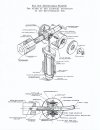
Here’s some additional tonearm diagrams….more info at theanalogdept.com

IMG_3364.jpeg
IMG_3732.png
 
Thanks. That is what I am thinking too.
Buttt..... if I take strap 2 off - what happens to those 2 grounds??? They will be connected to the plate/motor ground, but then the extra one for the outputs will not.IMG_5203[1].JPG
 
does it need to be a special type of cap?

Not really. the original looks like an American Radionics Ceracap, which was a mylar film. A film cap will do the job just fine, or an X rated "across the line" type safety cap is a good choice too since its effectively across the line when turned off.

assuming the switch is still good, apparently its a weak point. Mine was totally missing and I found a similar switch that I had to cut the actuator down to make it all work. A common toggle switch is also an option.
 
Not really. the original looks like an American Radionics Ceracap, which was a mylar film. A film cap will do the job just fine, or an X rated "across the line" type safety cap is a good choice too since its effectively across the line when turned off.
Thank you. I rebuilt my L37 a number of years ago and don't recall what I used for the capacitor.
assuming the switch is still good, apparently its a weak point. Mine was totally missing and I found a similar switch that I had to cut the actuator down to make it all work. A common toggle switch is also an option.
I do remember rebuilding the switch of the L37, the contacts were coated with some tarry goo

1736214692775.jpeg
 
Congrats on the table :thumbsup:

The tonearm is an ESL made by Ortofon and is actually an early stereo arm that’s quite good. They have very good bearing, the counterweight is laterally weighted/adjustable and isolated by the material that’s failing in your example above; you’d need an ESL/EMT diamond pattern headshell.

VR
Andy
Thank you. Does the sagging counter weight matter? Should it be fixed somehow?
 
Thank you. What did you replace the disconnector rubber thingy with? I reached out to Ortofon and they do not have any parts for that.
 
Back
Top Bottom