

You are using an out of date browser. It may not display this or other websites correctly.
You should upgrade or use an alternative browser.
You should upgrade or use an alternative browser.
PHC1 - MC275 w Sonus Faber Guarneri Memento/2 JL Audio F112's/Bryston 10B SUB active
- Thread starter Shane
- Start date
william.keith
Super Member
The key in my system is the fact that I use an "active crossover". In a conventional setup, your speakers and subs are producing bass together. You can tweak the sub a lot but you are still getting sound from both the speakers and the sub. That is the difficult part, to get them to blend together.
In my system, I can adjust the crossover points to both the speakers and the sub. Whatever voice I "give" the sub, I "take" away from the speakers. There is no "doubling up" of the bass. Another words, I cross the sub over at 100Hz on the active crossover and the subs will do 17-100Hz, my Sonus Fabers will do approx 100Hz and up from their "high pass" crossover point. There is a tiny overlap depending on the "steepness" of the crossover slopes I choose. It can be 18dB, 12dB or 6dB
The F112s sound amazingly musical all by themselves at the highest level I have tried of 100Hz so far. The F112s are just as good if not better than most of the speakers I've owned in the past in the limited range they have to produce. Some people may have a hard time believing this, but why shouldn't a well designed sub sound just as good as a full range speaker's bass woofers??? Think about it. :yes:
Take a look at the Bryston, maybe it will make more sense.
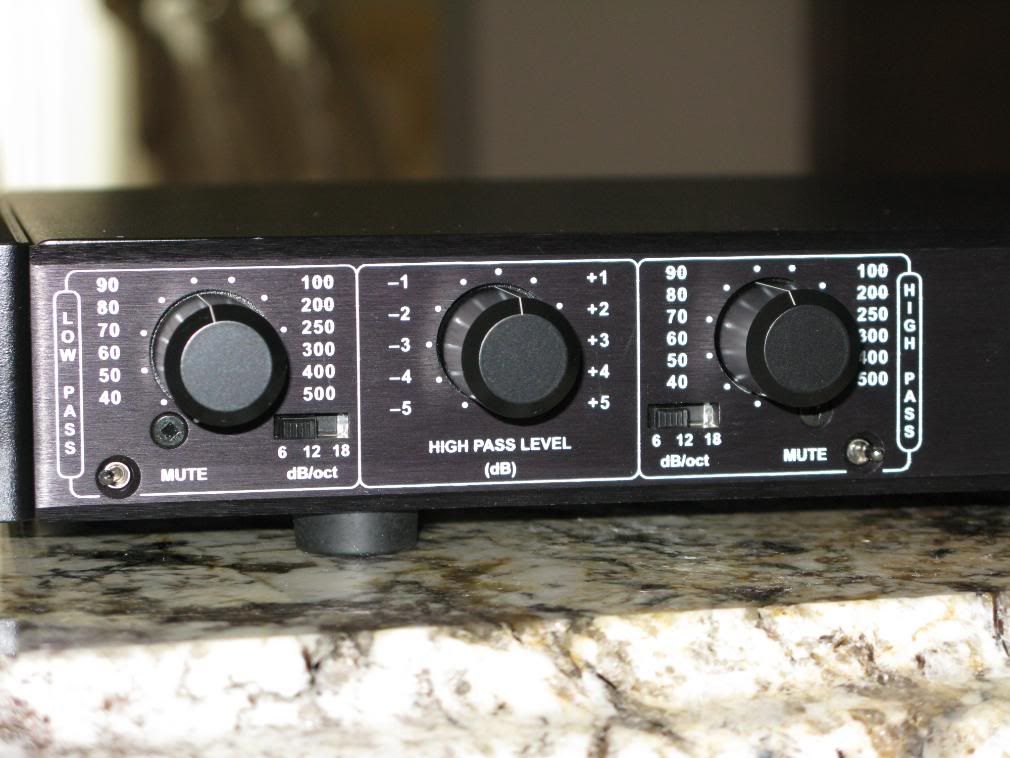
Does this mean that a signal from say a MCD201 feeds into the MDA1000, then the entire signal is sent to the crossover unit, from here the crossover splits the signal at 100Hz+, the 100Hz+ signal is then sent back to the MDA1000 which feeds the amp and mains the 100Hz+ signal?

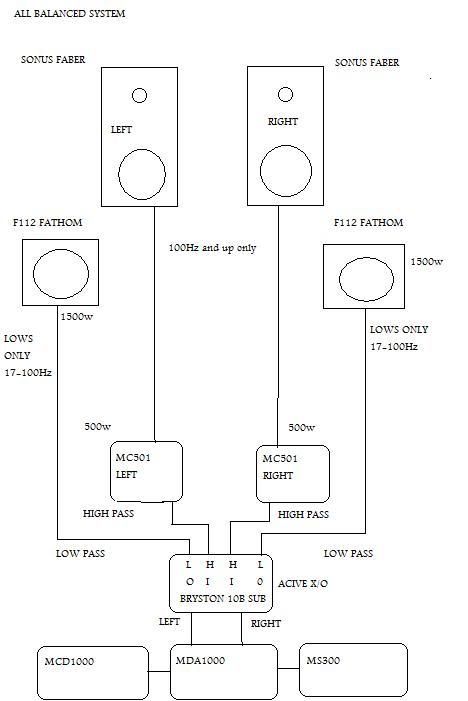
No, it is very simple. The MCD/MS300 feed the MDA1000, the balanced out goes to the Bryston active X/O, the Bryston splits the signal, the 100Hz+ signals now go to the 501s and my speakers, the other output from the Bryston with 100Hz and below now goes straight to the JL audio subs. Neither the 501s nor the speakers ever see any of the signal that subs will see, just like the subs will never see the 100Hz+ signal.Does this mean that a signal from say a MCD201 feeds into the MDA1000, then the entire signal is sent to the crossover unit, from here the crossover splits the signal at 100Hz+, the 100Hz+ signal is then sent back to the MDA1000 which feeds the amp and mains the 100Hz+ signal?
I'll have to come up with a diagram, it is much simpler than it sounds. :scratch2:
william.keith
Super Member
What path does the 100Hz+ signal from the x/o take to get to the MC501s?
What path does the 100Hz+ signal from the x/o take to get to the MC501s?
The balanced path...
 I am not sure I follow your question but the Bryston has 2 balanced outputs, each driven by the high and low pass respectively. This way the 501s/speakers see the 100Hz+ and the subs see the 100Hz- signal.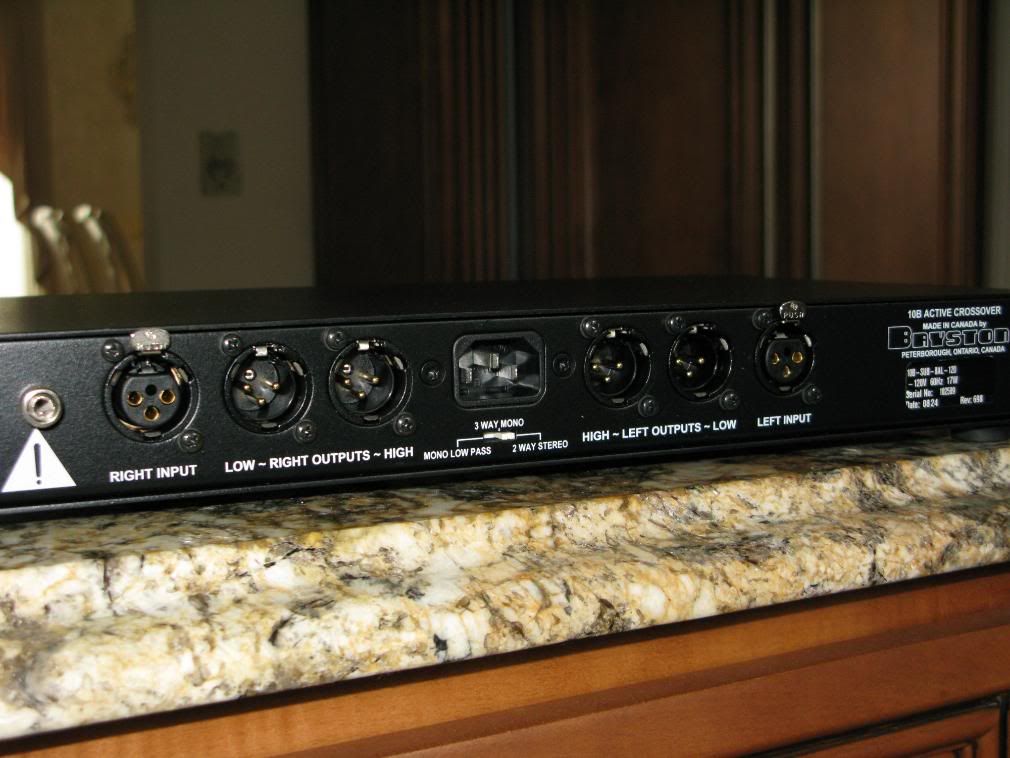
Here is a diagram.
To summarize the advantages:
1. Bass is now extended to about 17Hz. There is 3000w of dedicated low bass power. Bass is effortless, tight, well controlled and integrated with the speakers through numerous adjustments on both the subs and active x/o. Tweaked by ear for best results, confirmed with SPL meter for accuracy. Very impressive, flat response from 17 to 100Hz.
2. The monitors are setup to optimize with imaging, focus and soundstage as a priority. The wall coupling issues becomes "virtually" non existent. No lows to deal with from the monitors. Much less intermodulation distortion/cone break up from the mid-bass drivers having to deal with producing the low bass notes and midrange at the same time. The midrange is now more coherent, "expressive", "liquidy" and "seductive". The mid-bass driver can now focus on what it does best. This is what Sonus Fabers are famous for!
3. Amps are happy as well. Again, there is a new found level of coherence, smoothness and a sense of "air", "openness" and a more holographic acoustical space. The sound no longer sounds congested nor does the soundstage start to collapse when the levels are turned up or when the musical passages are very complex. The amps are no longer "loaded" down with the low bass and it is a proven fact that most of the current/power is absorbed by the lows. The power supplies are now experiencing much lower loads and the amps sound more liquid than ever. This is what the 501s are famous for. With the 275 driving the speakers, the result are multiplied by a factor of 2. The tubes really appreciate not having to do the low bass. :yes:
4. The integration of subs and speakers becomes much easier, there is no overlapping or doubling of bass from both. This setup gives the subs their own space in the audio band and the speakers their own. The active x/o and the available slopes allow you to bring the two together seamlessly.
To summarize the advantages:
1. Bass is now extended to about 17Hz. There is 3000w of dedicated low bass power. Bass is effortless, tight, well controlled and integrated with the speakers through numerous adjustments on both the subs and active x/o. Tweaked by ear for best results, confirmed with SPL meter for accuracy. Very impressive, flat response from 17 to 100Hz.
2. The monitors are setup to optimize with imaging, focus and soundstage as a priority. The wall coupling issues becomes "virtually" non existent. No lows to deal with from the monitors. Much less intermodulation distortion/cone break up from the mid-bass drivers having to deal with producing the low bass notes and midrange at the same time. The midrange is now more coherent, "expressive", "liquidy" and "seductive". The mid-bass driver can now focus on what it does best. This is what Sonus Fabers are famous for!
3. Amps are happy as well. Again, there is a new found level of coherence, smoothness and a sense of "air", "openness" and a more holographic acoustical space. The sound no longer sounds congested nor does the soundstage start to collapse when the levels are turned up or when the musical passages are very complex. The amps are no longer "loaded" down with the low bass and it is a proven fact that most of the current/power is absorbed by the lows. The power supplies are now experiencing much lower loads and the amps sound more liquid than ever. This is what the 501s are famous for. With the 275 driving the speakers, the result are multiplied by a factor of 2. The tubes really appreciate not having to do the low bass. :yes:
4. The integration of subs and speakers becomes much easier, there is no overlapping or doubling of bass from both. This setup gives the subs their own space in the audio band and the speakers their own. The active x/o and the available slopes allow you to bring the two together seamlessly.
william.keith
Super Member
Excellent diagram. I did not realize that you were placing the Bryston x/o between the MDA1000 and MC501s.

exracer
music speaks
Excellent diagram. I did not realize that you were placing the Bryston x/o between the MDA1000 and MC501s.
check this out electronic (active) crossover
exracer
music speaks
Excellent diagram. I did not realize that you were placing the Bryston x/o between the MDA1000 and MC501s.
Here is another article on the advantages of eliminating passive crossovers, go to the bottom 3.0 Conclusion
**not that PHC1 has done this with his speakers, but is somewhat related.
william.keith
Super Member
Thanks for providing the articles. I know that some have questioned the use of active crossovers even in light of the advantages. I believe this is because an active crossover adds additional circuitry to the system and because it is a powered device, it can raise the noise floor of the system, passive crossovers do not. I know, for example, that when McIntosh designed the current XLS speaker and subwoofer line they did not include a hi-pass filter in the sub as many owners did not want to place any additional circuitry, i.e., filter, between their pre-amps and amps.
Thanks for providing the articles. I know that some have questioned the use of active crossovers even in light of the advantages. I believe this is because an active crossover adds additional circuitry to the system and because it is a powered device, it can raise the noise floor of the system, passive crossovers do not. I know, for example, that when McIntosh designed the current XLS speaker and subwoofer line they did not include a hi-pass filter in the sub as many owners did not want to place any additional circuitry, i.e., filter, between their pre-amps and amps.
I researched the topic thoroughly before committing to an active crossover. :yes: The various reviews also indicated no audible signal degredation. The end result benefits would still far outweigh the signal degradation if there was one around the crossover point.
"All crossover selections are extremely accurate and repeatable, being implemented with 1% selected metal-film resistors and polystyrene capacitors. All switches are heavily gold-plated, for lifetime protection from corrosion. The level controls are precise 1 dB increments, also derived from gold-plated switches and 1% metal-film resistors. Most important, however, is that the Bryston 10B Crossover uses NO integrated circuits in the signal path. All internal buffer and amplification stages are Bryston's exceedingly linear and superbly quiet discrete op-amp circuitry. This means the signal is always maintained as "Audiophile Quality", with stability and freedom from noise and distortion unapproached in other crossovers."

william.keith
Super Member
I believe that when using stand-mounted 2-way speakers in combination with quality powered sub(s), the advantages outweigh the disadvantages. I suppose the alternative is to spend the additional money on full-range speakers instead.
I believe that when using stand-mounted 2-way speakers in combination with quality powered sub(s), the advantages outweigh the disadvantages. I suppose the alternative is to spend the additional money on full-range speakers instead.
If you can suggest a pair of speakers that would integrate smoothly into my 14x17 room, have a flat bass response from 17Hz on up and image like a pair of monitors, I would love to hear about them. So far, all the full range speakers I have owned have not even come close to what I am experiencing with this combo. Since you have no control over full range speakers bass, the results would never be even remotely close to this, at least not in a 14x17 room. That's not to mention all the other benefits already mentioned.
Spent some time tweaking the slopes today. Seems the 18dB low pass slope gives the most "musical" response yet, prevents the subs from "creeping" up too high into the Guarneri voicing range. The 6dB high pass slope on the other hand is the minimalist and purist approach with its gentle filter seems to have the least effect on the Guarneri voicing as well. Had to back off the subs a little due to the 6dB slope though. Like what I am hearing, think I will stick with this.
Before the subs, I only had a "hint" of what the performers wanted you to experience. I need to find some good "organ" music...
Serge.......If you can reproduce a low "C" on a pipe organ, then you are living large. You will feel it as much as hear it. I have experienced that note on a real pipe organ, and it is a beautiful thing. Moving, literally. :yes:
Serge.......If you can reproduce a low "C" on a pipe organ, then you are living large. You will feel it as much as hear it. I have experienced that note on a real pipe organ, and it is a beautiful thing. Moving, literally. :yes:
Well I know that it would be hard to reproduce a lowest tone of 8Hz and I don't think one audio system in the world can compete with the 64ft pipes moving a column of air.
The dynamic range is incredible with pipe organs, no wonder it is called the "King of instruments". :yes:Serge.......The pipe organ I heard was in Portland, Oregon, at a place called the Organ Grinder. It was a pizza restaurant, that was conceived, and constructed to house a huge pipe organ. Before it opened, I used to drive by and watch the construction, and the assembly of the organ. It was awesome. I went there often to eat, and listen to many famous organ players that came through Portland to play that organ. When the long pipes were played you had better hang onto you beer mug. Here's a link you might enjoy: http://www.pstos.org/instruments/or/portland/organ-grinder.htm . I moved from Portland in 1981, and didn't know until I saw this link that the Organ Grinder was closed in 1996, and the organ sold for parts. Makes me a bit sad to know that. The place was great fun to go eat pizza, drink beer, and listen to a world class pipe organ.

Similar threads


- Replies
- 16
- Views
- 2K
- Replies
- 10
- Views
- 3K

- Replies
- 39
- Views
- 2K
