• The move to the new server is done. There are some software and database maintenance updates in process. This has us passing the hat around to help out. We appreciate any donations. Seriously, even a dollar helps. The payment page may be found here - https://www.audiokarma.org/support.html

The Pioneer "eXclusive" Gear Thread!

Thank you for your replies, I'm a little calmer now.

For a rough calculation of the normal power loss of a power amp side of the M4, I assumed the following values:
U=64V (+32V/-32V between the collector terminals of the output stage transistors) and Ic=2.1A. This results in P=U*I=134.4W per side! It is understandable that a lot of heat has to be given off to the environment. Well, as I said above, I didn't set the standard value for Ic, but about 25% less, which, after closer inspection of a test signal, apparently means no influence on the signal quality. The reduction in Ic should mean 25% less heat output. Nevertheless, I measure the mentioned 87°C at a hotspot in the middle of the heat sink on the left side, about 4K less on the right side.
If anyone is looking for a suitable replacement for Pioneer's original AEX-002 posistors, I recommend the TDK B59901D0080A040 (PTC thermistor type D901, 80°C). Above about 90°C the resistance reaches about 900 ohms, which is needed to trigger the protection circuit. The housing of type D901 fits the original sensor exactly, only slightly longer connections have to be soldered to the connecting wires.

The M4 sounds really wonderful, yes.
And the visual appearance is a feast for the eyes!

During quiet passages of the music, however, I hear a slight noise from the fans... That bothers me a little.
At first I was looking for an Exclusive M3, but it's much rarer and therefore hard to find. When an M3 shows up, it's usually a totally worn out and tinkered device at totally exorbitant prices.
I'll keep looking and if I'm successful one day, I'll post a comparison between M3 and M4...
 
which, after closer inspection of a test signal, apparently means no influence on the signal quality.
Just curious how you did this test. The only way to know the impact on distortion for sure would be to feed an extremely low distortion sine wave in and use a distortion analyzer on the output.
 
Your are completely right, of course. At least as far as the measurement technology is concerned.
I used a high quality signal generator made by Siemens and a good scope made by Rohde &Schwarz , while reducing the bias current. Nothing changed on the scope display... It may be that the transistors are no longer in the optimal operating point. At Ic=2.1A, however, the device gets so hot that you could fry eggs on the heat sinks...

By the way: What's the point of the M4's ultra-low distortion if two fans produce clearly audible noise?
I'm still looking for an Exclusive M3 for good reason.
 
The fans shouldn't be audible from the listening position. I have to put my ear up to the heatsinks to tell whether my fans are operating or not.

Sounds like the bearings or motor must be starting give out on you. :(
 
That's remarkable. Do you still have the original Sanyo fans installed?

Maybe I'm just too sensitive to the noise... It's not a motor noise that is audible. More like a rush of air. It's always annoying when you're near the amplifier. The original 60V fans from Sanyo are still installed in my M4. During a test run when they were removed, the two fans seemed unsuspicious to me. It would be unfortunate if I had to part with the M4 because of the background noise, so I'm trying to find a suitable and quiet replacement for the fans first...
 
I can only tell mine are running if I put my ear right next to the front bottom and the room is quiet.
 
Then there is hope that it is only due to defective fans and that it is not a design-related thing. I have ordered two extra quiet full-metal fans "Papst 8830 N" , 0.49kg each, as a replacement. They are normally designed to run on 115V/ 60Hz and then have 8W power at about 1900 rpm and only 21 dB. I will have to run them at 100V/50Hz, so they will bring about 80% of the rated power, which should be enough. The noise level should also be reduced a bit by this. Let's see what comes out of the experiment.
Thanks anyway for your advice, you have given me courage again that I will be happy with the M4 after all!
 
Can folks comment on repair for the Pioneer Exclusive components. What is done when it is suspected a potted module component is bad?
 
Are you referring to the Pioneer Super Linear Module? If so, those are unobtainable.

I have a number of Z-series components that contain those. My backup was to purchase a cosmetically bad C-Z1 because it contains 6 of those modules.

Hope I’m understanding the module you are referencing, if not, my apologies.
 
It is general question but I think you have answered it. Seems a big risk for something like a C5 preamp, where everything is potted, especially given the prices.
 
Please do post the pictures! I am very curious about the inside of the 3401's; never opened mine..

about the Tuner; I do not mind to much; with the converter I am able to receive the total euro bandwidth from 88 to 108 mhz, so it works just fine!! Ony thing which bothers me is that there is no correct (optical) matching tuner or cd player for the series 7 eXclusive components; The PD-95 or DV-AX10 both do a fine job however. :yes:

Just curious - what model converter? And wonder if there is any degradation from it.
 
Exclusive c3
Exvlusive m3
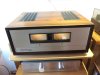
Exclusive m4a
Exclusive m4
Exclusive m5s
2401 twin horns drivers crossovers. No csbinets yet...
Cs-h9s
S 9500s
Tad 915s and horns
Plus over 100 spec items
 

Attachments

  • 20210108_085911.jpg
    20210108_085911.jpg
    99.6 KB · Views: 41
It is general question but I think you have answered it. Seems a big risk for something like a C5 preamp, where everything is potted, especially given the prices.
I will say having restored and owned a number if exclusive components, they are designed incredibly well, with no price spared. Like any vintage component, there is always risk, but I’d take my chances on exclusive gear any day of the week.

Good luck in your search!
 
Hello Exclusive fans
What is your opinion or experience with connecting older models (M4a to be exact) to modern 8 Ohm loudspeakers that are not really 8 but 4 Ohm or even less (minimum 3.5 or less) Will the amplifier work or will it turn off?
What speakers did you connect to with the lowest impedance?
M4a user manual if someone needs:
https://e-staff-net.com/shiryou/manual/exclusive_m4a.pdf
 
Last edited:
By the way: What's the point of the M4's ultra-low distortion if two fans produce clearly audible noise?
I'm still looking for an Exclusive M3 for good reason.

Finally i found an exclusive M3 in Japan...
IMG_1115.JPG
In a direct comparison with my M4, I can't tell any difference in sound - with the only exception that there is no annoying fan noise! And the power consumption of the M3 is ten times lower than that of the M4 at normal volume (1W is loud enough to cause trouble with the neighbours...)... My decision is clear: it's time to say goodbye to the M4 . Maybe someone else will be happy with the Class A heater...
 
What is your opinion or experience with connecting older models (M4a to be exact) to modern 8 Ohm loudspeakers that are not really 8 but 4 Ohm or even less (minimum 3.5 or less) Will the amplifier work or will it turn off?
What speakers did you connect to with the lowest impedance?

As far as I can understand the M4/M4a's circuitry, I see no reason why the load shouldn't be lower than 8 ohms. Four NPN and four PNP transistors drive the speaker in parallel in push-pull mode, and each of the transistors has a maximum collector current of 10 amps! The only problem seems to be the enormous power dissipation due to the Class A concept. You can calculate the power dissipation at 0V signal input as 2*2A*70V= 280W (2 power amplifiers* quiescent current*operating voltage of the output stage).
The total power consumption also increases to up to 320 W / 8 ohms when a signal level of 1 V is fed into the input of the amplifier. If you use speakers with only 4 ohms or ever lower impedance, there is a risk that the maximum power dissipation will be reached at a lower input level and eventually exceed the maximum rate. Don't panic, the protection circuit should shut down the amp after a while.
Unfortunately the thermal protection of amplifiers that are over 40 years old often fails due to bad PTCs. (I found defective PTCs on both sides of my M4) If the PTC´s don't reach the required resistance at 85°C, the output stage will be blown sooner or later
From time to time I use my M4 with two pairs of 8 ohm speakers (=4 ohm load). With low power (<10W) this is certainly not a problem.
 
Hi
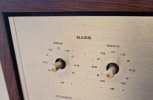
Got my C3 from Japan to match M4. It looks good but front panel is little dirty. How to clean especialny brown dirt in corner? Water with soap or some other cleaner? Picture attached:20230706_101636_.jpg
 
Last edited:
Hi,
The devices from Japan are mostly pretty dirty, both outside and inside.
All new arrivals from Japan are tested first with a radiation meter - they could be from the Fukushima area...
I remove the wooden cases of the Exclusive models and then I open the devices and dismantle all the buttons and the front panel. Sometimes i have even discovered animal inhabitants inside the wooden cases, such as small wasp nests!
All kinds of solvents can be used to clean the anodized front panels. The only thing you absolutely have to avoid is alkaline cleaning agents! (No lye, never!!!)
The brown film in the corners is from the grease on the lid hinges. If it's persistant, you can also gently polish it away with ceramic hob cleaner. I also use that cleaner to treat the whole front panel if necessary. If in doubt, I recommend that you test the cleaning agent on the back of the front panel beforehand. It must not damage the surface of the aluminum! Some cleaners may be inappropriate. This certainly includes all agents with a pH value greater than 7!
The wooden surfaces can be worked up again with car polish provided there are no deep scratches.
Look at the picture of my Exclusive M3 (two threads above).
The front panel was completely stained and the brown discoloration was visible throughout the flap area. Now the device looks like new again!
 
Hi
You surprised me with your statement about radiation, so I checked it with a borrowed meter to be sure. No radiation was detected, also on the other objects.
I tried to disassemble the knobs, which are mounted on screws, there is a lot of oil inside, I guessed it was from the potentiometer mechanisms.

On the back, especially in the lower part of black metal plate, you can see a lot of tarnish (rust?) - second photo, can it be polished somehow?
 

Attachments

  • 1.jpg
    1.jpg
    51.6 KB · Views: 12
  • 2.jpg
    2.jpg
    138 KB · Views: 14
Back
Top Bottom