• The move to the new server is done. There are some software and database maintenance updates in process. This has us passing the hat around to help out. We appreciate any donations. Seriously, even a dollar helps. The payment page may be found here - https://www.audiokarma.org/support.html

Genesis Physics Speakers:Model II

I'm working on my Genesis II+ speakers but have put the work on hold due to lack of time and
redoing my measurement system:

You are correct about there being a lot of stuffing, do you have 5, or is it 6 long pieces running
top to bottom and front to back? The cloth is just a layer between the woofer and the fiberglass.
 
I didn't remove the fill because as I just pushed it out of the way to get to the crossover. I had no idea there was a number of layers. But I think I can check that tonight. My speakers are covered in vinyl that is a tad sticky in places. I'll try to remedy that later. But I'm absolutely amazed that they are not marred at all. Same with the grill covers, a little bit here and there, but it's like these were stored for years.
 
From what I could tell but might be wrong as its kind of hard to count, 4 layers of fill split in half at each end. This creates a cavity under the pr and driver where there is a piece of rolled poly stuck between these cavity's directly below the drivers/PR.
 
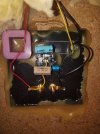
Been listening to these for the past few days, and the tweets are a little hot. I thought they were fine when I first started out, then I started messing with placement, songs, etc. I'm attaching a crappy pix of the inside of one of the boxes, do I have two, 10uf caps here? If so, why did they use one 10uf on some, and two on others?
Instead of the 2ohm resistor, can I swap in a 2.2 or 2.5?
Thanks
IMG_20250519_165425852_MP.jpg
 
The second cap, across the resistor, tilts up the top end but the tweeter already has excellent
extension. Hot sells in showroom demos, some had that cap, mine didn't. I would just clip it
out which you'll have to do when you recap them anyway.
Are you listening with the switch in the low position?
What I suggest is putting 2 or 2.2 ohms in series with the main cap, then hi will be like lo was
and low should end up about right. Adjust as needed.
Let us know what you think.
 
I read your extensive write up on how you measured these speakers which was really interesting. Yep, I listened using the switch in both spots. I listen to pretty much all rock and have all my life which has kind of ruined my ears, some.
Based on all the glue, which is hiding most of what's going on, I'm pretty sure you are referring to clipping the light blue cap, then replacing/upgrading the dark blue cap. I mean I really can't tell wth is going on under that mess, but after searching the web, I found some pixs of crossovers that have just the one cap.
It's interesting that they did this after reading how much they were struggling with money at one point. You would think they wouldn't have gone that route, adding another cap, because of costs.
I ordered some caps and resistors, going to open them up again and start chipping away at the glue so I don't get completely frustrated trying to do it all in one sitting.
My first thought after I read your last post, open them up, clip the cap, close them up. But the hell with that, I might as well kill all birds at once.
Thanks much!
 
Last edited:
Here is a pic after I removed the glue. I was actually surprised it came off so easily. Figure I will post some pics for future reference in case others need them. And why did they use two different caps. Was one considered better back then. Hmmm.IMG_20250528_173852076.jpg
 
Better? No, they bought whatever was the cheapest from decent quality companies.
They grab them from the bin and don't care what brand they are.

BTW, if you find it difficult finding the best value for the resistor you could just replace
the switch with an L-Pad. I show how to do this in my EPI 100 thread.
 
Since I'm waiting for parts, read some more about these speakers regarding the cabinets. The human website goes over bracing, and since I have lots of wood, figured I would add some. As you see in pix I placed them right between the PR and tweeter. I did the same on other side of tweet. I placed them so I could also use the screw holes for the drivers as extra support. Used copious amounts of wood glue to secure, and really don't need the screws they are in there so tight. IMG_20250530_055659518_MP~2.jpg
 
Better? No, they bought whatever was the cheapest from decent quality companies.
They grab them from the bin and don't care what brand they are.

BTW, if you find it difficult finding the best value for the resistor you could just replace
the switch with an L-Pad. I show how to do this in my EPI 100 thread.
Yeah, I figured that's what they did. Polk did the same on some older models.
Oh man, I was thinking of putting an L-pad back there but bought Mills 2.5-ohm resistors already. I'll take a look at that thread, maybe It will change my mind.
Thanks
 
Old semi-sticky vinyl on cabinets. For anyone that has the same issue as these old timers have/had, use goo gone spray gel. Done.
 
I have some 1/2" sonic barrier laying around from another project, do you think these might benefit from adding a square piece behind each woofer and leaving the fiberglass in place?
 
No idea what sonic barrier is, but putting it right behind the woofer will likely have a significant effect - impeding the air flow close to the woofer cone affects its Q - I believe that is why the JBL 100 has the fiberglass and cardboard basket right next to the woofer. If you want to see if the sonic barrier has a beneficial effect, I would guess that putting it against the back wall would be a better bet (and that may have been what you intended all along). That said, it is possible to overdamp a speaker, so do one, and compare to the other.
A brace between the front baffle and the back seems like a more promising idea, but there is one way to find out.
 
Yeah, i wasn't clear enough. This stuff has a sticky backside which would be placed on the back wall. I think I'll hold off. I'm still waiting for caps, etc to show up and I already braced them, front to back. So ill c how that works out.
Thanks
 
Back to the fiberglass, I'm working on my 2+ lately and have not looked at 2 s in over a decade
but from what I remember they're filled with fiberglass and you're right probably too much
right behind the passive. The woofer Qts is a bit high for a vented alignment so the fiberglass
behind the woofer is good. I would use the strips and line both side, and the back wall, then
fold a piece behind the woofer, if there's any left you could put another folded piece behind
the woofer or try it less one piece.
I doubt that the sonic barrier will make a huge difference but your plan sounds fine.
 
  • Like
Reactions: lms
Since I have time and lots of wood, do you think I should add a brace right behind the brace you see is the pix, but going from left to right so the sides get some more support?
 
Pete knows much more than I do, but I offer two related thoughts: there comes a point of diminishing returns when improving inexpensive speakers. Braces, of course,are cheap and easy, but, absent a lot of fancy research, they are also somewhat unpredictable in their effect. And the more you put in there, the less internal volume there is, and that is an important factor, so, in some instances, less may be more. Were you to build entirely new cabinets, then you could brace to your heart's content (at least until it occurs to you that a concrete enclosure would be much less resonant even without braces).
 
I get it. The only reason I brought it up was because, well the boxes are open, i have read that these vibrate, and most importantly, human speakers shows that it might be beneficial.
I also get that these were probably tuned, to a certain extent, with all the frickn fiberglass, and the poly right under the PR. Were they compensating for the somewhat, crappy boxes, who knows.
I'll leave it be right now. Hopefully the x-overs, once i install them and are broken in, and the braces i already put in, do something beneficial.
Thanks all.
 
I can tell you that the woofer is really more suited to acoustic suspension designs, but
they made it work really well. There was a thing written called alignment jamming
in the AES years ago by the experts. Basically take a given driver and see if you can find
a vented alignment that works. Not saying that the designers read that article or anything
else. I think that they fully stuffed it because that's what they were used to with acoustic
suspension, that then required a larger box. Anyway, they ended up with VERY extended
bass that sounds great. A few braces are not going to change the volume much, I wouldn't
worry about it. The output at the bass tuning frequency is proportional to the box volume.
Cut the volume in half and you lose 6 dB at Fb. Add too much stuffing and you also lose
output at Fb.
 
  • Like
Reactions: lms
Back
Top Bottom