

You are using an out of date browser. It may not display this or other websites correctly.
You should upgrade or use an alternative browser.
You should upgrade or use an alternative browser.
Dual 1219 Wow&Flutter?
- Thread starter Fishead
- Start date
Register to hide this ad

SaSi
Seriously Illogical
I haven't had any experience with the 1219, but recently worked on a 1009. Unserviced, it gave around 0.2% on 33rpm, a bit less in 45. After some cleaning, lubing and softening of the idler, 33rpm was usually in the sub 0.1% mark and 45rpm gave a very respectable 0.05%. I would expect a serviced 1219 to perform a bit better.
I used a w&f app on a smartphone, so the readings are not verified.
I used a w&f app on a smartphone, so the readings are not verified.

Thank you @SaSi, that's very good. I'm curious because I've been doing some work on my 1219 and can't seem to dial in the consistency I was hoping for. I'll keep trying.....33rpm at sub .1% would make me very, very happy! I'm thinking it will be time for a new idler wheel, has the original early 70s wheel on it now but the thing still looks very good, no hardening, glazing(I dressed it also) or visible defect of any kind but I think it is the culprit for my high w&f readings. I'm using an iPhone with the RPM app as well.....
SaSi
Seriously Illogical
The motor may also need cleaning and servicing. Nothing much, other than cleaning the bearings and adding some oil.
The idler is also important. It may appear to be pliable and grippy, but it may not be uniformly so. Like I said with the 1009: it was usually sub 0.1%. I have seen it wondering around.
Additionally, depending on how the platter is mounted on the main bearing, there may be a shim in the bottom of the "pit" there that the platter rests on. If so, it is important to remove it carefully, clean everything as best as possible and apply new lube.
The platter is heavy on these tables, so they can do well. The sources for w&f are the motor itself, the spindle, the idler, the cleanliness of the inner surface of the platter and the main bearing. If it's just dirt and grime, it only takes cleaning. But if there is wear, then not much can be done.
The idler is also important. It may appear to be pliable and grippy, but it may not be uniformly so. Like I said with the 1009: it was usually sub 0.1%. I have seen it wondering around.
Additionally, depending on how the platter is mounted on the main bearing, there may be a shim in the bottom of the "pit" there that the platter rests on. If so, it is important to remove it carefully, clean everything as best as possible and apply new lube.
The platter is heavy on these tables, so they can do well. The sources for w&f are the motor itself, the spindle, the idler, the cleanliness of the inner surface of the platter and the main bearing. If it's just dirt and grime, it only takes cleaning. But if there is wear, then not much can be done.

Warmed up, 0.06-0.08 is what i like to see. That's with the stock bearing and a good idler.


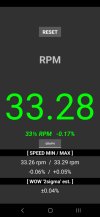
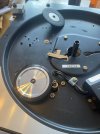
This is a lightly used 1219 that belonged to my father who bought it around 1972 or so while stationed in Nürnberg, Germany.....I have cleaned the spindle/platter bearing with mineral spirits and lubed with 3 in 1 electric motor oil. I cleaned the inner surface of the platter with very fine steel wool and I disassembled the motor and cleaned and lubed both upper and lower bearings, spindle and re-lubed with the same oil and later, re-did the whole thing and used sewing machine oil instead which produced no difference. I "dressed" the idler, rotating it in a drill and lightly touched the edge with a piece of 220 grit sandpaper on a small block I made for the purpose. The idler looks very nice, is very pliable, and seems to be fine.The motor may also need cleaning and servicing. Nothing much, other than cleaning the bearings and adding some oil.
The idler is also important. It may appear to be pliable and grippy, but it may not be uniformly so. Like I said with the 1009: it was usually sub 0.1%. I have seen it wondering around.
Additionally, depending on how the platter is mounted on the main bearing, there may be a shim in the bottom of the "pit" there that the platter rests on. If so, it is important to remove it carefully, clean everything as best as possible and apply new lube.
The platter is heavy on these tables, so they can do well. The sources for w&f are the motor itself, the spindle, the idler, the cleanliness of the inner surface of the platter and the main bearing. If it's just dirt and grime, it only takes cleaning. But if there is wear, then not much can be done.
Yes, my phone would agree.....starts out around .46 or so, then drops but I haven't seen it much lower than around .25 after a couple minutes. And the more concerning thing is the inconsistency......I can measure the speed, push the lever to STOP and then, after stopping the platter rotation, engage PLAY again and might get something quite different in terms of the speed. E.g., last night I did this test before turning in and I got 33.28rpm the first time, then after STOP and PLAY again, got 34.83rpm so I'm thinking my idler wheel is not making a consistent contact with the pulley. Or, more specifically, I have to set the pulley at a height to where the idler meets it almost right on the ridge between the 33 and 45 step. I think that ridge is sometimes being engaged by the idler and causing it to demonstrate such varying speeds. The service manual from Dual clearly states that one is to set the idler right in the middle of the step, which then allows for the fine-tuning of the speed up or down with the pitch control. The way I have it set is the only way I can get fast enough speed. If I set it in the middle, no amount of increasing the pitch control will get it to run faster than about 32.20. This is part of my dilemma and why I have had to set the idler so far down the pulley. In 78, I'm unable to get much more than about 75rpm no matter how far down the pulley I set it. Several here have suggested that I need a new idler, which I'm plenty willing to do, but first I would like to make sure I've ruled out other causes that might make a new idler give the same unhappy results as this original one.All the Duals I’ve had or worked on perform better with regard to this measurement after a several minute warm-up.
My 1219 hovers around .08.
That is what I've been using, my iPhone 12 Mini with the RPM app.Who knows how accurate it is, but I just measured my 1219 with my a phone app and got 0.04
Actually, I believe the phone uses the built-in gyroscope to measure the speed, but I could be wrong. I'd like to do as you suggest with a WFGUI though, can you provide some instructions? E.g., is there an app? Send the signal from the turntable to the computer I presume using the pre-outs from the preamp? I would like to learn how to do this as I've been skeptical of the phone app but others do just fine with it. As you say, why not double check it right?I presume the phone app listens to 3.000 or 3.150Hz tone off a test record. If so, why not double-check it with WFGUI?
Will, which app is that you're using?
Last edited:

Same one I've used for years.
No clue on accuracy, but it's gives consistent results so I feel it's got some merit for comparative measuring.
Idler tables are only ever going to be so good when it comes to WF.
My 1229Q is “tuned/serviced/modified” to within an inch of its life and this is whereabouts it usually measures on the WF app I use:

I would also like to note to not go off one measurement alone. I do three and then average them for a useable number. If one of the three measures is “right out to lunch”, I discard it and do a fourth to get my three average.
Even then, its like bragging about HP numbers on a dyno. The absolute number itself isn’t important, its which direction the numbers are trending while you’re fixing/modifying things. And thats how those WF apps should be used - ie: for trending.
That screen grab is the 1229q with Bruno’s machined idler and graphite center bearing, along with a few tweaks of my own and religious adherence to hitting manufacturers specs “right on the nose”.
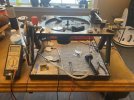
The wf number will oscillate around 0.04 to 0.06, but honestly, I don’t hear a difference between something like a 0.11 and a 0.04.
My belt drive 1249 will get even lower numbers. Its similarly restored/reworked. Belts are just better than idlers that way.
I’st the aircraft technician/engineer in me that makes me pursue the absolute best tolerance numbers I can humanly achieve. But don’t get hung up on a number. Most people I would say can just stop at where they can’t hear a problem and just enjoy it.
Typical WF sources on idlers to go after is the idler wheel rubber, the platter running surface, the idlers wheel center bearing and shaft, and the platter center bearing.
This is (of course) assuming the motor itself isn’t “ailing”.
Sometimes its worth cleaning the motor switch contacts, especially if the “pop” capacitor over the switch has failed in the past. Can lead to some burning on the switch contacts. That is VERY unlikely to be a source of wf though. Can limit some current and lead to less torque perhaps. I give mine a polish usually as just a matter of course on their annual teardown/inspection….
My 1229Q is “tuned/serviced/modified” to within an inch of its life and this is whereabouts it usually measures on the WF app I use:
I would also like to note to not go off one measurement alone. I do three and then average them for a useable number. If one of the three measures is “right out to lunch”, I discard it and do a fourth to get my three average.
Even then, its like bragging about HP numbers on a dyno. The absolute number itself isn’t important, its which direction the numbers are trending while you’re fixing/modifying things. And thats how those WF apps should be used - ie: for trending.
That screen grab is the 1229q with Bruno’s machined idler and graphite center bearing, along with a few tweaks of my own and religious adherence to hitting manufacturers specs “right on the nose”.
The wf number will oscillate around 0.04 to 0.06, but honestly, I don’t hear a difference between something like a 0.11 and a 0.04.
My belt drive 1249 will get even lower numbers. Its similarly restored/reworked. Belts are just better than idlers that way.
I’st the aircraft technician/engineer in me that makes me pursue the absolute best tolerance numbers I can humanly achieve. But don’t get hung up on a number. Most people I would say can just stop at where they can’t hear a problem and just enjoy it.
Typical WF sources on idlers to go after is the idler wheel rubber, the platter running surface, the idlers wheel center bearing and shaft, and the platter center bearing.
This is (of course) assuming the motor itself isn’t “ailing”.
Sometimes its worth cleaning the motor switch contacts, especially if the “pop” capacitor over the switch has failed in the past. Can lead to some burning on the switch contacts. That is VERY unlikely to be a source of wf though. Can limit some current and lead to less torque perhaps. I give mine a polish usually as just a matter of course on their annual teardown/inspection….
Last edited:
Dang, I think that's only available for Android devices as far as I can tell.....I have an iPhone.
Thanks again, @tourmax.....questions:Typical WF sources on idlers to go after is the idler wheel rubber, the platter running surface, the idlers wheel center bearing and shaft, and the platter center bearing.
1) Who is Bruno?
2) Are you talking about "graphite center bearing" as the bearing in the idler wheel?
3) What do you use and how do you do the platter running surface? I polished mine with some very fine steel wool, that good?
4) What do you do with the platter center bearing? I cleaned it and the spindle with some mineral spirits/Q-tips and then oiled with 3 in 1 motor oil.
Appreciate your help.
Actually, I believe the phone uses the built-in gyroscope to measure the speed, but I could be wrong. I'd like to do as you suggest with a WFGUI though, can you provide some instructions? E.g., is there an app? Send the signal from the turntable to the computer I presume using the pre-outs from the preamp? I would like to learn how to do this as I've been skeptical of the phone app but others do just fine with it. As you say, why not double check it right?
Somehow I thought you've been using a test record and an app that just "listens" to it through the microphone; I have no idea, if such an app actually exists, though.
The platter is balanced, so an off-center load of ~200 grams surely doesn't contribute to speed stability. I'd say the accuracy isn't limited by the (gyro) app as much as it is by placing the phone properly. Either way, it's not a calibration tool.
If you can hear it, or just being curious, you should invest in a test record and an designated W&F meter, either phisycal (not cheap and should be calibrated) or WFGUI (free and, to my understanding, very accurate...or accurate enough, at least).
Just search for WFGUI within the forum or go with Mat, the moaining tech:
You're right on how to feed the signal to a comp. Take WFGUI to check out your Nak ZX-7 as well.
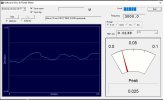
It seems that W%F below 0,1% is generally accepted as being next to impossible to detect even by golden ears (in a good sense...as in physical prime and trained), so I wouldn't neccesseraly aim for 0,06 as speced by Dual. But...measuring ekhms is in our genes, so here you go (Revox B215):
1. Audiovault. I just know his name from doing some beta testing stuff for himThanks again, @tourmax.....questions:
1) Who is Bruno?
2) Are you talking about "graphite center bearing" as the bearing in the idler wheel?
3) What do you use and how do you do the platter running surface? I polished mine with some very fine steel wool, that good?
4) What do you do with the platter center bearing? I cleaned it and the spindle with some mineral spirits/Q-tips and then oiled with 3 in 1 motor oil.
Appreciate your help.
2. Platter center bearing. Audiovault.
3. I don’t mess with the platter running surface other than IPA. No fingerprints basically. Finger oils on the running surface has a possibility of increasing wf.
4. See item 3. The new center bearing runs completely dry. Its self lubricating. Memory is a little unclear, it might be moly impreganated. Can’t remember offhand. Either way, you run it “dry”. I tested one for him oiled and it made no diff whatsoever, so run those ones dry and forget the hassle. Shaft still needs a very light skin of oil though. A chewed up platter shaft bearing (the brass looking bit down the center where the post rides) can also be an issue sometimes…
Aha! I believe that fate and destiny involves an interface with Herr Bruno at some point in the not-too-distant future. Thanks for the explanations. I've heard of both the idler wheels and the center bearings that they produce and nothing but good reviews. I'm usually hesitant to use an aftermarket item, but in this case there may not be a good alternative and besides, those idlers look really cool!!! I know, I know, who's gonna see 'em anyhow, right? Yeah, but I know it's there, and I know what it looks like!! 

Yes, there are definitely lots of questions associated with the use of cell phones to measure W&F, although many here are reporting very appreciable results, the kind I'm NOT getting with my table at the moment.....The platter is balanced, so an off-center load of ~200 grams surely doesn't contribute to speed stability. I'd say the accuracy isn't limited by the (gyro) app as much as it is by placing the phone properly. Either way, it's not a calibration tool.
Similar threads


- Replies
- 74
- Views
- 14K
