The issue with accuracy in “roundness” is the radial play in the quill bearing of whatever tool you’re using.
Dremels are useful tools, but “accurate” is not a term I would to apply to it. The quill bearing is sloppy as heck on every one I’ve ever used. Good for what they are intended for, but “accurate”? Meh.
The lathe is down in the 0.001-0.0005 range of bearing play. But I freely admit its not a machine most people have access too. Even my old Atlas (Its a 1954 model) is not something most will spend their hard earned cash on. Their “usage per dollar” ratio just wouldn’t make sense.
Even a good drill press will still have 5-10 thou runout.
Still, both dremel or drill press will do better job of it than holding it in hand drill. More so if you use a couple simple techniques to improve your chances. Namely, remove the “human powered” clamping/feeding part of the process.
All of it can be improved by using something with a feed screw to put your abrasive media into the work. For example, if you chuck it up in something like my drill press and use its x/y table to just “graze” the idler rubber while accounting for backlash and using little to no pressure, I think you could make a reasonably good go of it:
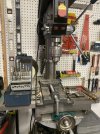
Even if you held the abrasive media down against the bare drill press table and just slid it in until you saw it graze the rubber would/might suffice in the contest of what we’re talking about. It would also ensure the idler and abrasive are held at right angles to each other. Right angle cutting is another important factor.
It’s the “hand held/feed” part thats the issue with keeping any kind of accuracy to a tolerance on any machine.
Of course, it all depends on what you define as accurate. Some might define it as “good enuff” is good enough. In many cases, it is.
I define it in thousands of an inch. A professional machinist might define it as in the 0.0001’s. A machinist who is used to making air bearings might even be more critical.
Of course, no amount of “truing” up an idlers running surface is going to matter if the rubber is older and has some harder and softer spots. Rubber (real rubber, not synthetic) is not a homogenous material. It “ages” at different rates inside of itself. Just the nature of the beast.
Now, the practical question: How much matters for a rubber idler? Eh. Who knows…just gotta try and find out what is and isn’t “good enuff”.
Audiovault had a video up at one point showing the runout on their idlers. Might still be there, dunno. Was chucked up in a collet device. About as accurate as you would need for this type of thing. Not even a thousandth on the gauge. Although, in all fairness, the gauge resolution (IIRC) was to 0.001….still, nothing to sneeze at for something like an idler wheel.
For me, that was “good enuff” and why I bought one.
Haven’t been disappointed.




