

You are using an out of date browser. It may not display this or other websites correctly.
You should upgrade or use an alternative browser.
You should upgrade or use an alternative browser.
Dual 1219 Wow&Flutter?
- Thread starter Fishead
- Start date
“Failing” in these old beasts of TT a motor is more often than not a bearing going away.
Only other real “failure” would be the coil windings shorting internally (the varnish deteriorated, which would be unusual).
Coil winding failures usually show as a short between windings and correspondent low ohm readings (ie: less wire to travel through, lower resistance).
I still think your problem lies in the speed selector/idler area somewhere.
Wish I had it in front of me right now. Hard to troubleshoot over the internet….
Only other real “failure” would be the coil windings shorting internally (the varnish deteriorated, which would be unusual).
Coil winding failures usually show as a short between windings and correspondent low ohm readings (ie: less wire to travel through, lower resistance).
I still think your problem lies in the speed selector/idler area somewhere.
Wish I had it in front of me right now. Hard to troubleshoot over the internet….

That is why I am asking about how to test the coil windings, or I think the manual calls them "field coils," are those the same thing? As I mentioned before, when I tested the green and orange(yellow) together, i.e. negative wire from the multimeter to the green lead, positive wire from the multimeter to the orange lead, I get 336.2ohms. Testing the other two wires from the motor, the black and white the same way, I get 330.3ohms. The service manual actually does have a diagram showing the connections for with and without the voltage selector switch, page 4 but I can't seem to copy that page to post it here.

SmileyFaceEQ
Super Member
Just enjoy your table. Let it play and burn in after the maintenance. Give it a month and retest. The motor is fine. The idler tire is fine. A new shiny tire would be a nice gift one day. You risk catastrophe if you keep fiddling with it. The main platter bearing is the upgrade I would reccomend. Did you open and clean it?
There are also brand new ones from Japan with 2x ball bearings in the set.
I am saying it's a combo, but a new main platter bearing and tire would be nice.
There are also brand new ones from Japan with 2x ball bearings in the set.
I am saying it's a combo, but a new main platter bearing and tire would be nice.
No, I did not open the main platter bearing.....I can tell you that if I give the platter a spin by hand, it spins for a long, long time.....so, pretty smooth still and I did not want to risk it because as you say, too much fiddling could end in a bad situation and I feel very confident in the things I've done so far, just haven't gotten the speed to where it needs to be. Thanks for your thoughts.....Did you open and clean it?

twiiii
Lunatic Member
I owned a 1219 for a while and then tried the 1229 which I thought was a marginal improvement. But neither could close to manual turntables that were belt driven so I gave up on Dual a long time ago. As far as the auto mechanism operation Miracords were so much smoother, more consistent and more dependable. But neither could match belt driven Empire or Thorens turntables. So. I gave up on changers by the mid 70's.
I really like this one and have a special attachment to it. Is it on the level of my Nottingham Spacedeck? No. Or even the PX-3? Probably not. And I'd say the TD160 would, by virtue of being a belt drive, and I'm given to them, also be preferable. But the Dual is just classic and very well made, in my opinion, and I think I'm lucky to have this one. I'll get it all sorted out, being the stubborn German that I am, as nothing I think is important will go undone.....
Sincere thanks to those who have provided wisdom and advice so far.....this place is a real haven for the weary as there are many who help to lighten the load and best of all, so often find solutions to problems otherwise far less solvable. Carry on, amigos.....
Sincere thanks to those who have provided wisdom and advice so far.....this place is a real haven for the weary as there are many who help to lighten the load and best of all, so often find solutions to problems otherwise far less solvable. Carry on, amigos.....

NoTransistors
Dual Turntables Super-Restorer
Fishy: Why is your 1219 the only one with the pulley not near the top of the taper?
Thanks for checking in here @NoTransistors . Can you elaborate a bit, not sure I'm understanding what you mean by "the pulley not near the top of the taper?"
Last edited:

I think he means it's riding low on the spindle relative to others? Like at the bottom of the 33 section vs the top? Possibly implying low rpm?Thanks for checking in here sir. Can you elaborate a bit, not sure I'm understanding what you mean by "the pulley not near the top of the taper?"
There is something oddly satisfying about these tables. I've cycled quite a few diffeent makes and models thru this place over the years, but the 1219 just somehow feels very right. Way more usable than my td160, far more life than any of the direct drives. It feels like an old watch that's going to outlive me.
Are you saying that the pulley is not as high on the spindle from the motor as others?
The way I understand it is that the height of the pulley is pretty much dictated by the height of the idler wheel as that is constant and dictated by the selector mechanism. You raise or lower the pulley in relation to where the idler wheel is and the service manual directs one to adjust the pulley so that the idler contacts it in the middle of the "step" that is machined on to the pulley for each speed. The trouble with mine is that when I set things up this way, the speed is far too slow and I have to adjust the pulley upward on the spindle, so that the idler rides near or at the bottom of each step where the circumference is largest in order to have any hope of getting the speed up to where it needs to be.
So, the way I'm looking at it, my pulley is probably positioned higher on the spindle than most which is why I'm not quite understanding the comment about "lower" on the spindle.
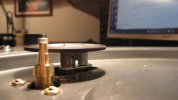

The top of the pulley is exactly 15/16" above the top of the base where you see the motor screws. As you can also see from these pictures, the idler wheel contacts the pulley at the very bottom of the step for 33rpm. What I've been trying to convey is that slight movement of the idler can sometimes cause it to make contact with that ridge between the 33 and 45rpm steps, which then plays hell with the stability of the speed. This picture also gives a pretty good representation of where the idler wheel is in relation to the top of the base and measures 12.5/16"(25/32") above it. The height of the idler wheel is dictated by the plastic shaft with the "S" groove in it that causes it to lock into 33, 45, or 78rpm positions. One cannot change those distances as they are fixed by that shaft and it only fits on to the bottom of the base one way.
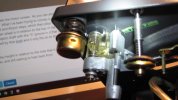
Hope these pictures help with understanding what I have been trying to convey......Would it be possible for you to take a picture of yours that shows the pulley height in relation to the hole that it comes out of on the top plate of the turntable? That might shed some light on the matter. Thanks, and still waiting to hear back from @NoTransistors as well......
The way I understand it is that the height of the pulley is pretty much dictated by the height of the idler wheel as that is constant and dictated by the selector mechanism. You raise or lower the pulley in relation to where the idler wheel is and the service manual directs one to adjust the pulley so that the idler contacts it in the middle of the "step" that is machined on to the pulley for each speed. The trouble with mine is that when I set things up this way, the speed is far too slow and I have to adjust the pulley upward on the spindle, so that the idler rides near or at the bottom of each step where the circumference is largest in order to have any hope of getting the speed up to where it needs to be.
So, the way I'm looking at it, my pulley is probably positioned higher on the spindle than most which is why I'm not quite understanding the comment about "lower" on the spindle.
The top of the pulley is exactly 15/16" above the top of the base where you see the motor screws. As you can also see from these pictures, the idler wheel contacts the pulley at the very bottom of the step for 33rpm. What I've been trying to convey is that slight movement of the idler can sometimes cause it to make contact with that ridge between the 33 and 45rpm steps, which then plays hell with the stability of the speed. This picture also gives a pretty good representation of where the idler wheel is in relation to the top of the base and measures 12.5/16"(25/32") above it. The height of the idler wheel is dictated by the plastic shaft with the "S" groove in it that causes it to lock into 33, 45, or 78rpm positions. One cannot change those distances as they are fixed by that shaft and it only fits on to the bottom of the base one way.
Hope these pictures help with understanding what I have been trying to convey......Would it be possible for you to take a picture of yours that shows the pulley height in relation to the hole that it comes out of on the top plate of the turntable? That might shed some light on the matter. Thanks, and still waiting to hear back from @NoTransistors as well......
Last edited:

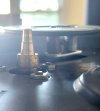
This is the audiovault idler. 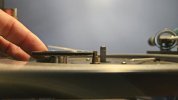
I've never gotten into the speed control. Sits one mark left of center. I should also add that im still in the break in period for the platter bearing, for which i did need to increase the speed a hair.
I've never gotten into the speed control. Sits one mark left of center. I should also add that im still in the break in period for the platter bearing, for which i did need to increase the speed a hair.
Last edited:
Yes, I can see that.....however, the matter at hand has to do with the actual height of the pulley itself and I can't see how far above your turntable top plate that it sits.....can you maybe measure or perhaps take a picture showing the pulley in relation to the top plate?This is the audiovault idler. View attachment 3415631
I've never gotten into the speed control. Sits one mark left of center. I should also add that im still in the break in period for the platter bearing, for which i did need to increase the speed a hair.
Hey Will, and yes I can see that your pulley actually rides lower than mine, which makes sense as your idler is touching it up a bit higher in the middle of the step for 33rpm as it should be. If I adjust mine to that height, the speed will not be much above about 31.5rpm. That has been my dilemma all along here. Thanks for the picture, and yeah.....some Brasso will hopefully clean that pulley right up if it's not pitted (hope, hope).Here's a picture of mine. It does seem like your pulley is higher in relation to the top plate. My idler wheel rides right about in the middle of the 33 pulley section.
(noticing that my pulley could use a little polishing...)
View attachment 3415626
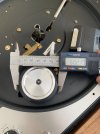
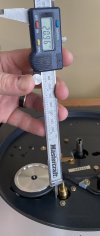
I just realized you can use the end of my calipers as a depth gauge...
I measure 0.857" from the plate to the top of the brass
I measure 0.857" from the plate to the top of the brass
Yep, pretty nifty, eh? That's another reason these conversations are so useful.....I'm constantly learning about one thing or another!
OK, so your pulley is actually lower than mine (15/16" = .9375") and that is exactly what I've been saying, and again, the reason for this is that when the pulley is higher, it increases the speed which is what I've been trying to do but "I've run outta room!!!" This because the idler wheel is encroaching on that ridge of the 45rpm step. Thanks for measuring that and confirming amigo!
I'm still waiting to hear from @NoTransistors to explain what he meant by his comment earlier so I can better understand what he is seeing that might be off......
OK, so your pulley is actually lower than mine (15/16" = .9375") and that is exactly what I've been saying, and again, the reason for this is that when the pulley is higher, it increases the speed which is what I've been trying to do but "I've run outta room!!!" This because the idler wheel is encroaching on that ridge of the 45rpm step. Thanks for measuring that and confirming amigo!
I'm still waiting to hear from @NoTransistors to explain what he meant by his comment earlier so I can better understand what he is seeing that might be off......
Not aure if these will help any, but my 1229Q:
33:
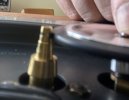
78:

Finger is not pushing down but simply holding the idler against the pulley. The idler won’t sit against the pulley otherwise without power on. If your’s does, the idler arm mechanism is not working properly.
There’s going to be some degree of measuring error. The depth rod on the vernier doesn’t sit square to the table because of the opening so theres a small amount of angle.
But the measure is close enough for this purpose. I’ve got more precise means of measuring, but there comes a point where you’re just picking “flystuff” out of the pepper.
Dual’s are more precision built than people think, but for this exercise, the vernier depth measure is “good enuff”…

33:
78:
Finger is not pushing down but simply holding the idler against the pulley. The idler won’t sit against the pulley otherwise without power on. If your’s does, the idler arm mechanism is not working properly.
There’s going to be some degree of measuring error. The depth rod on the vernier doesn’t sit square to the table because of the opening so theres a small amount of angle.
But the measure is close enough for this purpose. I’ve got more precise means of measuring, but there comes a point where you’re just picking “flystuff” out of the pepper.
Dual’s are more precision built than people think, but for this exercise, the vernier depth measure is “good enuff”…
Last edited:
That means that either your motor is running slow, or your idler is slipping on the rim.
Similar threads


- Replies
- 74
- Views
- 14K
