• The move to the new server is done. There are some software and database maintenance updates in process. This has us passing the hat around to help out. We appreciate any donations. Seriously, even a dollar helps. The payment page may be found here - https://www.audiokarma.org/support.html

Highend Tonearm Dimishing returns?

I could serve a pallette of goodies here but to convince you I will just point out a very few examples:

#1
Materials.
Carbon Fiber
This material were not in any production line in the 70s/80s
Look at e.g. aviation in general.

The Magnapan Unitrac1 arm was carbon fiber as was the Infinity Black Widow of that era.
Regards,
Jim
 
The Magnapan Unitrac1 arm was carbon fiber as was the Infinity Black Widow of that era.
Regards,
Jim

Ok

I stand corrected.
I was not aware of that.

But at least it's far wider spread in production line today.

And at least other materials have taken into use as well.
 
Ultralyd,

Not all S or J shaped arms are low end. There are a few highly regarded examples, such as the Acos and a couple of Technics EPA models as well as the Jelco transcription tonearms. Not to mention the classic Ortofon designs used by no less than EMT for years. All of the above have good reputations. Might not be what you like. But your wants, needs, and desires are different. And the fellow who wishes to use a mono moving coil like the Denon DL-102 has different needs than the fellow who wishes to use a low mass MM or MI pickup like a SoundSmith model. Some other users wish to be able to use both, which explains the man with multiple turntables or the turntable with several tonearms mounted on it's plinth. Some need convenience in operation, some need performance without compromise, some need a happy medium. There's something out there for all tastes. Tonearm construction and design has come a long way and matured a lot, but the classic great designs have merit and make sense for some users. What matters in the end is the music we play back and how happy we are with the results. And some users have a modern arm alongside a classic even.
 
Last edited:
Carbon fiber tonearms have been around since the early 1970s and a number of mfgs used them in the 70s/80s/90s, I'm not going to bother listing all of them. Tolerances, ever here of Switzerland/Germany/Japan, powerhouses when it comes to mfg going back more years than can be counted. About the only thing new and on the horizon is 3d printing and it won't be affordable for a long time.
 
Carbon fiber tonearms have been around since the early 1970s and a number of mfgs used them in the 70s/80s/90s, I'm not going to bother listing all of them. Tolerances, ever here of Switzerland/Germany/Japan, powerhouses when it comes to mfg going back more years than can be counted. About the only thing new and on the horizon is 3d printing and it won't be affordable for a long time.

3d printing is cheap, really really cheap, espicaly for small productions like most tonearms, draw something up on one of the many free programs, then have shapways print a couple, just a estimate but depending on the material it would cost around 150 bucks, which is alot cheper then geting injection molds made up for a limited run, with the printer in my basment i can print a whole arm(yes i've done it) for about 3 bucks in plastic cost.

But unfortantly so far i've found that the plastic normaly sounds kinda bad, once i figure that out though, it problay could prove your point where new tech makes better sound
 
Precision production advances? Check out the work of Abraham Louis Breguet and the "Marie Antoinette" commission along with his other works;
"Considered as “Queen” or “Mona Lisa” of all timepieces, the Breguet No. 160 is a horological masterpiece by genius watchmaker Abraham Louis-Breguet. It was commissioned in 1783 as a gift to Marie Antoinette by an unknown admirer. It was completed in 1827, 34 years after the death of Marie Antoinette and four years after its maker Breguet passed away.
23 complications are encased in 18-carat gold and a clear crystal glass dial to show off its superb mechanisms. Perpetual calendar, thermometer, shock-absorbing device, the phases of the moon and a repeater that chimes the hour are some of its features, the movement plates are optically perfect machined natural crystal to show the details of the mechanism."
pocketwatch.jpg

http://luxguru.typepad.com/lorre_wh...es-of-intriguing-history-breguets-no-160.html

Precision line production? Check American Railroad Standard Watches, Webb C. Ball, and various manufacturers of them.
 
Last edited:
Precision production advances? Check out the work of Abraham Louis Breguet and the "Marie Antoinette" commission along with his other works;
"Considered as “Queen” or “Mona Lisa” of all timepieces, the Breguet No. 160 is a horological masterpiece by genius watchmaker Abraham Louis-Breguet. It was commissioned in 1783 as a gift to Marie Antoinette by an unknown admirer. It was completed in 1827, 34 years after the death of Marie Antoinette and four years after its maker Breguet passed away.
23 complications are encased in 18-carat gold and a clear crystal glass dial to show off its superb mechanisms. Perpetual calendar, thermometer, shock-absorbing device, the phases of the moon and a repeater that chimes the hour are some of its features, the movement plates are optically perfect machined natural crystal to show the details of the mechanism in detail."
pocketwatch.jpg

http://luxguru.typepad.com/lorre_wh...es-of-intriguing-history-breguets-no-160.html

Precision line production? Check American Railroad Standard Watches, Webb C. Ball, and various manufacturers of them.

The most complicated watches ever made, the watches considered to be best craftmanship ever are present watches from Patek Philippe and Vacheron Constantin.

The most precise watches ever made are from present time.

The most advanced technology in any watch is also from present time with radio control and build in sat-nav, watches with ability to go deeper into the ocean than ever using gas to keep water out.

Technological advances.

And back to the tolerances in car engines.
If this was not the truth, the engines would not have been able to produce more power AND return a better fuel consumption than ever.
Service intervals are getting longer in between.
New technologies to control valve timing, to inject fuel, new materials to make the racing engines lighter, double clutch transmision.

New technology all over.

This is also a fact within materials for tonearms and cartridges.

S-arms and J-arms of yesteryear might have been high-end back then but measured with todays standard, they are no longer.

A 3D print might only be plastic but a clay mock-up of a car, a 3D graphic on a PC, is also the beginning of tomorrows supercars.

As is it with mechanics for high end audio.

A one piece aluminium Plinth of 60 kilogram have never been made before now.

Suspension elements from car technology can be adapted into turntable construction.
Never have computercontrol of suspension had such a huge influence on roadholding and security.
So some of the very succesfull turntable manufacturers from yesteryear, even though they were inactive for a decade or two, are getting back into bussiness, launching some of the most innovative and expensive TTs ever with their suspended constructions.

Magnetical drive, hydraulic drive, plinth made out of one whole piece of Norwegian rock, new belt materials, new platter materials, motor control precision have never been better no matter drive system.


Never have it been possible to grind a diamond with such a precission as today.
Never have man been able to physical manipulate so microscopical elements before.

Precisions in bearings have been better than today.
Laser sharpening of knives and blades for precise balancing of some armbasing have never been better.

The number of decimals to calculate geometri of the arm movement over the LP have never been more precise.

Jump out of the vintage illusions and get your feet grounded in present time.

 
My point was that it wasn't all relatively blacksmithing until the modern era, I'm with you on the possibilities that modern methodology make possible whether they find their place in the topic field of interest or not. Still lots of dead ends being chased IMO.
Re engines, agreed! Never truer than now even with the Miller 91 in retrospective. The thing is that light petroleum distillates have yet to be eclipsed as an economical energy source for highly efficient portable motive power, other sources like electric still lack a rational context that generally makes sense outside of low-milage local low-speed transport such as retirement communities and city transport, and subway and cantenary railway with a central power station.
 
Last edited:
"Ultimate" turntable players with a global engineering approach are indeed fascinating tho' the economies of such an approach tend to be unfortunately beyond practical reality for most interested persons. Historically the Colonay AB-1, the Versa Dynamics TT and the "out-of-the-usual-box-designed " Well-Tempered players come to mind as good examples. The Kuzma is another more modern example. The point of rapidly diminishing returns may define the cross-over point between real-world practicalities and cutting-edge all-out efforts.
FWIW, There was a gent that ran an automotive service in Los Alamos, had an appreciation of fine cars and mechanics and precision in playback with "High-end" sensibilities that would have enjoyed this discussion but sadly suddenly departed existence last May. Our loss.
 
Last edited:
Ultralyd: You mix a bunch of statements that are obviously correct but don't necessarily have anything to do with tonearms -- the tolerances that can be machined have never been tighter, but which arms actually are built to such tolerances -- F1 racing engines and military fighter planes yes, but what tonearms are built to tolerances that were unachievable long ago? -- and statements which are just your opinion -- S arms and J arms are not state of the art -- says who, and why not?
All the improvements in machining that you cite aren't relevant unless they are actually used in the production of arms and I am kind of dubious that anyone is actually using such staggeringly expensive machinery (and for the reproduction of vinyl discs that are made to vastly less stringent tolerances) -- certainly throwing money at a problem often has positive results, but I am not convinced that there is an actual business model there. Just because it could be done doesn't mean it is.
And some of your other examples are either mistaken or of dubious merit. -- Thorens built an enormous turntable out of granite back in the 70s or 80s -- 60 kg aluminium plinths are toys compared with it. Magnetic drives aren't new -- Strathearn had one in the early 70s and Denon did too, and Stanton had magnetic suspension of the platter.
3D printing is new, but so far it's just a cheaper way of making things out of plastic -- is that necessarily an advance in the state of the art?
I could go on.
 
Ultralyd: You mix a bunch of statements that are obviously correct but don't necessarily have anything to do with tonearms -- the tolerances that can be machined have never been tighter, but which arms actually are built to such tolerances -- F1 racing engines and military fighter planes yes, but what tonearms are built to tolerances that were unachievable long ago? -- and statements which are just your opinion -- S arms and J arms are not state of the art -- says who, and why not?
All the improvements in machining that you cite aren't relevant unless they are actually used in the production of arms and I am kind of dubious that anyone is actually using such staggeringly expensive machinery (and for the reproduction of vinyl discs that are made to vastly less stringent tolerances) -- certainly throwing money at a problem often has positive results, but I am not convinced that there is an actual business model there. Just because it could be done doesn't mean it is.
And some of your other examples are either mistaken or of dubious merit. -- Thorens built an enormous turntable out of granite back in the 70s or 80s -- 60 kg aluminium plinths are toys compared with it. Magnetic drives aren't new -- Strathearn had one in the early 70s and Denon did too, and Stanton had magnetic suspension of the platter.
3D printing is new, but so far it's just a cheaper way of making things out of plastic -- is that necessarily an advance in the state of the art?
I could go on.

Both of your posts covered just about everything I wanted to say. I was at work reading this on my phone, and thinking along these lines, but knowing I could not take the time to tap that kind of response out on a phone. i agree 100% that many of the examples given have nothing to do with manufacturing a tone arm, or advancing the state of analog.

Regards
Mister Pig
 
Vintage Audio can, within a few product groups, still perform great.

When it comes to tonearms, cartridges, speakers, cables, platters, damping and maybe other areas, developments of material, chemicals, microscopic assembling have taken a HUGE step forward from the years of the outdated tonearms in debate here.

So most of the arms you mention would never perform as a present high end arm.

S-arms are not in use on any great gear any more.
They simply don't sound good compared to todays standard anymore.

Rarely do I ever come down on the side of vintage audio, but I regularly do support 80's and 90's era analog tables and arms, and to some extent cartridges.

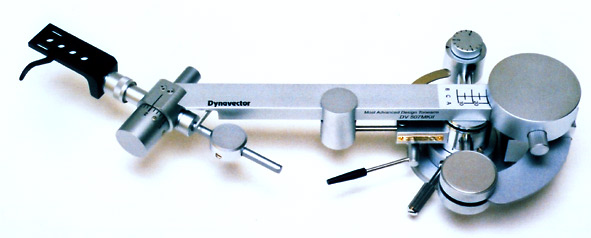
Now in regards to materials on amrs form this era. In 1984 SME introduced the Type V arm, which was a cast magnesium arm....ground breaking in many facts. The Eminent Technology II has a very precisely machined air bearing, and owners could select carbon fiber or magnesium arm wands as upgrades. The Technics EPA 100 used a titanium nitrite arm wand, and very precise ruby jewel bearings. Thre Dynavector DV501 qand 505 being bi axial design with separate vertical and horizontal pivots. Very very sophisticated arms that are still highly valued.

Matter of fact, the SME, ET, and Dynavector arm remain the same in overall concept, although they have been updated over the years. The design philosophy remains the same, because they are well executed products. Good sound never goes out of style.

SME-Series-V-Zoom.jpg


2006-10-KUZMA-airline.jpg


507mk2_full.jpg


Matter of fact, if you look at the Thales tone arm you currently use, it is a reinterpretation of the Garrard Zer100 or the Van Eps design. This is nothing new, but an improvement on a vintage design. The rotating head shell to offset tracking error is not unique, one of the latest designs to do this is the RS Labs RS 1 arm, which is now owned by 47 Labs.

RSLabRSA1-1.jpg


Although the most interesting pivoting arm with zero tracking error would have to be the new Schroeder design. Has a pivoting base along with a conventional pivot at the tone arm yoke. This is a variation on a zero tracking error pivoted arm that has not been tried before. Basically moving the rotating portion away from the head shell, and making it occur at the tone arm base. No super exotic materials, just enthusiastic engineering prowess.

IMG_1188.jpg


even though those last two modern arms are very very cool, at least the RS Labs like the Thales owes its design to vintage arms. And those vintage arms....well from the 70's and 80's are still components that are very relevant in the analog world. Many a vinyl-phile would be very happy to own one of them.

Regards
Mister Pig
 
Last edited:
But you already knew this;

:yes:
Kuzma Airline;
2006-10-KUZMA-airline.jpg


ET-2.5 ;
DSCF1153-for-email.gif


A Thales gif;
attachment.php


And here was a fabulous integrated TT;
attachment.php

Mislabeled, it's Versa Dynamics Model one
 
Last edited:
Snipped the wrong image when trying to find ET pics. The first one wouldn't load, and I moved to the next one and got the Kuzma by accident.

Lets try this one.

sota.jpg


Regards
Mister Pig
 
S-arms are not in use on any great gear any more.
They simply don't sound good compared to todays standard anymore.

Ultralyd, can you please list all the S-arms and 'modern' arms you have listened to side by side on the same turntable to offer this opinion?
There are many on these Forums and others....who tend to write with authority whilst having no direct experience with the actual topic?
It's great having someone who can enlighten through hands-on auditioning? :yes:
 
... what tonearms are built to tolerances that were unachievable long ago? -- and statements which are just your opinion -- S arms and J arms are not state of the art -- says who, and why not?
All the improvements in machining that you cite aren't relevant unless they are actually used in the production of arms and I am kind of dubious that anyone is actually using such staggeringly expensive machinery (and for the reproduction of vinyl discs that are made to vastly less stringent tolerances) -- certainly throwing money at a problem often has positive results, but I am not convinced that there is an actual business model there. Just because it could be done doesn't mean it is...

Would this also apply to turntables and cartridges?

Regarding Ultralyd's last post. He is also off with his watch points.
 
Rarely do I ever come down on the side of vintage audio, but I regularly do support 80's and 90's era analog tables and arms, and to some extent cartridges.

Now in regards to materials on amrs form this era. In 1984 SME introduced the Type V arm, which was a cast magnesium arm....ground breaking in many facts. The Eminent Technology II has a very precisely machined air bearing, and owners could select carbon fiber or magnesium arm wands as upgrades. The Technics EPA 100 used a titanium nitrite arm wand, and very precise ruby jewel bearings. Thre Dynavector DV501 qand 505 being bi axial design with separate vertical and horizontal pivots. Very very sophisticated arms that are still highly valued.

Matter of fact, the SME, ET, and Dynavector arm remain the same in overall concept, although they have been updated over the years. The design philosophy remains the same, because they are well executed products. Good sound never goes out of style.

...

Regards
Mister Pig

The ETII bearing is identical to the ET bearing. The ergonomic improvements of the ETII made it commercially viable. The ET2.5's bearing was upgraded to cope with audiophiles who were using pumps whose pressure was too high for the ETII bearing (Bruce Thigpen told me this - I was an insignificant ET dealer back in the day). There was one tonearm wand for the II. IIRC the magnesium wand came out about around the same time as the 2.5 and the carbon fiber even later.

I currently have a DV-505 and am friends with a Dynavector dealer (he is primarily an overhauler of uber Japanese DDs and next a builder of plinths). His favorite arm is the DV-505. He's compared it with a DV-507II and hears no meaningful sonic differences. He told me that the main improvement is to the 507's height adjustment. Most of the changes are cosmetic, however I don't know about wire or bearings. Another unique feature of the Dynavectors is their double damper system - inertial controlled dynamic damping plus electromagnetic damping. Han's (dealer) thinks the damping system has a greater sonic impact than the bi-axis bearing system. I should note that neither Han's nor I consider ourselves audiophiles.

In also own an SME V and the only update I'm aware of is more expensive wire. Google provides nothing on bearings. Over a 1984 lunch at a Korean barbeque restaurant David Fletcher told me that the V's bearings were well beyond the quality needed for a tonearm - this was not a criticism. Sumiko was the V's first importer and David is the designer of The Arm. I think SME got it right the first time with the V.
 
The ETII bearing is identical to the ET bearing. The ergonomic improvements of the ETII made it commercially viable. The ET2.5's bearing was upgraded to cope with audiophiles who were using pumps whose pressure was too high for the ETII bearing (Bruce Thigpen told me this - I was an insignificant ET dealer back in the day). There was one tonearm wand for the II. IIRC the magnesium wand came out about around the same time as the 2.5 and the carbon fiber even later.

I currently have a DV-505 and am friends with a Dynavector dealer (he is primarily an overhauler of uber Japanese DDs and next a builder of plinths). His favorite arm is the DV-505. He's compared it with a DV-507II and hears no meaningful sonic differences. He told me that the main improvement is to the 507's height adjustment. Most of the changes are cosmetic, however I don't know about wire or bearings. Another unique feature of the Dynavectors is their double damper system - inertial controlled dynamic damping plus electromagnetic damping. Han's (dealer) thinks the damping system has a greater sonic impact than the bi-axis bearing system. I should note that neither Han's nor I consider ourselves audiophiles.

In also own an SME V and the only update I'm aware of is more expensive wire. Google provides nothing on bearings. Over a 1984 lunch at a Korean barbeque restaurant David Fletcher told me that the V's bearings were well beyond the quality needed for a tonearm - this was not a criticism. Sumiko was the V's first importer and David is the designer of The Arm. I think SME got it right the first time with the V.

The time period that I owned an ET II, the 2.5 had already come out. When I spoke with Bruce he was offering the magnesium arm wand as an option for low compliance cartridges, don't recall the carbon fiber being available then. Bruce is one of the great guys in audio, so darn smart, but very polite and unassuming, and very willing to share his knowledge and give advice. What a great guy, and I thought the ET II was a wonderful arm.

I have been considering a SME 309 or IV for my Thorens 124. Been speaking with a longtime SME dealer in the UK about them. Now this dealer relates stories that the IV and V have had slight alterations in sound due to refinements in parts and assembly technique, along with a different wire being used. Now is this gospel according to SME? No, but I have no reason to disbelieve a very respected dealer.

I have only heard the Dynavector arms in passing, and never would claim any experience with them. The systems I heard them in were excellent though. A couple of years ago I considered buying one, as a couple hit Audiogon then. But I dallied a bit and they sold. The Dynavdctor arms still command a substantial price, and are sought after. Not sure if I could fit one on the Thorens though.

Thanks for the post, it was an interesting read.

Regards
Mister Pig
 
The ETII bearing is identical to the ET bearing. The ergonomic improvements of the ETII made it commercially viable. The ET2.5's bearing was upgraded to cope with audiophiles who were using pumps whose pressure was too high for the ETII bearing (Bruce Thigpen told me this - I was an insignificant ET dealer back in the day). There was one tonearm wand for the II. IIRC the magnesium wand came out about around the same time as the 2.5 and the carbon fiber even later.

I currently have a DV-505 and am friends with a Dynavector dealer (he is primarily an overhauler of uber Japanese DDs and next a builder of plinths). His favorite arm is the DV-505. He's compared it with a DV-507II and hears no meaningful sonic differences. He told me that the main improvement is to the 507's height adjustment. Most of the changes are cosmetic, however I don't know about wire or bearings. Another unique feature of the Dynavectors is their double damper system - inertial controlled dynamic damping plus electromagnetic damping. Han's (dealer) thinks the damping system has a greater sonic impact than the bi-axis bearing system. I should note that neither Han's nor I consider ourselves audiophiles.

In also own an SME V and the only update I'm aware of is more expensive wire. Google provides nothing on bearings. Over a 1984 lunch at a Korean barbeque restaurant David Fletcher told me that the V's bearings were well beyond the quality needed for a tonearm - this was not a criticism. Sumiko was the V's first importer and David is the designer of The Arm. I think SME got it right the first time with the V.

Thanks for mentioning Dave Fletcher. I was his representative in New England during the late 1970s. This is back when Sumiko imported Grace products. I believe that good progress has been made in tone arm design and performance. However, it's a matter of evolution rather than revolution. I'm staring at a Grace 707 II as I type this and marvel at the execution of the design. One company that gets overlooked in terms of great performance that will go toe to toe with modern designs is Audiocraft. They were built to a very high standard.
 
Back
Top Bottom