
Who's arguing? I'm pointing out facts.And you want to make it into an argument again, no thanks.


Who's arguing? I'm pointing out facts.And you want to make it into an argument again, no thanks.

Who's arguing? I'm pointing out facts.

A high-level input allows the sub to have the same exact input signal that the speaker is getting- and therefore, the sub has a better chance of achieving the same voicing as the main speakers.

I've read this countless times over the years and I still have a hard time wrapping my head around the "voicing" part. Perhaps I don't understand the meaning of "voicing" or I'm just dense. (I'm not a speaker designer nor an engineer, just a passionate hobbyist.) Right now I have my sub connected via high-level to good effect BTW, but I've also used the low-level connection as well using Decware's switch box. What escapes me is how the tube signature from my Decware amp is retained when the signal is then amplified by the sub's amp?
 , why not daisy chain a Krell, Sansui, Kenwood, etc, etc, adinfinitum to get the flavor of all, now that's the **** eh?
What was that you said about JL Audio? Facts, r i g h t lol.
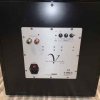
JL AUDIO GOTHAM G213V2 DUAL 13.5" SUBWOOFER
View attachment 2026708
- Regular price$16,500.00
look at all those speaker inputs
As I stated, truly high end eschew speaker level inputs. True, some have been adding them in the hopes to sell more units to the masses with lower end gear without pre outs like many receivers/integrated amps, but those in the know realize the signal directly off a preamp is cleaner with a much lower noise floor and less colored signal.
ya, there's the bullshit theory this helps to integrate the sub, but it's just that, BS. Everywhere else in the signal path we look for purity in signal, but here, in this one case it's preferable to have a dirty colored signal?
It's much more important to give the subwoofer amplifier "the identical signal" the main amplifier is receiving, not some ambiguously dirty signal if wanting a truly clean presentation.
That's it, I'm done with this, this has been hashed over in many threads here at AK, not getting into this again, that's the argument you were wanting, again.
It doesn't, it's just added noise. This myth was started by Rel, it's just snake oil.
I've stated over and over, I've used both, and I'm currently using both methods. But I'm not fooling myself into believing feeding one power amplifiers high output into another amplifier is better than feeding both with the identical signal directly from the preamp. My subs connected high level are mated to the mains in my surround setup, not my critical 2-channel setup.
I wonder why all power amps don't have speaker level inputs
This will be argued forever because many hear not as good as bad, that's not the case. Both will work just fine, just one has less noise.
If you're familiar with biamping then you know it's using more than one amp to drive the speakers. Typically one amp to drive the woofer, and another the higher frequency drivers.Thank you guys .. much appreciated.
Congrats, you found one. As for the rest....lol.What was that you said about JL Audio? Facts, r i g h t lol.
JL AUDIO GOTHAM G213V2 DUAL 13.5" SUBWOOFER
View attachment 2026708
- Regular price$16,500.00
look at all those speaker inputs
As I stated, truly high end eschew speaker level inputs. True, some have been adding them in the hopes to sell more units to the masses with lower end gear without pre outs like many receivers/integrated amps, but those in the know realize the signal directly off a preamp is cleaner with a much lower noise floor and less colored signal.
ya, there's the bullshit theory this helps to integrate the sub, but it's just that, BS. Everywhere else in the signal path we look for purity in signal, but here, in this one case it's preferable to have a dirty colored signal?
It's much more important to give the subwoofer amplifier "the identical signal" the main amplifier is receiving, not some ambiguously dirty signal if wanting a truly clean presentation.
That's it, I'm done with this, this has been hashed over in many threads here at AK, not getting into this again, that's the argument you were wanting, again.
Unless the gain levels are matched there will be issues with integration.If you're familiar with biamping then you know it's using more than one amp to drive the speakers. Typically one amp to drive the woofer, and another the higher frequency drivers.
There are other arrangements but this most helps to illustrate the use of a subwoofer. Often when a tube amp is utilized in the biamping it's for the high frequency drivers to ad the tube warmth, but solid state is retained for the woofer for its perceived tighter control over the larger driver, no issues with integration.
If you're familiar with biamping then you know it's using more than one amp to drive the speakers. Typically one amp to drive the woofer, and another the higher frequency drivers.
There are other arrangements but this most helps to illustrate the use of a subwoofer. Often when a tube amp is utilized in the biamping it's for the high frequency drivers to ad the tube warmth, but solid state is retained for the woofer for its perceived tighter control over the larger driver, no issues with integration.
... But I'm not fooling myself into believing feeding one power amplifiers high output into another amplifier is better than feeding both with the identical signal directly from the preamp. My subs connected high level are mated to the mains in my surround setup, not my critical 2-channel setup.

For each their own- but I've never been satisfied with using a tube amp straight from the preamp for the highs, and a SS amp straight from the preamp, for the lows, in any bi-amp situation I've worked with. You could ALWAYS hear the difference between the damping and the transient response between the two- they never seamlessly integrated, to my satisfaction.
It's less noticeable for a sub (low frequency crossover)- but if you get up into the midrange for the transition- it's especially distracting and detrimental.
Regards,
Gordon.
The problem with your argument is that you are looking at only one side of it. Of course there is more "noise" when driving the sub with the main speaker outputs because that signal is going through the preamp and the amp, instead of just the preamp. That said, the additional "noise" of the amp is negligibly small in any decent system. If there was any meaningful noise from the amp, you'd hear it a hundred times more out of the main speakers than you would out of the sub (take a look at typical THD of the audio out of subs if you doubt this). Unless you are driving the amp to its limits, there won't be any meaningful noise at all in the mains, and it would be far less audible in the sub. I fully agree with you that the preamp signal is unquestionably cleaner, on a theoretical basis and even a measurable basis, but that difference means nothing in the real-world in terms of what is audible (unless you have a defective or overdriven amp).
The side of the argument that you are ignoring is that driving the sub with the main speaker outputs allows the sub to see the exact same signal as the mains. Whatever interaction there is between the amp and the speakers, and whatever coloration is in the amp, will be seen directly in the signal fed to the sub (just as it is fed to the mains). The advantage of this, at least in theory, is that using the high-level inputs allows the subs to act more like an extension of the mains (it's only purpose in a 2-channel system) because both mains and sub see the exact same signal. When you drive with the preamp, that preamp circuit (while theoretically cleaner) is completely divorced from what is happening between the power amp and the main speakers. It's a cleaner signal from the preamp, but it's less reflective of the signal the main speakers are driven by.
The preceding outlines both sides of the theoretical argument. Everyone should test both if they can (and are inclined) to see which theoretical side bears out more in their real-life environment for their individual components.
My experience, and I believe the universal experience, is that the tiny, tiny bit of "added noise" from using speaker-level is totally inaudible in any quality system. My experience is that driving a 2-channel sub with speaker-level does make the sub more integrated with the mains. Others might have a different experience -- I wouldn't argue one way or the other for anybody else's circumstances. What you can't do, though, is make only the "cleaner" side of the argument while ignoring the "subs and mains seeing the exact same signal" side of the argument.
where did i say it sounded better?Grenadeslio, the reason in your case the speaker level inputs sound better is because of the phase shift in the main amp. With the sub amp connected that way it has the same phase shift at the crossover point so it will sound better.
However if one eliminates all phase shift from an amp and subwoofer amp then it won't much matter if high level or line level inputs are used.
With speaker level inputs one has to be sure the mains have a capacitor that forms a crossover at the desired crossover frequency for the subs and when using line level inputs a good quality 24 db/octave active two way crossover must be used.
However if the subwoofer is crossed over at where the mains start to drop out then no real crossover on the mains or main amp is needed.
edited my last post, read post #165Think that may have been the other guy you quoted.


