Sometimes I just have to slow myself. If the cabs aren’t sealed properly there is no point in changing anything. I am thinking if I removed the passive and internal damping I could place a light inside the cabinet and turn off the light in the room. If lite comes out of the speaker cabinet then I need to seal it.


You are using an out of date browser. It may not display this or other websites correctly.
You should upgrade or use an alternative browser.
You should upgrade or use an alternative browser.
ADS 1230 or ESS 1a
- Thread starter Squirrely
- Start date
Sometimes I just have to slow myself.
Couldn't have been more aptly put!
Congratulations on a nice buy, Squirrely. The 1a cabs are nothing short of 39 yrs old but the engineering (and vendors) in place during the mid 70's often incorporated considerably good joinery. The original passives had mass attached in a wide fashion all the way to their very edges. The environment used to do mass calcs isn't available to you nor i so you may want to sample any attachments while experimenting in your particular listening setting. I don't recommend centering any mass, although in later years ess did in fact do just that.
Take your time with any adds, moves and changes. There aren't very many sources for information on vintage ess but i suggest you carefully filter info from whichever sources you can find... including this post, Ricky, and even in this thread. Whatever information one might glean from ess about upgrading should be treated with the utmost caution. Using the new woofers and the option of swapping in conical radiators as the perfect example, would be taking your premier speakers in the wrong direction as it were.
The 1a original woofers in particular, had the very best heat treated bobbins they ever offered in the 12" and a 4 layer voice coil which, was not to be seen again shortly thereafter. The diaphragms the same, anything new in a replacement element is actually a downgrade. Conical radiators should be avoided altogether in these. As the option of drone cones in any speaker is in short supply for a reason, they're very difficult to tune, and rarely display subsonics as their flat piston rivals do. Mostly lower end and budget speakers use them if any, Polk Audio tried on several sets and Klipsch as well with some success.
Think of ess like you might any vintage hi-fidelity mfr where the original diaphragms and voice coils are worth their weight in gold as compared to extremely recent replacements, even if produced by what is to be known as the same company. Altec and JBL are perfect examples. An original Altec Lansing tweeter diaphragm assembly (and coil) from a popular and rare 50 year old alnico driver is generally thought of as wholly manufactured under superior engineering and build mat'l than what could be obtained brand new, today. Any desirable JBL woofer cone / coil from 1964 as an example for a re-cone candidate, is better outfitted with an original replacement assy rather than brand new. The 1a are just a short few years younger is all. But that's not quite all of it, as ess experienced a rapid decline in sales decades ago, so did their production quality. It happens, and it's entirely understandable. We just don't have to like it!
So in short, if you received your speakers with the original diaphragms and original woofers, those should be salvaged until they can no longer perform. The circuit breaker used is a nice, very nice thing. Membranes were of the 6ohm variety originally until outmoded by 4ohm units. The hand wound inductor coils were of the best quality they produced as well. Since i'm very familiar with the set, i can also share my experience with them as an aurally pleasant speaker and sonically can handle more power (mightily and continuously) than their predecessors and successors, the amt1 and the 1b. Transient attack and decay does not suffer from the stealth of tube driven amplifiers at all, and the 1a's can enjoy a very healthy amount of solid state power as well. I've owned the 1a for some time now and they are not my 1st pair. I currently employ 120~160wrms a side in THX Class A format so, just enjoy them!
Any other item specifics or detailed questions could be posted here or shoot me a message.
L7

essNeff
Active Member
Thanks essNeff. What did you use for weight and how did you attach it to the passive. My thoughts are to lay strips of duct tape to make a panel of tape then cutting it into a circle. I could then lay a coil of leaded fishing line on the duct tape panel and attach that to the passive. I don't want to ruin the passive though. What I like about this idea is that the tape and fishing line coil would move and flex with the radiator. How did you go about it?
I assure you...............nothing that complicated at all!
In fact I was laughing my A$$ off while doing it. I needed an attachable weight close to 100 gms. A US quarter is 88 gns., too light. The weights I've seen used are very similar to a washer. I started weighing objects and came up with WINGNUTS that weighed 101 gms. LOL, they have a hole in the center so I simply hot glued then to the center of the Radiators on the cardboard backing. I knew I could always remove them easily. With the glue I have more than 100 gms but not much.
By the way the originals attached with a post I think. I have seen them for sale but I don't remember where.
I enjoy the discussion and all the help received here.
I'm thrilled that folks still have an appreciation for these oldies but goodies.
Last edited:
essNeff
Active Member
Great info.Couldn't have been more aptly put!
Congratulations on a nice buy, Squirrely. The 1a cabs are nothing short of 39 yrs old but the engineering (and vendors) in place during the mid 70's often incorporated considerably good joinery. The original passives had mass attached in a wide fashion all the way to their very edges. The environment used to do mass calcs isn't available to you nor i so you may want to sample any attachments while experimenting in your particular listening setting. I don't recommend centering any mass, although in later years ess did in fact do just that.
Take your time with any adds, moves and changes. There aren't very many sources for information on vintage ess but i suggest you carefully filter info from whichever sources you can find... including this post, Ricky, and even in this thread. Whatever information one might glean from ess about upgrading should be treated with the utmost caution. Using the new woofers and the option of swapping in conical radiators as the perfect example, would be taking your premier speakers in the wrong direction as it were.
The 1a original woofers in particular, had the very best heat treated bobbins they ever offered in the 12" and a 4 layer voice coil which, was not to be seen again shortly thereafter. The diaphragms the same, anything new in a replacement element is actually a downgrade. Conical radiators should be avoided altogether in these. As the option of drone cones in any speaker is in short supply for a reason, they're very difficult to tune, and rarely display subsonics as their flat piston rivals do. Mostly lower end and budget speakers use them if any, Polk Audio tried on several sets and Klipsch as well with some success.
Think of ess like you might any vintage hi-fidelity mfr where the original diaphragms and voice coils are worth their weight in gold as compared to extremely recent replacements, even if produced by what is to be known as the same company. Altec and JBL are perfect examples. An original Altec Lansing tweeter diaphragm assembly (and coil) from a popular and rare 50 year old alnico driver is generally thought of as wholly manufactured under superior engineering and build mat'l than what could be obtained brand new, today. Any desirable JBL woofer cone / coil from 1964 as an example for a re-cone candidate, is better outfitted with an original replacement assy rather than brand new. The 1a are just a short few years younger is all. But that's not quite all of it, as ess experienced a rapid decline in sales decades ago, so did their production quality. It happens, and it's entirely understandable. We just don't have to like it!
So in short, if you received your speakers with the original diaphragms and original woofers, those should be salvaged until they can no longer perform. The circuit breaker used is a nice, very nice thing. Membranes were of the 6ohm variety originally until outmoded by 4ohm units. The hand wound inductor coils were of the best quality they produced as well. Since i'm very familiar with the set, i can also share my experience with them as an aurally pleasant speaker and sonically can handle more power (mightily and continuously) than their predecessors and successors, the amt1 and the 1b. Transient attack and decay does not suffer from the stealth of tube driven amplifiers at all, and the 1a's can enjoy a very healthy amount of solid state power as well. I've owned the 1a for some time now and they are not my 1st pair. I currently employ 120~160wrms a side in THX Class A format so, just enjoy them!
Any other item specifics or detailed questions could be posted here or shoot me a message.
L7
Last edited:
essNeff
Active Member
Sometimes I just have to slow myself. If the cabs aren’t sealed properly there is no point in changing anything. I am thinking if I removed the passive and internal damping I could place a light inside the cabinet and turn off the light in the room. If lite comes out of the speaker cabinet then I need to seal it.
Don't forget to check the speaker gaskets.
Speaker gaskets. Yes absolutely I will make sure they are sealed properly. Thank you essNeff.
L7! I am doubling down on essNeff’s statement, “great info”!
Thank you so much. Vintage everything carries the quality standards of the time of manufacture. It is very clear to me that your wealth of knowledge is deep and conferms my theory of how changing values and ethics can sabotage any attempt to “upgrade” my gear. The business ethics today reflect the value of the bottom line in numbers. Back in the day, business ethics reflected the pride of producing the best product and allowing the public to gravitate to quality. There is so much trickery today.
I will absolutely slow down and work with what I have. I love these speakers already and believe with a few tweaks they will provide rich base as is described by others. A 12” woofer and 12” passive has to be capable. I may also try playing them off a wall with sheetrock. Right now the wall behind the speaker provides no sound reflection. This is great for imaging but may be reducing base response.
Thanks again (everyone) for all the help!

Glad El Seven was able to respond.
The gaskets are important-I used P.E. speaker gaskets with good luck.
I sealed my 3's-they have a inner box and outer shell-box in a 1/2 box-but sealing is easy.
I'm glad he filled you in on the woofers.
IMHO the new ESS woofers are not as good either, after hearing a few comments in the past-but I wanted 7 to fill you in.
I have had a little disagreement with El-Seven on the AMT3's Heppner's woofers-as IMHO they were ok at best-but hard to find modern woofers to improve on them using the AMT3 box. The woofers are probably good in a different configuration, as I thought they were a compromise in the AMT3, they basically took to AMT1 woofers and put them in-the early pairs used 4 ohm woofer-the later 8 ohms.
The bass, regardless of what I did-redistributing the damping, plugging the port-etc never IMHO measured quite up to the rest of the speaker.
But many are completely happy, so if so, IMHO leave them stock.
After a lot of trial and error, I found the Dayton ST-255-8 to work very well, and throw back woofer in specs and construction in many ways, with a clean non boomy output, and works well the relatively small AMT3 box. They also play much louder with out compressing.
They need more port- 2-3x6" ports on the rear-so you have to be willing to mod them.
They weight a ton, so the front baffle need additional bracing.
IMHO ESS put much better woofers in the early AMT1a's/Monitors on up, the the 3's.
My opinion of course, but every AMT1a on up I have heard, has much deeper and cleaner bass then the stock AMT3's.
But of course the 3's sound more refined due to the transition driver-so it's not a easy comparison in overall sound of the speaker, as they sound much different IMHO. Same Heil air, but different.
My mods on the AMT3's dealt mainly with the woofers.
Easy in one point, as they are basically subs in the AMT3's , hard to due the small box for 2x10" woofers, and finding a match to the transition driver, and Heil as well.
I think they could have easily gone with a single 12" AMT1a woofer in these with the mid and been golden.
essNeff
Active Member
I had little choice in centering the damper on the radiator as it was only one piece. (see pic) I was worried that anything off-center would stress the surrounds. I viewed it as experimental anyway, perhaps subject to change.
The cabinets are 3.1 cu. ft and stuffed with 1 1/2 lbs. of damping.
The XO's are ESS originals. I don't know when or if they were recapped.
I didn't do them as yet. I learned from my mechanical experiences that you only "fix" things when they need it and I was not sure.
The bass has tightened up considerably and they hit pretty hard.
When standing behind them while they are playing, you can really feel the bass reinforcement that the radiators provide. I don't have them "toed-in"
at all. I don't feel that they need to. The dispersion of the Heil is so great horizontally that I can actually hear sounds from OUTSIDE of the speakers physical position.
Attachments


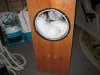
Nothing but good news here. I am in love with the Heil tweeter. The dynamic sound stage is holographic! I removed a passive today and found out a lot about my speakers. There was no gasket between the passive and the cabinet. There is no weight on the passive and the damping material inside the cab was in contact with the Woofer! Everything that could be wrong was wrong. All easy fixes that can rob all base response from the speaker.
EssNeff, did you add 100 grams to a passive that did not have weight already or did you add 100 grams to a passive that already had weight? Or, I should ask, how much weight should I put on the passive starting from no weight at all?
Audiomojo, I am looking into gaskets from Parts Express. Did you use only a gasket of is there an adhesive as well?
I plan to remove the woofers and passives in the next day or two. I see the base of the speaker is filled with damping material. Looks like cotton candy and fills the base of the cabinet up to the bottom of the passive. Is this normal? I can’t take anything for granted since someone worked with these speakers and did some things wrong. I plan to pull all the stuffing to check for leaks in the cabinet joints. I doubt I will find problems with the cabinet itself but might as well check. When reassembling I plan to use gasket tape (3/8”) form Parts Express unless someone here has another suggestion. Are there other things I should look for while inside this speaker? Are there other upgrades that I should consider while they are apart?
Thanks all!
Thanks all!
SleeperSupra
Super Member
Glad you are enjoying your speakers.
I would try to change out the terminals and put foam on the sides of the HEIL. The foam does make a noticeable improvement.
I would try to change out the terminals and put foam on the sides of the HEIL. The foam does make a noticeable improvement.
essNeff
Active Member
I've seen the foam used alongside the Heil before.
I've also seen "waveguide" arrangements used in the same position.
L7 and Automojo are the experts here in these speakers and most type of "mods" with their extensive knowledge and experience.
The gasketing tape is applied to the back of the speaker not the cabinet.
My gasket came off the speaker due to compression and stuck to the Mdf.
Does anyone know which brand of Caps were used in the earlier production
runs of the Great Heil? The XO's I have use 10uf and 33uf caps.
The Inductors and l-pads look of very good quality.
So far all I have done is Deox the L-pads and clean some terminals.
I'll eventually replace the wingnuts with the appropriately weighted washers.
Looking at a early AMT3 cap.
It's silver, part #7414.
Later versions used black plastic bodies with red end caps made in Mexico.
I like the Erse PulseX caps, as they are a bit smaller, and shorter then the Parts Express poly caps. Either is a good choice.
I agree-the air coils-l-pads are very good.
I am using a few custom wound large 14 gauge gauge inducters in the bass section from Meniscus, along with 15 gauge inductors, off the shelf units, for the rest. It's hard wired, 16 gauge, no p.c. board, new switch for Heil (AMT3 uses a resistor bank to pad the Heil in 3 positions as opposed to l-pads), fuse holder, and inputs. I also used Mills resistors, and Erse Pulse X caps.
My stock crossover I used new fuse holders, and inputs as well. Stock sand cast resistors, and P.E. poly caps, and 18 gauge tinned hookup wire.
The stuffing is stock on the AMT1a-don't remove it-just evenly distribute it, by pulling it apart, and ensure there is no clumping. There should be some free space between the woofer and the passive. If you think the bass is on target, I wouldn't mess with different types or amounts of dampening material.
The damping material is mainly to prevent mid/midbass reflections off the bottom interfering with the woofer, so you should be just fine.
In the ported AMT3's i find a piece of Auralex 2" foam directly behind the woofers works well. I'm still perfecting the damping-with foam and stuffing, with my AMT3's. The stock setup was either a completely sealed system, of a leaky sealed system with the port-but both used the same amount of stuffing-3lbs + in each enclosure-so they were essentially full. The Dayton woofer doesn't need this type of stuffing-and P.E. foam along the bottom, under the new rear ports, on both sides, and the 2" Auralex on the back resting on the 2 new ports, and directly behind the 2x10" woofers, so far seems to work the best-as the Daytons have different specs then the O.E.
Auralex is very effective, (works more aggressively on not only lower frequencies, but midbass/mids as well) much more then P.E. or most foams, so you can easily over due it. I'm still experimenting with the white stuffing, using a net to keep it out of the ports, and occupying the space between the woofers and the Auralex. I think I might just end up with the stuffing filling the space on each side of the mid tube, suspended by netting-and leave the space clear between the woofer.
Auralex is also very effective for the sides of the Great Heil for wings.
I also cut small triangles of foam to fill the top and the bottom "v voids", between the plastic housing and laminations. Some have put foam on each side of the laminations-I didn't like it, as it disturbed distribution.
I would recommend using Hurricane #8 nuts from P.E. on the woofers-,Epoxy them in-slow dry type. This will make it easy if you need to make changes, and you wont wear out screw holes. Any other visible weak areas slow dry epoxy.
If the baffle mating surface has been damaged from the black silicone, use slow dry epoxy to strengthen it, a little isopropyl alcohol to thin it out a bit.
Let it dry a couple days-but it's still a bit tacky for awhile. The gasket tape may stick a bit. Yes-put the tape on the speakers!
18 gauge wire is fine for hook ups, but you can go 16 if you want.
I would also recommend a new coat of black paint-as it helps stabilize and seal old particle board, and really improves the appearance.
As Squirrely is finding out, these are truly world class speakers when refurbed and set up properly-nothing else like them, and very few-even the new "Heil Type" speakers can compete with a Great Heil ESS speaker-in the sheer enjoyment- the details and dynamics of music-not afraid to lay it all out there.
They are made to enjoy music, become part of the detailed and dynamic wall of music enveloping your listening space, not amaze you with a ruler flat frequency graph/response coming from box, and bore you to sleep....
From the true Golden Age of speaker crafting....
Last edited:
Thanks for the info about wire and damping material. There is bracing inside behind the woofer creating two chambers. One with the woofer and the other with the passive. I pressed the damping material against the cabinet in the forward chamber to clear the movement of the woofer. By doing so I have cleared the airspace so the woofer will have direct influence on the passive. I don't know if this material should be fluffed out more or kept to the sides. It may not be a big deal at all. Most importantly it is not interfering with the travel of the woofer.
There are some small areas where the cabinet was damaged when the passive was removed. I will use your suggestion of slow dry epoxy to repair these areas.
There are some small areas where the cabinet was damaged when the passive was removed. I will use your suggestion of slow dry epoxy to repair these areas.
If you can post a picture of the bracing.
Thanks
I agree with El Seven on be cautious on filtering information, especially when in comes to swapping drivers etc.
I lived with my AMT3's for years, and did quite of bit of research, lots of asking questions, and a lot or trial and error before modifying the cabs with ports.
As many have found-stock works just fine-many times a refurb and a few small changes are all that's needed.
Last edited:
essNeff
Active Member
It's funny you mentioned "netting". I used excess window screening to do that exact thing. It helps to keep the polyfil in position just above the mid-bracing.
I was actually thinking of fooling with some Sonotube to create a "Venturi Effect" between the woofer and radiator (a sort of Velocity Stack) but would have no way of proving its advocacy other than by listening.
I'm not familiar with the AMT 3's. ESS used confusing nomenclature as I have seen obviously different speakers under the same designation or at least with confusingly similar names.
I would also note that the quality of product did seem to decline and was not up to the initial standards.
Similar threads


- Replies
- 86
- Views
- 6K


- Replies
- 228
- Views
- 29K