• The move to the new server is done. There are some software and database maintenance updates in process. This has us passing the hat around to help out. We appreciate any donations. Seriously, even a dollar helps. The payment page may be found here - https://www.audiokarma.org/support.html

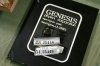
Genesis Physics Speakers:Model II

View attachment 1583704

New posts screwed in. You can see where I got carried away enlarging the holes peeking out above the post strip. :/

The brass screws are a nice match to the gold plated binding posts. I would replace the entire crossover plate with a sturdier one, then glue and screw it. The original masonite board is so thin and only glued, which causes them to fall off over time anyway as many owners have reported. Both of mine were lose / falling off when I got my Genesis speakers.
 
I might end up doing that for speaker #2, depending on how speaker #1 works out. What kind of material would you recommend for a new crossover plate?

I really liked the silkscreened speaker and company info...any ideas on how I could potentially replicate that on a new plate? One idea I had was taking a photo, and then printing it into regular paper and pasting it into place or something.

(If I were truly hardcore, I'd buy silk-screening equipment and do it right, lol....but I already have too much invested in this new hobby at the moment)
 
I might end up doing that for speaker #2, depending on how speaker #1 works out. What kind of material would you recommend for a new crossover plate?

I really liked the silkscreened speaker and company info...any ideas on how I could potentially replicate that on a new plate? One idea I had was taking a photo, and then printing it into regular paper and pasting it into place or something.

(If I were truly hardcore, I'd buy silk-screening equipment and do it right, lol....but I already have too much invested in this new hobby at the moment)

Last time I did a pair of Genesis I actually replaced the thin plastic input plate with 1/2" mdf that I veneered in walnut, then glued and screwed in place. The speakers got all new walnut veneer, so I had some left over pieces. I could just as well have sealed the mdf and painted it black.

fullsizeoutput_4a6.jpeg

fullsizeoutput_4a7.jpeg

fullsizeoutput_4a8.jpeg

fullsizeoutput_4a5.jpeg

fullsizeoutput_495.jpeg

fullsizeoutput_491.jpeg

fullsizeoutput_4a4.jpeg
 
WIN_20200822_14_19_59_Pro.jpg WIN_20200822_14_20_48_Pro.jpg WIN_20200822_14_20_56_Pro.jpg

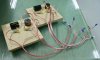
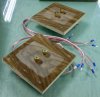
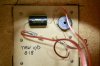
Finally getting around to my 1+ caps. Dates on the drivers are 1979, which is the year I purchased them. I pulled one driver, clipped and measured the capacitor, 10.4 uF. I assume that's not enough measurement to determine if they are operating properly, or suffered some degradation? So, I'll order some audio quality Jantzen 10 uFs, and try them out. Here's a couple shots, notice my surround popped loose, which had been replaced years ago. I may tack it back, and order a new set:
 
Those black caps with red ends are notorious for failing catastrophically. They definitely should be replaced regardless of how they measure.

As for measuring caps, two variables are important: capacitance value and equivalent series resistance (ESR). ESR increases as electrolytic caps age. The increased ESR attenuates the tweeter. In extreme cases, the sound is muffled, like a thick blanket is covering the speaker.
 
But it is also true that if the newer cap has a lower ESR than the old cap had to begin with (which the originan crossover design accounted for), than the tweeter may be too bright - something some people have noted.
 
Those black caps with red ends are notorious for failing catastrophically. They definitely should be replaced regardless of how they measure.

As for measuring caps, two variables are important: capacitance value and equivalent series resistance (ESR). ESR increases as electrolytic caps age. The increased ESR attenuates the tweeter. In extreme cases, the sound is muffled, like a thick blanket is covering the speaker.
i feel like they do sound really unbalanced, like a thick blanket over the tweeters, compared to what I recall years ago, and compared to a cheapy class D PA. I ordered the Jantzen Audio 10uF 400V Z-Standard Capacitor identified a few posts ago.
 
Are you certain that the tweeters work? Age and humidity sometime corrode the very thin wires so that there continuity is lost. It usually takes place in the transition area between the terminals and the voice coil, so it might be repaired relatively easily with a bit of wire to jumper it. But it may require unpeeling one loop of the voice coil, which is more complicated since you have to take the magnet off and put it back on after without damaging the voice coil.
 
Are you certain that the tweeters work? Age and humidity sometime corrode the very thin wires so that there continuity is lost. It usually takes place in the transition area between the terminals and the voice coil, so it might be repaired relatively easily with a bit of wire to jumper it. But it may require unpeeling one loop of the voice coil, which is more complicated since you have to take the magnet off and put it back on after without damaging the voice coil.
Tweeters are working, as is the contour switch. I'm having to roll off a lot of bass to sound balanced. Its possible, I've been listening to PA gear far too long, and my ears are out of calibration. I'll replace a cap in one, and compare with the others, like an A/B test. While I wait for the caps to deliver, I hit the walnut vinyl exterior with high proof isopropyl, then some Minwax special walnut. It really cleaned up, and brought out the color of the vinyl. I always loved these speakers, and drug them around to many opportunities to A/B with other speakers. I thought about pulling the vinyl, and adding a nice genuine veneer, but decided to save that for another day.
 
Thought I'd update. Got the parts. Checked them with a simple LC meter, all good. Removed one red tip cap and replaced it with a blue Jentzen. i I left the other 41 year old speaker as-is, for testing and comparison before swapping it too. Performed a test as follows: Left cabinet on speaker circuit A, right cabinet on speaker circuit B. Input was mono, and I started with poor man's white noise (mid-band static on FM). I also have an A+B speaker circuit selector, so I can monitor A, or B, or A+B, all with the same mono input. AND, theCR 2020 can switch the source from Stereo to Mono/mix, R, L, or R+L (mono mix). Plenty of options to make sure the same signal is going to either, or both speakers, and for quick switching back and forth.

I downloaded Visual Analyzer 64 bit a few nights ago in preparation. During the audio testing, I used my ears, but also watched the real-time frequency response plot in VA64, and could clearly hear and see heavily attenuated mid and high frequencies with the as-is speaker, versus the speaker with a new cap. At 10k, I estimated the level was 6 dB louder with the new cap. I really didn't need to see it - it was immediately, and convincingly obvious the old cap was really choking the highs. Using the tuner, I found an NPR affiliate playing some traditional Jazz (one of my favorite sources for audio testing) and enjoyed a small combo playing a nice piece with space, and dynamics. An interesting observation was that the bass appeared to be louder with the new cap to my ears. But AV64 showed no difference in frequencies below 1k. I can only theorize that the correct balance and detail provided by the new cap in the higher frequencies, somehow made the low frequencies more defined, easier for the ear to pickup, especially the dynamic range of attack. Or perhaps some other properties associated with proper high frequency emission.

I replaced the second cap, and enjoyed listening for a while longer, but only to FM. I don't have another source right now, with my turntables needing cartridges, my tapes not easily accessible, and no CD player with any AV outs. I tried to feed a Spotify signal from my phone, but the level was way too low, and Spotify is not a great source anyway.

 
Ps - apologies for digressing. Ill explain that i discovered my second pair of larger genesis speakers are not IIs, but 110s, and then discovered age issues with crossover caps, and just wanted to wrap that up, thanks all for the helpful information.
 
Hello! Just happened across a pair of these. The cabinets are in great shape. All of the drivers need refoaming. Both of the woofers work, but only one of the tweeters does. Can anyone give any advice on how to troubleshoot the tweeter? I am also curious to know if anyone has purchased the rebuild kit from Human Speakers. It is $420 which is pretty steep, but claims to be a substantial improvement over the original components.

I also have concerns about the refoam. I would have to remove the dust caps to center the voice coils, but there are some lead wires there.

With regard to the crossover, can I leave the old inductor coil? The cap is 10uF? What about the resistor? I would appreciate any advice. Thank you.
 
If the original caps are still in there it might be possible the problem is the cap, not the tweeter. You can check this by swapping the tweeters between cabinets. One does not need to remove the dust caps to center the voice coils. You can center the voice coil by running a 30Hz test tone through the speakers when gluing the surrounds to the frame, assuming you do the surround to the cone first. If the resistor is still in spec, you can leave it though some swear by boutique "non-inductive" resistors. Coils seldom go bad, though some would replace them with higher quality components.

Yes, the rebuild kit for these is expensive, but you're looking at two pairs of drivers plus a pair of passive radiators. I haven't heard any of Huw's drivers, so I can't attest to their sound vs. the originals, but Huw has the advantage of considering reasonably quality parts without the level of price point considerations of the originals. Huw also has materials available, such as dome materials for the tweeter, that Winslow Burhoe could only have dreamed of at the time.
 
Genesis woofers have wide magnetic gaps so it is easy to refoam them without cutting away the dustcap. A low level sine wave will center the coil as it glues, or you can use the momentarily connecting an AA battery to center it and then pressing the foam down, simply pressing the cone all the way down and then releasing it and pressing the foam down, or even tapping around the outer edge and shifting until you can going all around with no sound of the voice coil hitting. Any will work. You don't even need to do that with the passives - just glue relatively concentrically.
Tweeters are easy to find, and cheap, though the cap may be the real problem. Replacing the cap with an equivalent value film cap is probably is a good idea and very cheap. You can measure the resistor to see if there is a problem - unlikely. Coils do no age - you could replace it with a heavier gauge wire coil, but you will have then changed it's resistance somewhat, and that may not be a good thing - I suppose you could argue that you'd get better power handling, but at least in some of the EPIs which are in most regards identical to Genesis , the coil was actually just a voice coil - if the coil can't handle the power, the voice coil probably can't either (though the voice coil is cooled by its motion whereas the coil is stationary). But that might be seen as a safety measure - replacing the coil is easier and cheaper than replacing the driver.
I do not think that it makes sense to invest in Huw's kit right now (if ever). You can get the speakers up and running for less than a hundred bucks, and possible much less if you don't have to source used tweeters. At least find out if you even like how they sound before dropping more than the speakers are worth (I ahven't checked prices recently, but I'd be amazed if they sold for that) to upgrade them.
 
Thank you for the info. I swapped the tweeters and it is still dead. Is it dead and that is it or can I do something to fix it? I will leave the coil. Can you recommend some nice caps and resistors? I don't mind spending a little more if it will improve the sound. Thank you.
 
These tweeters do pop up on Ebay.
Fairly often, to emphasize coonmanx's point.

Dayton, Solen, some not expensive Jantzen, any decent cap should be fine, and an improvement over the originals. Any decent audio resistor should also be fine. Mills resistors are nice, but I can't hear the difference, others will claim they can; this also goes for caps.
 
If you are very good at soldering small stuff, you might be able to find a break in the wire leading to the voice coil and either bridge it with solder or unwrap on loop of the voice coil and redo the path back to the terminal. But it will not be easy.
Used EPI/Genesis tweeters are not expensive and are a more reliable fix - I have fixed tweeters but they don't always stay fixed since you've had to shift things around and it is difficult to then get everything reshaped and seated perfectly.
 
I used Monacor resistors in a recent project. Got them from England... They work well. Lots of choices... Ceramic wound...
 
Thank you everyone for the advice so far. I am starting to get the parts together. I am ordering some 16g wire, the switches mentioned previously in the thread and will ponder which caps and resistors to order for a bit. I am ordering the filet style foam for the refoam. What material do you use for gaskets?
 
Back
Top Bottom