

You are using an out of date browser. It may not display this or other websites correctly.
You should upgrade or use an alternative browser.
You should upgrade or use an alternative browser.
new Klipsch Jubilee
- Thread starter bolero
- Start date

60% methinksIn a few years I wonder what the used pricing will look like?
Just my 2 cents:
I own both vintage and new McIntosh separates; and heavily modified Klipschorns. I’ve found AK to be extremely helpful on all fronts. I very much appreciate the knowledge, opinions, helpfulness, and expertise available here.
Also: I recently spent 3-4 hours alone auditioning the new Klipsch Jubilees with McIntosh 275s (and, a few years ago, 2-3 hours listening to an owner’s Underground Jubes). I’ve found a dealer who is willing to sell a pair of new Jubes at a substantial discount. If I could swing it, I’d buy them in a heartbeat.
I own both vintage and new McIntosh separates; and heavily modified Klipschorns. I’ve found AK to be extremely helpful on all fronts. I very much appreciate the knowledge, opinions, helpfulness, and expertise available here.
Also: I recently spent 3-4 hours alone auditioning the new Klipsch Jubilees with McIntosh 275s (and, a few years ago, 2-3 hours listening to an owner’s Underground Jubes). I’ve found a dealer who is willing to sell a pair of new Jubes at a substantial discount. If I could swing it, I’d buy them in a heartbeat.
Oh So by this you mean your are not going to brag about how satisfied you will be forever with roomful of Klipsch Cornwalls?Just my 2 cents:
I own both vintage and new McIntosh separates; and heavily modified Klipschorns. I’ve found AK to be extremely helpful on all fronts. I very much appreciate the knowledge, opinions, helpfulness, and expertise available here.
Also: I recently spent 3-4 hours alone auditioning the new Klipsch Jubilees with McIntosh 275s (and, a few years ago, 2-3 hours listening to an owner’s Underground Jubes). I’ve found a dealer who is willing to sell a pair of new Jubes at a substantial discount. If I could swing it, I’d buy them in a heartbeat.
Instead, you talking about Both types of Klipsch Jubilees that use the best of their R&D/Production while listening to the Grand Father of low distortion folded horn Bass, like I have for 45 years?
Actually sticking to the OP? What a great concept!!!
It's a good thing. Most of us used to attend McIntosh clinics to get a near zero flat line. Then we went home to listen to MUSIC instead of looking for Opinions that are totally irrelevant to the ROOM you are in. If you want that, just watch TV, where it's 99% opinions rather than FACTS.I begged and begged and begged for an opinion on the McIntosh MC255 and couldn't get one.
So here you go, here's a free OPINION for you. Be happy and listen to Cornwalls while you post opinions on Jubilees you have no experience with, just like the other 99% opinions. Then you can play "Satisfaction" by the Rolling Stones.
Last edited:
Oh So by this you mean your are not going to brag about how satisfied you will be forever with roomful of Klipsch Cornwalls?
Instead, you talking about Both types of Klipsch Jubilees that use the best of their R&D/Production while listening to the Grand Father of low distortion folded horn Bass, like I have for 45 years?
Actually sticking to the OP? What a great concept!!!
As I recall, I started an AK thread on the new Klipsch Jubilees last year (requesting opinions from anyone who had actually HEARD them) and got a couple brief responses. So I finally went to Audio Classics and listened for an afternoon the day they actually arrived and were set up—right out of the box, still flashing that new car smell.
They hadn’t even stretched their legs. I was blown away. As a Klipschorn owner who fully appreciates what Khorns can and can’t do; where they thrive and falter, I realized the Jubes just get everything absolutely right. I’ll posit this, also, in terms of the Heritage line. My brother has La Scalas—which grace the cover of the current Stereophile and are treated as absolutely magnificent in the review (reviewers constantly are surprised by Klipsch Heritage speakers, even though they’ve been here for 75 years—shrug). But Klipschorns better La Scalas by no small margin when properly set up. And Jubilees better Klipschorns—and by no small margin, either.
Klipsch Jubilees, in another class, ain’t no Khorns. They ain’t no La Scalas. And they certainly ain’t no Cornwalls, either.
Last edited:
View attachment 2664653
Got to AC today. Listened for two hours. Some initial thoughts:
Big!
Big sound. Big presence. They make a big statement. But nothing is exaggerated. The bass can drive you out of the room. They make the Klipschorns look like beanpoles. Basically, if you like Klipsch speakers you’ll love the Jubilees.
The setup here (on the short wall), constricting the soundstage, is not ideal, and the room is too small, but you can easily get the idea, if unleashed, of what they’re capable of, as they warm up and stretch out over time. System was all McIntosh: two MC 275 VI; C52; MCT500. Because they were powered by two identical amps, I turned the bass and treble gain controls on the Klipsch crossover to flat/zero. Better to my ears. As if a contour loudness was flat.
The Jubilees are pretty astounding and surprising. They are impressive for what they do; how easily and how well they do it; and for what they don’t do. As a Klipschorn owner, I’m aware that their sound signature (voice) is very, very similar yet very, very different from the KHorn. This is reassuring and heartbreaking. If you recently purchased Klipschorns, I’d wait to audition these. Unless you can trade them in. You can tell the Jubs and KHorns are related. However: The Jubs do nothing wrong. No screeching. No flabby bass. Nothing missing. Nothing ever strident or unnatural. The Jubilees are natural, authoritative, graceful, authentic reproducers. They never break a sweat. They’re like sleeping giants. On some material, I could have almost been listening to my modified KHorns. But the Jubs do a lot the KHorns can’t. And they also don’t do a lot of what the KHorns do. Both points are equally noticeable and important.
The Jubs are tighter, faster, more dynamic, more transparent, less fatiguing, and without any congestion—with more finesse and honey smooth liquid transitions. They are also fuller, more present, more controlled and, therefore, completely relaxed in their presentation. When listening loud, KHorns can induce a lingering anxiety, as you wait for that rare horn or female vocal to pierce just a little to high and loud, making you wince. It’s very rare (almost nonexistent since I got McIntosh tubes), but can still happen. The Jubilees, no matter the volume or material, just flowed out more and more of what you want from the music. I felt like they could do anything demanded of them. And the bass: the bass is broader, deeper, bigger, more detailed, more grounded, and, especially, more fluidly connected to upper mid-bass, mids, and treble—and it’s all effortless. Just music. Time alignment matters. So do these big horns.
The Jubs are silky yet muscular. Piano and cymbals and voices sound live, natural—not muddled. No sibilance anywhere. And the details! The moisture moving around in Nina’s mouth; and the clucking sounds of her tongue against the roof of her mouth on “Strange Fruit.” Jaw-dropping. We all heard things we had never heard in familiar material before (including finger snaps on one song and a ceramic coffee mug being slid across a ceramic saucer in a live jazz club). Yet nothing seemed distracting. Just more of what’s already there. More of the music.
If I had the $$$…and was not married…and pigs could fly…
This was what I posted in September of last year as my first impressions of the Jubes.
Last edited:

Roy's Magnum Opus.That is a nice writeup, well done

Southern
Active Member
This was what I posted in September of last year as my first impressions of the Jubes.
What was the source of music you were using (CD, Lossless, Vinal, etc.) ?
Are the Jubes "sensitive" to the source of material (does so-so recordings sound good or do they sound really bad?)
What was the source of music you were using (CD, Lossless, Vinal, etc.) ?
Are the Jubes "sensitive" to the source of material (does so-so recordings sound good or do they sound really bad?)
Mostly, I streamed through AC’s McIntosh server and DAC. Not sure what their service is, but it’s standard—not HiFi spectacular. And I listened only to a few of their redbook CDs (I didn’t have any of my own with me because I just happened to be nearby on business when the Jubs arrived that day).
To answer your question: I would have loved to hear vinyl and some of my favorite SACDs with material I knew well. (And I chose only material I liked, knew sounded good, and wanted to hear.) That said, nothing sounded bad. I know that my Klipschorns are so revealing that I can’t listen to some material on them. I did not have that problem with the Jubilees, but, then again, because of time constraints, I didn’t search out recordings I know to be of bad SQ to see how well (or not) the Jubilees handled them.
If I had to guess, I’d venture that because the Jubilees—an improvement over the Klipschorns—are never strident, and smooth everything out so well, relatively speaking, that they might be more forgiving with bad source material. OTOH, they might accentuate it. IDK. This would be a question better answered by Jubilee owners. @Coytee? @ClaudeJ1?
I don't have "new" Jubilees, just one of kind clones with no drivers installed. Creating spacer rings so K-31's will never do "the slap thing" against the flat piece of the throat.
When I had Jubes properly set up (for a year before Covid Lockdowns) they were more revealing then my Klipschorns ever were. I never use tone controls like a friend does, always messing with his bass and treble knobs until he is happy, I just won't listen to bad recordings unless they are background music. But a flat, revealing setup like the Jubes, allow for full enjoyment of great recordings of good music where you get lost in the 3 Dimensional Spatiality, dynamics, and micro details of the presentation. The K-402 Horn is the only thing that is common with the New Jubilee 75, otherwise, the U-Jube and the clone variations have different drivers top and bottom, so not much in common except top horn lens and part of the name.


twiiii
Lunatic Member
In my case if I owned Klipsch again it would be Cornwall IV's. But from my experience in sound you just cannot believe the difference between a horn loaded system crossed at 700 or 800 hz versus a horn loaded system crossed at 300 hz. with a 250 HZ rated horn that is well damped. None of the honky sound a lot of people complained about once hearing Altec and Klipsch systems. Older Altec using using 300 HZ crossovers for their out door systems sounded better for sure in addition to keeping sound off floor ceilings and walls in the very important midrange frequencies in enclosed spaces. That also applies to line arrays even though they have Very high frequency issues in some cases. Its all about traded offs.
Even Though I choose not to Spend $36,000 for a pair of speakers today. In the scheme of things thats a very moderate price for the Ultimate High Efficiency Loud speaker now days. Wilson and Magico top of the line speakers are over $500,000 and some of Steinway Lyngdorf line array systems push 1,000,000 using their amps and electronics. Even Magneplanar known for their relatively low priced line arrays ribbon speakers that require way to much power top of the line speaker is close to $40,000. Mcintosh and SF designed top of the line models are all over $125,000. There must be 20 or 30 top of the line Speakers over $40,000 dollars, So to my way of thinking you guys should not be shunning the Jubilee but praising Klipsch for designing a two way system that very few others can approach at this moderate price, compared to others.
I am sure you all have priced Ford, Chevy or the new to be announced Ram and Tesla pick ups. $60,000 to easily over $100,000. I'll stick with my 2018 2500 Ram diesel. I got such a deal. Are you not offended by those prices? No you just accept them. So why not the price of a Jubilee. My line Arrays were about $25,000 a pair when introduced in 1990. Their current replacements about $65,000. But I got mine pre-owned. Maybe you can find a pair of Jubilees pre-owned some day. Just hope you have friends that are not jaded as you are and buy lots of them. Maybe they will be yours one day. But start saving now. You never know they maybe so good as to out price inflation in 20 years pre-owned. My two MC 275 amplifiers did.
Even Though I choose not to Spend $36,000 for a pair of speakers today. In the scheme of things thats a very moderate price for the Ultimate High Efficiency Loud speaker now days. Wilson and Magico top of the line speakers are over $500,000 and some of Steinway Lyngdorf line array systems push 1,000,000 using their amps and electronics. Even Magneplanar known for their relatively low priced line arrays ribbon speakers that require way to much power top of the line speaker is close to $40,000. Mcintosh and SF designed top of the line models are all over $125,000. There must be 20 or 30 top of the line Speakers over $40,000 dollars, So to my way of thinking you guys should not be shunning the Jubilee but praising Klipsch for designing a two way system that very few others can approach at this moderate price, compared to others.
I am sure you all have priced Ford, Chevy or the new to be announced Ram and Tesla pick ups. $60,000 to easily over $100,000. I'll stick with my 2018 2500 Ram diesel. I got such a deal. Are you not offended by those prices? No you just accept them. So why not the price of a Jubilee. My line Arrays were about $25,000 a pair when introduced in 1990. Their current replacements about $65,000. But I got mine pre-owned. Maybe you can find a pair of Jubilees pre-owned some day. Just hope you have friends that are not jaded as you are and buy lots of them. Maybe they will be yours one day. But start saving now. You never know they maybe so good as to out price inflation in 20 years pre-owned. My two MC 275 amplifiers did.
Jaded? What the heck do you mean by that. Once again, showing you have never owned any Jubilees but just talk, talk, talk. Many flavors have been available and enjoyed by many for over 15 years. So why didn't you get a pair then? For much less than $10,000, which is still cheaper than new passive Khorns. Now they are $40,000 with companion electronics. TOO LATE. and you still just wanna Talk "principles of economics" without ownership and talking about those compromised "flying bananas," wasting time in the process.Just hope you have friends that are not jaded as you are
Serious means "set out the cash."I am seriously thinking about putting the K402 horns on top of my modded Khorns!!!
twiiii
Lunatic Member
I admit I have never heard the Jubilee but have close friends I trust who have. So they are great pieces for the price, plus they have very important features the primitive previous models do not have have. Time aligned drivers at a lower crossover frequency to provide added clarity to the fundamental frequencies. No tweeter with a compromising crossover introducing time shifts and having drivers with different acoustic centers. Having new throat vanes to reduce intermodulation distortions and standing waves in the throat like the older attempts at being a Jubilee. Then the idea of using two 12 inch woofers in a tuned cabinet in a horn loaded cabinet is a great idea, too. Paul was an original thinker for sure.

Dave MacKay
Active Member
I had the opportunity to see and (briefly) hear Jubilees today.
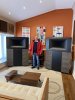
The first thing that strikes you is their size. They are enormous. The salesmen apologized that the room they were in was really too small for them, but it was the biggest in the store.
The salesman interrupted what he was doing and hooked them up and played one (unfamiliar) track for me. He chatted throughout and showed me how the active DSP allowed one to turn the bass or the horn up or down. I asked if he had many customers for speakers that big and that costly. He said that one person --- a real Klipsch aficionado with lots of Klipsch, an enormous place, and (seemingly) oodles of money --- had come in and said he'd be back to get a pair. Unfortunately, the salesman had to leave to attend to other things and turned the Jubilees off when he went.
As such, although I got to hear them --- and what I heard sounded good --- I wasn't able to form much of an opinion of them.
The first thing that strikes you is their size. They are enormous. The salesmen apologized that the room they were in was really too small for them, but it was the biggest in the store.
The salesman interrupted what he was doing and hooked them up and played one (unfamiliar) track for me. He chatted throughout and showed me how the active DSP allowed one to turn the bass or the horn up or down. I asked if he had many customers for speakers that big and that costly. He said that one person --- a real Klipsch aficionado with lots of Klipsch, an enormous place, and (seemingly) oodles of money --- had come in and said he'd be back to get a pair. Unfortunately, the salesman had to leave to attend to other things and turned the Jubilees off when he went.
As such, although I got to hear them --- and what I heard sounded good --- I wasn't able to form much of an opinion of them.
Similar threads

- Replies
- 20
- Views
- 6K


- Replies
- 179
- Views
- 18K


- Replies
- 33
- Views
- 8K
