• Please note that Audiokarma will be offline briefly for updates early on Monday morning, September 28th.

Yamaha GT-2000 Turntable Social Group

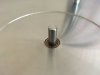
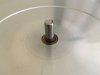
The spindle is conical with 1:10 ratio of width/height ratio. The problem is not the "cone" itself. I believe the problem is the small shelf sitting at the bottom where the cone ends. If platter bottoms out on this shelf instead before the cone bottoms then there will be a problem by a wiggling platter. So obviously this "cone drilling" have been put too deep up to the platter for Mark. I believe an insert or to modify the bottom of the platter would do the trick. If modifying the bottom the whole platter might sit too low perhaps and there might be a clearance problem instead to the plinth.

 

Attachments

  • IMG_20181023_134421.jpg
    IMG_20181023_134421.jpg
    26.2 KB · Views: 32
Well the internal layout is a lot less convoluted than my sony biotracers. That makes me feel better about any need for future maintenance.
 
Could the conical taper be removed from the spindle and a larger one made? Probably just a pressed fit. The platter is bottomed out on the shoulder.
 
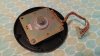
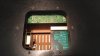
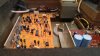
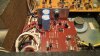
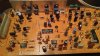
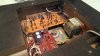
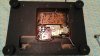
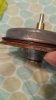
Maybe it can be done but not easily removable because the spindletap itself has some kind of bent locking washer that most likely should be removed and then push the pin up out from the magnet/lid but I'm not sure how the conical part is pressed or glued to the top of the pin. I attached a pic of that ring people are talking about and which is causing a strange noice when motor is turned slowly by hand or running if the glue is drying out and gets loose as mine had done. I just carefully removed it completely and discovered why it's installed. Without that plastic ring at the bottom of the magnet/lid that lid will ring alot like those old cowbells when picking on it with my nail. With the ring glued and installed properly again that lid makes a very muted sound more like a "bop" instead of "riiing" when picked upon. So yes that ring is important. I used normal contact glue and I think it shouldn't be too critical what kind of glue that is used. Worst scenario is that I need to glue it in again if it gets loose within next 20 or 30 year or so . OK a 3rd pic of the coils inside that motor too just for fun and nice looking pics. Notice those two small sensors too in the pic that is reading the magnetic field for proper commutation of the power to the windings.
 

Attachments

  • IMG_20181023_134352.jpg
    IMG_20181023_134352.jpg
    41.9 KB · Views: 38
  • IMG_20181023_135332.jpg
    IMG_20181023_135332.jpg
    29.6 KB · Views: 39
  • IMG_20181023_134334.jpg
    IMG_20181023_134334.jpg
    39.4 KB · Views: 39
Photos of the SS and stock aluminum platters showing how they fit on the spindle:


SS platter:

SS GT-2000 Platter View 1.JPG


Aluminum platter:

Al GT-2000 Platter View 1.JPG
 
Maybe it can be done but not easily removable because the spindletap itself has some kind of bent locking washer that most likely should be removed and then push the pin up out from the magnet/lid but I'm not sure how the conical part is pressed or glued to the top of the pin. I attached a pic of that ring people are talking about and which is causing a strange noice when motor is turned slowly by hand or running if the glue is drying out and gets loose as mine had done. I just carefully removed it completely and discovered why it's installed. Without that plastic ring at the bottom of the magnet/lid that lid will ring alot like those old cowbells when picking on it with my nail. With the ring glued and installed properly again that lid makes a very muted sound more like a "bop" instead of "riiing" when picked upon. So yes that ring is important. I used normal contact glue and I think it shouldn't be too critical what kind of glue that is used. Worst scenario is that I need to glue it in again if it gets loose within next 20 or 30 year or so . OK a 3rd pic of the coils inside that motor too just for fun and nice looking pics. Notice those two small sensors too in the pic that is reading the magnetic field for proper commutation of the power to the windings.

That's what mine did. A little rubber cement squirted through a pen nib between the plastic ring and the spindle plate fixed it (I never removed the spindle from the lower bearing shaft). I was kind of freaked out when it first happned then realized it's not a big deal. The original glue just gets old.

1017151534.jpg

1017152057.jpg

1018151113.jpg
 
Last edited:

So if the fabricator had made the hole on the platter about half a millimeter tighter it would be a perfect fit. He drilled it out just a smidge too much on the SS and probably got Sunnyday's just right.

The Japanese fabricators likely had a series of jigs/mounts to check that the diameter and riding height were just right. No eyeballing under any circumstances or you would risk incurring the wrath of fussy Japanese customers and bring shame upon your work section (the cardinal sin in Japan).
 
Last edited:
I'm just thinking out loud now: if there still are clearance between the platters bottom down to the plinth even when pushing it to wiggle the most to one side then it should be possible just to take out some 1/10 of a mm of the "thickness" of the platters Center on the bottom side. Then the conical hole will sit tighter to the spindles axle without trying to "shrink" the hole in the platter sort of speaking?
 
I'm just thinking out loud now: if there still are clearance between the platters bottom down to the plinth even when pushing it to wiggle the most to one side then it should be possible just to take out some 1/10 of a mm of the "thickness" of the platters Center on the bottom side. Then the conical hole will sit tighter to the spindles axle without trying to "shrink" the hole in the platter sort of speaking?
That might work Henrik. It would require a very precise removal of material from the boss around the bottom of the center hole to make sure it was perfectly level. I would want to test fit the platter after removing a little material and then remove more only if necessary.
 
I'm not sure it's that critical really with the material removal since everything will self Center on the conical tap and the platters hole. If too much material is removed I think the platter might get really stucked and be a pita to remove if there is no bottom of the platter that can stop to the shelf of the bottom of the tap. Sort of insurance that the platter never slips down to tight on the tap and locks forever. For this case it's critical of course but for the centering/wobbling part of the problem it shouldn't be too critical to mill down or even just sand down just a notch of material on that boss in the centerpart of the bottom side of the platter.
 
Prototype is finally done !

All of ideas i wanted to do, was made.
- central layout with two interchangeable arm posts
- magnetic suspension
- super heavy
- powered by YOP-1 only - internal transformer was taken out

Sounds fantastic! Its hard to say on this thread, but sounds far more better then the stock one, with the same cartridge, with YOP-1.
It sounds so good, that I'm start to think about make few ones...
Now is time to take care of the look.

IMG_4857.jpeg IMG_4858.jpeg IMG_4856.jpeg IMG_4855.jpeg
 
Prototype is finally done !

All of ideas i wanted to do, was made.
- central layout with two interchangeable arm posts
- magnetic suspension
- super heavy
- powered by YOP-1 only - internal transformer was taken out

Sounds fantastic! Its hard to say on this thread, but sounds far more better then the stock one, with the same cartridge, with YOP-1.
It sounds so good, that I'm start to think about make few ones...
Now is time to take care of the look.

View attachment 1507573 View attachment 1507574 View attachment 1507575 View attachment 1507576

Gigantic AND Tremendous :D
 
Back
Top Bottom